Category: Washington Post

  • This company says it has produced the holy grail of batteries

    This company says it has produced the holy grail of batteries

    If you can believe the ambitious claims in a slickly produced video released Jan. 4 ahead of the CES technology show in Las Vegas, a battery revolution is coming this year that could upend the EV market and eventually usher in a new era of fast-charging, long-range cars and trucks.

    The high-end electric motorcycle maker Verge Motorcycles and its spin-off motor company Donut Lab say they’re selling the world’s first EV powered by a “solid-state” battery — a much-hyped, long-promised type of battery that packs more power than standard cells, if companies could figure out how to design and mass-produce it.

    But Verge and Donut Lab have offered no evidence and few details about their battery claims. The proof, they say, will come when customers start to receive the $30,000 electric motorcycles they are selling now and plan to deliver by the end of March. Scientists are skeptical, and the controversy illustrates the long and troubled history of companies that have tried — and so far failed — to develop a technology sometimes lauded as the holy grail of batteries.

    Solid-state batteries are similar to the standard lithium-ion batteries found in phones, laptops, and electric cars, but they replace liquid electrolytes with solid materials that, theoretically, could allow them to store more energy, charge faster, and last longer, while lowering their fire risk. Researchers have struggled to develop solid-state batteries that combine all these benefits and work consistently in the real world. Even if they succeeded, companies would have to spend years and billions of dollars overhauling battery factories to mass-produce solid cells instead of batteries that use liquid electrolytes.

    Global car companies including Toyota, Nissan, and Hyundai have promised to release long-range EVs with solid-state batteries for years — but they’ve pushed back their release dates so many times that it has become a joke in the auto industry. Battery giants including Samsung, Panasonic, and CATL, and well-funded solid-state start-ups such as QuantumScape and Solid Power, are also working on the technology, targeting mass production in the next few years and churning out a steady stream of patents and peer-reviewed papers.

    Donut Lab, a Finnish start-up with fewer than 100 employees that announced its existence 14 months ago, says it has beaten its rivals with an “all-solid-state battery” that CEO Marko Lehtimäki says makes no trade-offs whatsoever: It stores about twice as much energy per pound as a typical EV battery, charges from zero to 100% in five minutes, can last 100,000 charge cycles, loses almost no capacity in the bitter cold of minus 22 degrees or the boiling heat of 212 degrees, uses no rare or “geopolitically constrained” materials, and is cheaper than standard lithium-ion cells.

    The start-up has raised nearly $60 million from investors like Risto Siilasmaa, the former chairman of Finnish cell phone giant Nokia, who now sits on Donut Lab’s board of directors.

    “Extraordinary claims require extraordinary evidence,” said Paul Braun, a professor and director of the Materials Research Laboratory at the University of Illinois at Urbana-Champaign. “While no laws of physics appear to be broken, I need to see a lot more data before I am convinced the battery technology is real.”

    Kelsey Hatzell, an associate professor at Princeton University who heads a materials science lab that works on solid-state batteries, said the no-downside combination of properties Donut Lab has promised “sounds impossible.” She added that if the cells could be mass-produced in Finland, where Lehtimäki said they’re starting to be built, “that would be shocking to me.”

    Lehtimäki declined to reveal any data or details about the battery, arguing that Donut Lab needs to protect its trade secrets. But, he said, manufacturers have been testing his batteries under nondisclosure agreements, and outside groups he declined to name would validate his claims in the coming weeks.

    In the meantime, Verge is taking orders in the United States and Europe for an electric motorcycle that starts at $29,900 and promises to charge from zero to 80% in under 10 minutes and travel over 200 miles on a single charge thanks to its new solid-state battery. It’s an overhauled version of the company’s TS Pro motorcycle, whose previous battery had the same range and price but weighed more and charged in 35 minutes. A new long-range version starts at $34,900 and promises to travel 370 miles on a single charge.

    The standard TS Pro has been on the market since 2022. It holds a Guinness World Record for the longest electric motorcycle trip on a single charge, reaching 193 miles on a loop around London last year. The promised improvements in the overhauled TS Pro are plausible, according to Braun, but don’t require solid-state batteries.

    “It might be hard, however, everything stated (except cost) could be done with high-end conventional cells,” he said in an email.

    Whether or not Verge and Donut Lab deliver, scientists and companies will continue to study solid-state batteries.

    “There’s a real need for energy-dense solid-state batteries,” Hatzell said. “I do think they’re going to exist one day, and there’s been significant progress in the last decade.”

    She envisions solid-state batteries being used in flying drones, autonomous robots, and other products for which consumers might be willing to pay more to pack as much energy into as little battery weight as possible.

    Niche, high-performance electric motorcycles also make sense as an early use for solid-state batteries, according to Braun. Eventually, they could take over the luxury EV market, or even the mass market for electric cars and trucks — but they may never get cheap enough or good enough to knock out standard lithium-ion batteries, Braun said.

    “Regular batteries are getting better,” he said. “Maybe solid-state costs never quite get down there, and so they’re only [used] at the highest performance regime.”

    But Lehtimäki, like many battery entrepreneurs before him, insists the solid-state revolution is nigh.

    “We would be just stupid to go and say some lies in front of the whole world where, in a matter of weeks, people will be opening these battery packs and scanning these cells,” he said in a phone interview with The Post. “We don’t need to go and scam people. … Every single thing I said in the video is not an exaggeration of any kind. It’s fact, and people will be shocked.”

  • On Greenland, Europe stood up, Trump blinked and the E.U. learned a lesson

    On Greenland, Europe stood up, Trump blinked and the E.U. learned a lesson

    BRUSSELS, Belgium — After President Donald Trump used his bully pulpit in Davos, Switzerland, to demand “the acquisition of Greenland by the United States — just as we have acquired many other territories throughout our history” — and then backed down on the same day, many officials here see a lesson for the European Union: Pushing back works.

    The brazen ultimatum — give up Greenland or face tariffs — elicited a level of unity that largely had eluded the leaders of the 27-nation EU in the year since Trump’s second inauguration.

    Trump’s gambit for Greenland, an autonomous territory of NATO ally Denmark, bonded some unlikely partners in opposition: Europe’s mainstream political establishment with populist and nationalist parties; Republicans and Democrats in the deeply partisan U.S. Congress; the mostly Indigenous people of Greenland with their Danish former colonizers; and the EU and Britain, the only country ever to quit the bloc.

    For advocates of taking a tougher line with Trump, the president’s climbdown regarding the strategic Arctic territory was proof that retaliation — not conciliation — is the answer to his hardball tactics. After accommodating Trump on trade and on arming Ukraine, the Europeans finally stood up to him. Even more significantly, Trump backed down.

    “When we stand together, and when we are clear and strong, also in our willingness to stand up for ourselves, then the results will show,” Danish Prime Minister Mette Frederiksen told reporters in Brussels on Thursday night. “I think we have learned something during the last couple of days and weeks, and now we, of course, want to find a solution.”

    A chorus of European leaders insisted they would not be blackmailed. They blasted Trump’s crusade to grab land from a NATO ally as “unacceptable” and “inexplicable.” The EU threatened its own tariffs on American goods. And resolve grew within the bloc to unleash a trade retaliation tool it had long hesitated to use, which could target U.S. services in Europe — a profit center for American companies in which they benefit from a big surplus.

    The solidarity from across Europe, Frederiksen said, “was extremely important in this very difficult situation.”

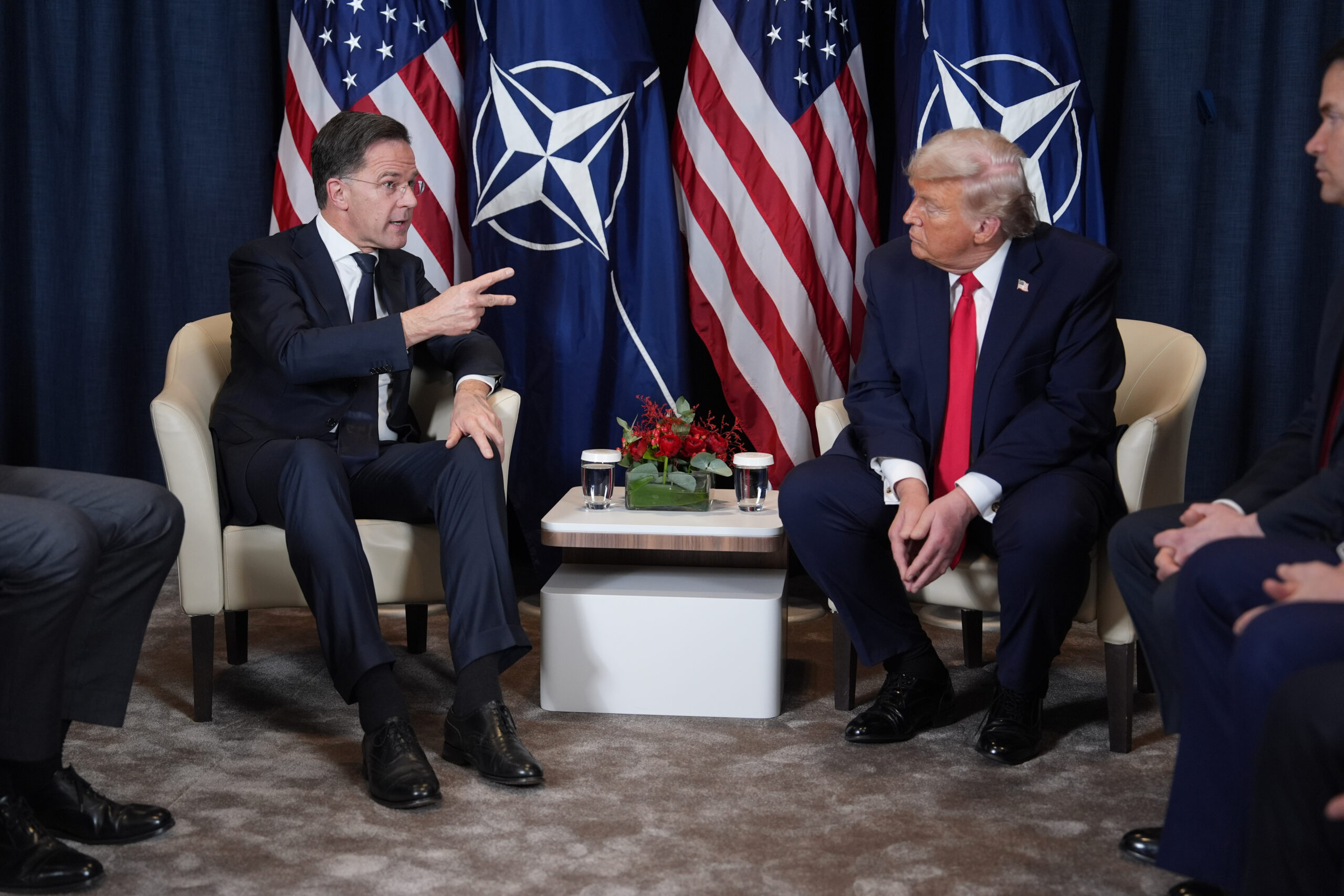
    President Donald Trump meets with NATO Secretary-General Mark Rutte during the World Economic Forum in Davos, Switzerland, on Wednesday.

    The White House maintains that Trump did not blink but actually got everything he wanted, including full access to Greenland for the U.S. military, without having to pay a dime through a deal brokered with NATO Secretary-General Mark Rutte.

    “President Trump was preparing for a Feb. 1 tariff and that has only been removed from the table for one reason: he and the NATO Secretary General agreed upon a framework for a deal on Greenland,” Anna Kelly, a White House spokeswoman, said in a written response to a question.

    Trump’s true motive for compromising may never be known. He arrived in the Swiss resort of Davos for the World Economic Forum planning to emphasize his efforts to address concern over an affordability crisis in America, which Trump has denied. The prospect of EU tariffs further raising costs for U.S. consumers may have moved him. Or perhaps it was a sharp sell-off in U.S. stock and bond markets, or the bipartisan opposition in Congress during a midterm election year.

    Whatever the reason, Trump suspended his tariff threats against European nations, proclaiming he had reached the “framework” of a deal.

    Points under negotiation include greater American access to military bases and minerals extraction in Greenland, European operations in the Arctic, and oversight over investments to prevent Russia or China from gaining a foothold, according to two European officials, who spoke on the condition of anonymity to discuss sensitive diplomacy.

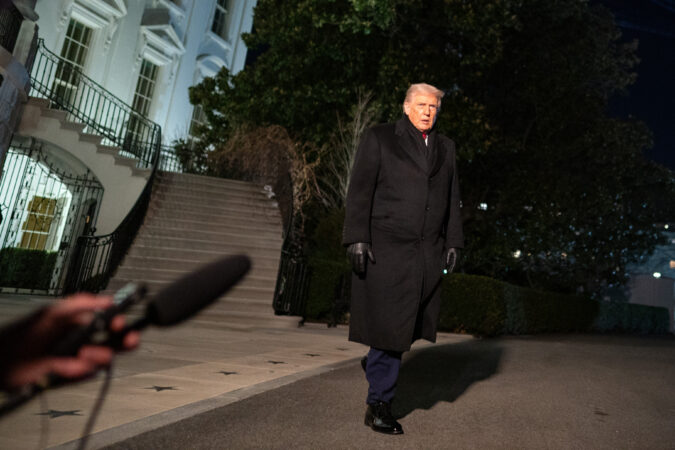
    Trump had been clear about wanting to “own” Greenland either by buying or otherwise acquiring the territory, even hinting at military action. In a speech in Davos on Wednesday, Trump ruled out the use of force. And within hours he declared victory and backed down.

    An aurora borealis is seen in the sky above Nuuk, Greenland, on Tuesday.

    Danish leaders said ceding sovereign territory is a red line and that they requested a NATO mission in the Arctic. The Danes also had insisted that Trump could achieve his goals through an existing 1951 defense pact — a position the White House previously dismissed.

    Now, the Trump administration will pursue negotiations with Denmark on updating that defense treaty, as well as with European nations over expanding NATO military presence in the Arctic, they said.

    European officials said they believed his U-turn came from a change of heart, rather than a change in substance. Danish and other NATO leaders made such overtures for weeks before Trump escalated the standoff.

    Officials said Trump appeared to shift after realizing that EU retaliatory tariffs could take effect in February, and that his bid for Greenland was unpopular back home, including with American businesses.

    “Who knows what really goes on in his mind,” one official quipped.

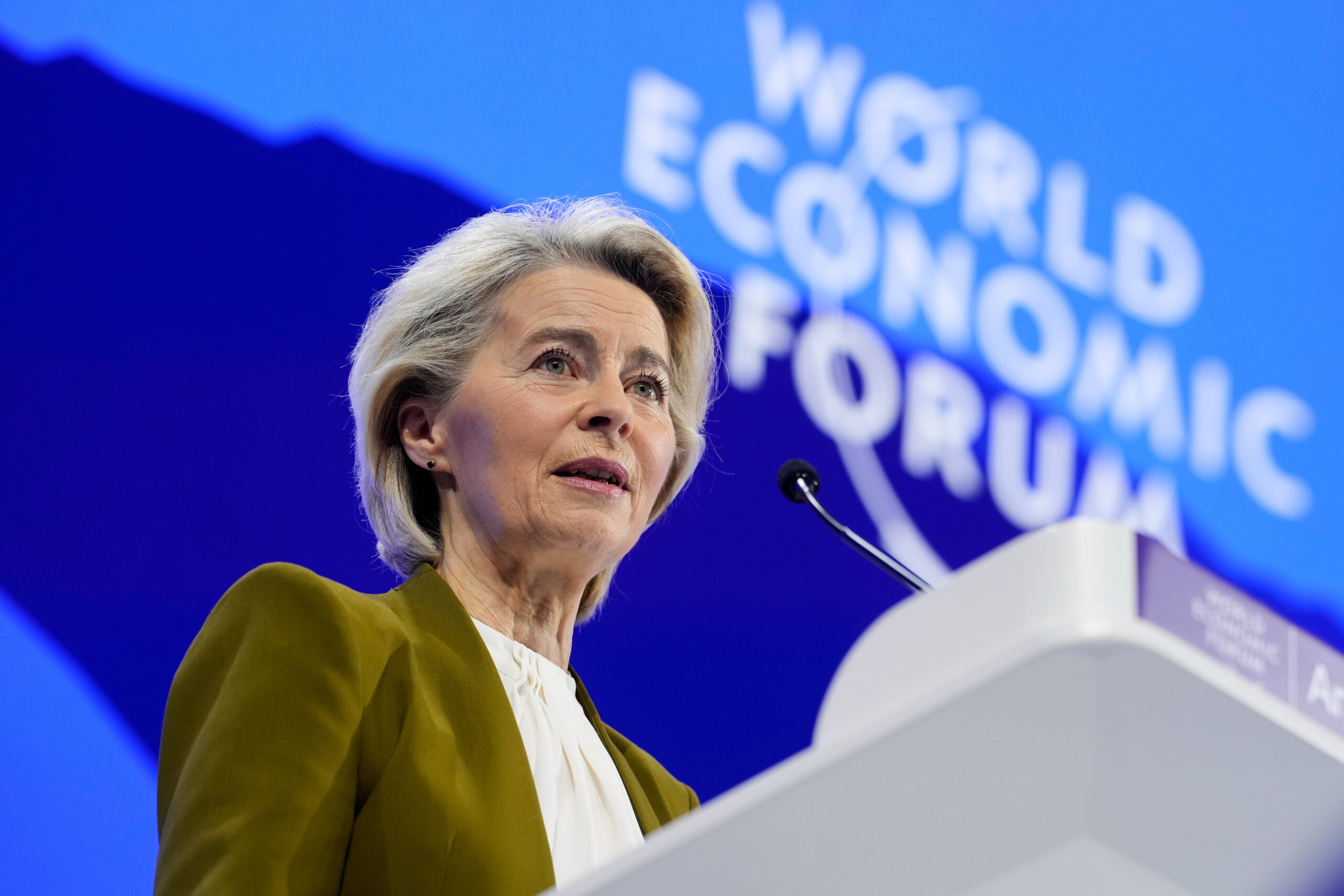
    European Commission President Ursula von der Leyen speaks during the World Economic Forum in Davos, Switzerland, on Tuesday.

    Ursula von der Leyen, the president of the European Commission, the EU’s executive body, said many elements “may also have played a role … but without firmness, non-escalatory responses, and unity in the European Union, they would not have worked.”

    “We are here in a better position than we were 24 hours ago, and tonight we drew the lessons of our collective strategy,” von der Leyen said. “It was effective,” she added, “so going forward we should maintain this very approach.”

    Von der Leyen spoke to reporters overnight following a summit of all 27 of the EU’s heads of state and government in Brussels. Beyond Greenland, they discussed how to prepare for a volatile world in which Washington, at any moment, might turn the threat of its military or economic power on longtime European allies.

    Even as Europeans pushed back, leaders dispatched Rutte, a former Dutch prime minister often dubbed their “Trump whisperer.” Rutte’s job at NATO has been consumed by papering over rifts with Trump.

    Publicly, the NATO chief said little about the Greenland crisis, refusing to deviate from praising Trump or agreeing with his grievances about Arctic security.

    A few leaders attributed Trump’s reversal to patience and an extended olive branch. Italian Prime Minister Giorgia Meloni, an ally of Trump on the hard right, pointed to “fostering dialogue between allied nations.”

    Emmanuel Macron on stage at the World Economic Forum in Davos, Switzerland, on Tuesday.

    French President Emmanuel Macron, however, said tough resolve was the trick. “What we should conclude is that when Europe reacts with a united front, using the instruments at our disposal while it is under threat, it can command respect,” Macron said. “And we remain extremely vigilant.”

    Even Polish Prime Minister Donald Tusk, still one of the most ardent champions of preserving the transatlantic relationship, said it was important “for our partners in Washington to understand the difference between domination and leadership.”

    That said, the standoff has dramatically darkened the mood within the EU regarding relations with Washington — a bond that has insured economic stability and security on the continent for 80 years.

    European lawmakers voiced a sense that the EU had to push back or there would be no end to Trump’s breaching of red lines. Playing nice only goes so far in shielding them from confrontation, officials conceded, and many warned that the Greenland matter was not yet settled.

    “When we genuflect, Trump weighs in, when we keep our back straight he tacoes out,” Nathalie Tocci, director of the Rome-based Institute for International Affairs, wrote on X in reference to “Trump Always Chickens Out” — a favorite phrase of Trump critics. It’s not because “he’s scared of Europe but of the markets,” Tocci said. “Lesson learned hopefully.”

    Lucky for EU leaders, they did not actually have to hit back — at least not yet — because the mercurial president stood down. That would have proved a bigger test of the cohesion between countries favoring a harder line, like France, and those more cautious, like Italy.

    For all the declarations of EU unity, the standoff caused a serious and potentially enduring split in the NATO alliance.

    Trump’s comments in Davos went to the heart of the European dilemma of how to navigate a world in which their most powerful ally is defining its positions. Trump cast the dispute as the U.S. vs. NATO, saying that Rutte was “representing the other side” while adding, “which is really us too, because, you know, we’re a very important member of NATO.”

    In his pursuit of Greenland, Trump also suggested in his speech that the U.S. was not inclined to defend territory it does not own. The core pillar of NATO is its Article 5 collective defense clause — that an attack against one is an attack against all. For smaller nations such as the Baltics, near Russia, the key to this idea is that the U.S. would come to their defense.

    Whatever moved Trump, everyone wants to claim the success.

    In London, Prime Minister Keir Starmer had been facing pressure within his own Labour Party for a tougher response. Starmer delivered his sharpest rebuke yet hours before Trump’s pivot, promising he “would not yield” on his defense of Greenland.

    The timing allowed officials to say Starmer’s government had stood up to Trump and even to claim some credit for deterring the president. British Foreign Secretary Yvette Cooper told Sky News it was a “a reflection of the strength of our connections in Washington.”

    Still, European officials spoke of a deep breach of trust across the Atlantic. In Brussels, some diplomats from countries that have been the loudest cheerleaders of the U.S. now refer to America as “our former ally.”

    Asked if she can still trust the U.S., Frederiksen, the Danish prime minister, hesitated. “I mean, we have been working very closely with the U.S. for many years,” she said, “but we have to work together respectfully, without threatening each other.”

  • DHS pauses cuts to FEMA as massive winter storm barrels in

    DHS pauses cuts to FEMA as massive winter storm barrels in

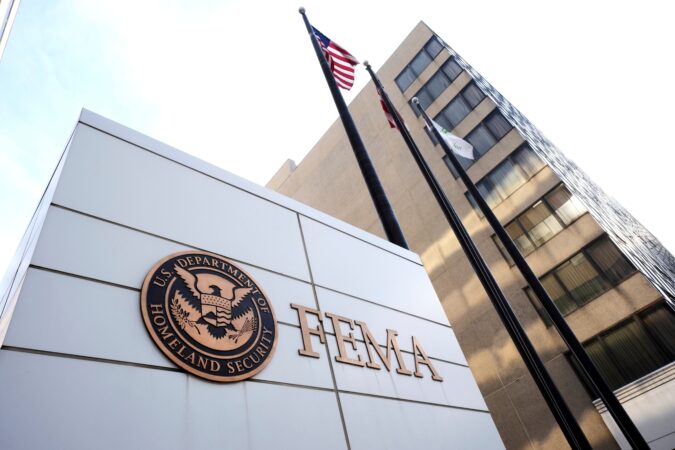
    The Department of Homeland Security has paused terminations of employees working on the Federal Emergency Management Agency’s disaster response as it ramps up preparations for a massive and life-threatening winter storm that will pummel half the country this weekend.

    Earlier this month, the Washington Post reported that the agency planned to terminate disaster response and recovery workers in waves. On New Year’s Eve, agency officials eliminated about 65 positions that were part of FEMA’s largest workforce, known as the Cadre of On-Call Response and Recovery (CORE) — staffers who are among the first on the ground after a disaster and often stick around for years to help communities recover.

    But on Thursday night, DHS’s head of human resources sent an email notifying teams that “just a few minutes ago,” FEMA headquarters decided the agency would halt their process of non-renewing dozens of federally funded employees. These roles, hired by FEMA for multiyear terms under the Stafford Act using the disaster relief fund, have been up for renewal on a rolling basis.

    Earlier that day, about 30 disaster workers received notices that their jobs would not be renewed. The pause then prompted human resources staff to backtrack, notifying those same workers that they still had jobs, according to the email and an official familiar with the process. Like others interviewed for this story, the official spoke on the condition of anonymity because they were not authorized to speak publicly about the matter.

    “I didn’t even know what was happening until it happened,” the official said, adding that as human resources initially emailed people informing them that their jobs would not be renewed, senior leaders were learning that FEMA was pausing terminations.

    In a statement, the Department of Homeland Security said that the agency regularly changes staffing levels for its disaster response and recovery efforts.

    “The CORE program consists of term-limited positions that are designed to FLUCTUATE based on disaster activity, operational NEED, and available funding,” the department said in its statement, which included text in all-caps.

    “FEMA’s National Response Coordination Center has been activated in response to a historic winter storm, in line with this mission FEMA is following standard protocol to ensure mission functions are being met,” it added.

    Officials would not comment on how long the pause would last.

    While states and local authorities handle most of their preparation and response to winter storms, FEMA will often deliver resources ahead of time, including generators and personnel if the potential for disaster seems high. Stafford Act employees, such as CORE members, will deploy to a state if they request an emergency or disaster declaration and the president approves it.

    The sudden shift in staffing direction has caught officials across the agency by surprise, six officials said. In recent weeks, their teams were told to prepare to lose a substantial number of people over the next few months.

    Since December, DHS has terminated more than 100 people across the agency who FEMA employs under the Stafford Act.

    Some were informed on New Year’s Eve; others were given only a day or two to turn in their equipment; and still more were cut after their supervisors sent detailed memos explaining why their roles remained vital to FEMA’s mission. The agency also lost veteran employees who oversaw finances for Hurricane Helene recovery, as well as civil engineers who assist states with mitigation and rebuilding roadways, bridges and schools. Some offices in the Midwest have lost experienced managers who typically help lead operations during emergencies and big disasters.

    On Wednesday, FEMA cut nearly 85 local hires from several regions, including a handful who were still working on Hurricane Helene recovery projects in North Carolina — a state now readying itself for potential power outages — according to two people with knowledge of the situation. FEMA’s call center in Puerto Rico lost many of their local hires Wednesday as well, one FEMA official said. If multiple states are hit hard enough and ask the president for federal assistance, those workers could have helped out, two officials said.

    The same day the department halted the terminations, Homeland Security Secretary Kristi L. Noem visited the agency’s headquarters to help guide national coordination and preparation for the sweeping storm. Noem, whose department oversees FEMA, also hosted a call Thursday morning with governors from 21 states that are bracing for dangerous, chilling weather. She assured them that DHS and FEMA will support them.

    “We can pre-deploy any needs that you may have, as far as generators or supplies to different parts of your state if you think you have a weakness in some area that’s going to be hit pretty hard,” Noem told the governors, reiterating that “if there is certain responses or requests specific to this event, feel free to reach out and use that contact information, and we’ll do all that we can to be helpful.”

    During the call, Karen Evans, FEMA’s agency’s interim administrator, and Gregg Phillips, who is now overseeing the Office of Response and Recovery, also offered their personal cell phone numbers in case any governor needs to get in touch with them immediately.

    Noem has instructed FEMA to be aggressive in preparing for the heavy snow and ice forecast to blanket a large portion of the United States and has promised a rapid and well-coordinated response, according to an official with knowledge of the situation. FEMA has delivered tens of thousands of meals and liters of water to various states, and it has positioned drivers who shuttle supplies outside distribution centers from Louisiana up to Pennsylvania.

    The decision to pause the terminations also coincides with the House’s approval Thursday of a spending bill that would fund FEMA’s disaster relief fund and help the agency “maintain staffing levels, including a reservist workforce and its Cadre of Response/Recovery Employees, necessary to fulfill the missions required under” federal law.

    Ahead of the storm, 10 officials from different parts of the agency who spoke to the Post said they were nervous about their ability to properly respond, given how their ranks have thinned over the past year, with the agency losing about 20% of its staff.

    Noem, who has exercised strict oversight over FEMA since taking over DHS, has repeatedly expressed a desire to shrink or eliminate the agency. The Post reported that she previously recommended cutting agency staffing by about half.

    In a previous statement, FEMA spokesperson Daniel Llargués said the agency had “not issued and is not implementing a percentage-based workforce reduction.”

    Employees in CORE roles are typically renewed every two to four years. When the end of an employee’s contracted term approaches, their supervisors typically seek approval to renew those roles. Most positions are usually reinstated, according to four current and former FEMA officials, in part because recovery work is long and complex.

    But in recent weeks, DHS’s process for renewing these temporary roles has changed frequently, according to officials with knowledge of the situation. Last week, supervisors in each region had to write memos justifying every role coming up for renewal this year, which would then be sent to FEMA’s temporary top official and then to Noem, according to two people familiar with the process. Guidance then shifted earlier this week. In a memo from Thursday, obtained by the Post, FEMA officials said that DHS will be making the calls without collecting justifications, and that “only extensions approved by DHS will be processed and they will be limited to 90 days.”

    One CORE employee said DHS suddenly cut her job without warning after her manager had submitted a memo urging to keep her on. Because some firings have been abrupt, some were not able to transition their work, she said.

    “And to be clear, I think most of us expected there to be staffing cuts this year,” the person said. “Just not in the bulldozer approach that didn’t take into account your job or performance.”

  • You can get stronger with gentle weight training, new study finds

    You can get stronger with gentle weight training, new study finds

    If you’re intimidated by weight training, a new study is full of reassurance.

    Weight workouts don’t have to be complicated or grueling to be effective, the study found. Almost any kind of lifting led to increased muscle and strength in the study. Whether people lifted heavy weights or light, through many repetitions or few, the results were broadly comparable.

    “Lift however you like to lift. That’s the lesson,” said Stuart Phillips, a professor of kinesiology at McMaster University in Ontario, Canada, and an expert in resistance exercise. Phillips is the senior author of the study, which was published last month in the Journal of Physiology.

    The study also provided other lessons, some unexpected, including about the importance of genetics in our bodies’ response to weight training and how some of us may get stronger without getting much bigger — or vice versa — when we begin to train.

    Do you have to lift heavy weights?

    Gym culture is full of widely held beliefs about the best ways to lift, Phillips said, many backed by scant evidence.

    “You’ll see guys who’ve been lifting for decades and swear you have to lift heavy” to gain substantial muscle mass and strength, he said. For them, weights must be hefty enough that you can barely grunt through eight or nine taxing reps before your arms or legs give out.

    But mounting evidence suggests that heavy weights are overrated. A comprehensive 2023 review of hundreds of past experiments concluded that, compared with no exercise, any lifting — not just with heavy weights — “promoted strength and hypertrophy” or larger muscles.

    But questions remain about the most effective weight workouts. If you use lighter weights, how many times should you repeat each lift? What drives muscle growth, if it’s not heavy loads? And will everyone make the same gains from the same workouts?

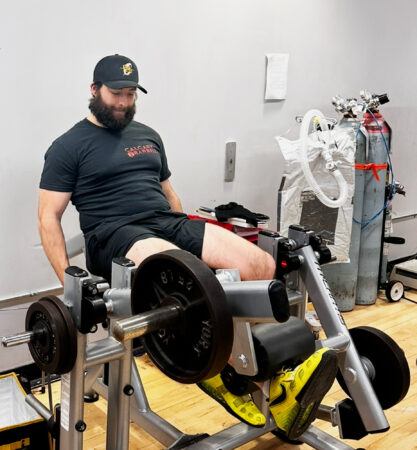
    For answers, Phillips and his colleagues recruited 20 healthy, young men who didn’t normally weight train and checked the size and strength of their muscles. (They have a similar study underway with women.) The men’s limbs were then randomized to heavy or light lifting; that is, their right or left arm was randomly assigned to complete biceps curls using a heavy weight, while the other arm did the same exercise with a much lighter weight. Similarly, one leg did knee extensions against a heavy weight; the other leg completed the same exercise with a much lighter load.

    The heavy weights were challenging enough that lifters could manage no more than 12 repetitions before reaching muscular failure, meaning they felt they couldn’t lift again. With the lighter weights, the participants lifted through as many as 25 repetitions before deciding they couldn’t do another.

    Light weights work fine

    The men worked out three times a week under the researchers’ supervision, increasing their weights once they could easily complete more than 12 heavy or 25 light repetitions. At the end of 10 weeks, the researchers retested everyone.

    By then, the men’s muscles were almost all stronger and larger, with little difference between limbs. The arm that lifted light weights was just as buff as the one that lifted heavy and ditto for legs. Both approaches were equally effective.

    This finding “reinforces the idea that load isn’t an important determinant” of muscular response, Phillips said. “Effort is.” If people lifted until their muscles tired, they got results.

    The practical takeaway is that you can “pick what works for you,” Phillips said. Have sore joints or little taste for big weights? Use smaller ones. Have limited time? You’ll finish faster with heavier loads.

    But don’t expect your results to exactly mirror mine. There were substantial differences from one volunteer to the next. Some nearly doubled their strength or mass; others added less. And there was little relationship between bulk and strength. Some men got far stronger without growing much bigger, and some achieved almost the opposite.

    These differences underscore the role of genetics. “To some extent, our muscular responses are baked in,” Phillips said. After 10 weeks of the same lifting routine, I won’t look precisely like you. But we’ll both be stronger and better muscled.

    What about body weight exercises?

    This study “was very well-designed,” said Brad Schoenfeld, an exercise scientist at CUNY Lehman College in the Bronx, who researches resistance training but was not involved with the new work. The findings suggest that “within broad limits, you can build similar amounts of muscle mass” with light or heavy loads.

    The study has limitations, though. It involved only young men new to lifting. Phillips said he believes the results would be similar for women, older people, and anyone who’s been weight training for years. But studies are needed with those groups to be sure.

    The training also involved gym machines. Would the results be the same with body weight exercises? “I think so,” Phillips said, adding, “I’m counting on it.”

    Much of his own training nowadays, at age 60, takes place at home, he said, and involves body weight work. “I’ve got enough space in my basement to do squats, do deadlifts,” he said. He repeats each exercise until he can barely finish another rep, he said. “I do what I preach.”

    But the key point is that he does something, Phillips said, and regularly. “Based on self-report and participation data, about 80% of people do not lift weights at all.” He hopes his group’s study and other research will encourage more people to try some kind of resistance training routine, he said. “Let’s make 2026 the year of strength.”

  • What ICE is doing that’s so controversial

    What ICE is doing that’s so controversial

    It’s not just Minneapolis. In cities across America, Immigration and Customs Enforcement agents have arrested hundreds of thousands of immigrants and clashed with protesters in what is on its way to becoming one of the largest deportation efforts in U.S. history.

    The White House says it’s deporting both criminals and people who are working in the country illegally.

    But ICE is increasingly unpopular, and it’s getting more headlines for its sometimes-violent tactics than it is for getting supposed bad guys off the streets.

    “They’re going to make a mistake sometimes, too rough with somebody,” President Donald Trump said of ICE. “You know they are rough people.”

    ICE’s reach is only expected to spread. It has been infused with billions more from the Republicans’ tax bill, and the Brennan Center for Justice estimates it will become one of America’s largest police forces. It is spending $100 million to try to hire gun rights supporters and military enthusiasts.

    “By the end of this, almost everyone is going to know someone who had a friend or family member or colleague affected, or who witnessed an arrest happening,” said David Bier, the director of immigration studies at the libertarian-leaning Cato Institute. “I think it’s unnerving to see people targeted who don’t seem to be doing anything out of the ordinary, just going to work or doing their jobs.”

    Here’s more about what’s happening:

    What ICE is doing on the streets

    There are about 11 million undocumented immigrants in the United States. ICE can’t be everywhere all at once, so the agency typically works with local authorities to help arrest people in the country illegally.

    But now agents are on a mission to deport as many people as possible.

    What was once a job largely out of the public eye is now taking place on city streets, parking lots of big-box stores, deep in local neighborhoods, and at churches and workplaces as agents mine federal data and go door-to-door to create what the nonpartisan Migration Policy Institute says is an unprecedented show of force in cities.

    Immigration agents have surged into Chicago, Los Angeles, D.C., Minneapolis, and Charlotte, rushing into upscale neighborhoods and shops, country clubs and near schools. Sometimes they are in plain clothes; many times they are masked.

    They’ve been recently empowered by the Supreme Court to stop people based on factors such as race, ethnicity, language or job.

    Some agents are using chokeholds to arrest people; others have been filmed smashing car windows to get at someone. U.S. citizens of color say they’re being asked to show paperwork (including off-duty police officers).

    Trump and his administration say they are targeting “the worst of the worst.” But there’s no evidence migrants commit crimes at a higher rate than Americans, and most migrants arrested don’t have a criminal record, according to the Migration Policy Institute.

    A record number of children are being detained, and data suggests families are being separated, ProPublica finds. The New York Times reported on a Cuban migrant arriving for a check-in with ICE and being immediately separated from her 17-month-old daughter she was breastfeeding and deported.

    “It feels like a member of my family is under attack,” one Charlotte woman told The Washington Post after telling her children’s caregiver to stay at home.

    Trump cracking down hard on protesters

    Communities of activists have sprung up to try to slow or stop arrests and film what’s happening.

    “I’ve been in touch with friends and former students in Minneapolis as well as Chicago, Los Angeles and now, Maine,” Robert Reich, a former labor secretary and prominent Trump critic, wrote this week. “Some have been extraordinarily brave. A few tell me they’ve tailed ICE agents and whistled loudly to warn others of ICE’s whereabouts. Some have sought to block agents from entering schools, courthouses, and clinics. Others have been taking videos to give to the media or use in court.”

    Trump has responded with force. His administration has tried to label protesters as “domestic terrorists” (which legal experts say isn’t an actual designation) and has sought to deploy the National Guard where there are protests. He’s also threatened to send in the military to arrest protesters in Minneapolis. Vice President JD Vance said the ICE agent who killed protester Renée Good has “absolute immunity.” ICE agents are launching tear gas and pointing guns at protesters. The Trump administration has launched criminal investigations into Democratic officials in Minnesota who have criticized ICE.

    Yet for all the conflict, Bier is tracking federal charges of protesters and finds it’s rare, suggesting many of their actions are protected by the First Amendment.

    ICE detentions also controversial

    Trump is building some of largest deportation centers in history, including makeshift facilities and plans by ICE to hold up to 80,000 immigrants in seven large-scale warehouses, The Post reported.

    Conditions can be tough. Some ICE facilities have been described as “inhumane,” with reports of spoiled food, undrinkable water or lights on 24 hours a day. The pro-immigration American Immigration Council writes that ICE is “trapping hundreds of thousands of noncitizens in an increasingly opaque world of remote jails and private prisons.”

    An ICE detainee died in January; witnesses say he was choked, and his death may be classified as a homicide. (The government disputes that account of events.) He is one of dozens who have died in ICE custody since Trump took office a year ago.

    ICE getting harder to defend politically

    Polls show that Trump’s ICE raids have strong support from Republicans.

    “Letting millions of illegal immigrants come to work in the U.S. will depress wages, and we can’t allow that to happen,” says Nick Iacovella with the Coalition for a Prosperous America, a conservative, pro-tariff group that also supports Trump’s mass deportations.

    But a new Economist/YouGov poll finds 47 percent of Americans think ICE is making America less safe, compared with 34 percent who said more safe. And for months now, a majority of Americans have disapproved of how Trump is handling immigration overall, on what used to be his strongest issue. Republicans are particularly concerned mass deportations are hurting them with Latino voters, who helped Trump win the presidency again.

    “For the first time, immigration is maybe having a negative impact on my party,” former North Carolina Gov. Pat McCrory, a Republican, told Politico this fall.

  • Trump budget office orders review of funds to Democratic-controlled states

    Trump budget office orders review of funds to Democratic-controlled states

    The Trump administration has ordered Cabinet agencies to review federal funding for a group of Democratic-controlled states, according to a White House budget official and records reviewed by The Washington Post, as the administration looks to cut off resources for “sanctuary” jurisdictions that refuse to collaborate with immigration enforcement authorities.

    The White House Office of Management and Budget ordered all federal agencies except the Defense and Veterans Affairs departments to report every grant, loan, contract, subcontract and “other monetary awards” to a group of 14 states and Washington, D.C.

    The memo, sent Monday with instructions to report back by Jan. 28, says the exercise is meant to “facilitate efforts to reduce the improper and fraudulent use of those funds through administrative means or legislative proposals to Congress.”

    “This is a data-gathering exercise only,” the memo states later. “It does not involve withholding funds and therefore does not violate any court order.”

    President Donald Trump declared in a speech last week that as of Feb. 1, the federal government would stop making “any payments to sanctuary cities, or states having sanctuary cities, because they do everything possible to protect criminals at the expense of American citizens.”

    The Trump administration has surged immigration enforcement in Minneapolis as prosecutors focus on nonprofits there that have received federal grants. Many of the targeted organizations are affiliated with the city’s large Somali community, and Trump has used the situation to call for a crackdown on both federal benefits fraud and immigration from East Africa.

    During a speech Wednesday at the World Economic Forum in the Swiss resort town of Davos, Trump described the investigation’s targets as “Somalian bandits.”

    “We are moving forward with taking fraud seriously,” said an OMB spokesperson, who spoke on the condition of anonymity to discuss internal proceedings.

    The jurisdictions included in the budget office’s request are: California, Colorado, Connecticut, Delaware, Illinois, Massachusetts, Minnesota, New Jersey, New York, Oregon, Rhode Island, Vermont, Virginia, and Washington state. It also includes the District of Columbia.

    The memo was reported earlier by RealClearPolitics and CNN.

    It requests agencies provide detailed information on all funds to those states, including money routed for state and local governments, nonprofit organizations and higher education institutions.

    The memo includes a worksheet that asks agencies to report money sent to those recipients in the 2025 fiscal year and estimated spending for the 2026 fiscal year.

    White House budget director Russell Vought has faced off with Democratic-controlled states before.

    During the 43-day government shutdown that stretched from the start of October into mid-November, Vought’s office paused billions of dollars for New York subway and rail projects; Democrats’ leaders in Congress, Sen. Charles Schumer and Rep. Hakeem Jeffries, both represent the Empire State.

    Vought also attempted to cancel $8 billion in clean energy funds for a group of 16 Democratic-run states. A federal judge said this month that the move was unlawful and reinstated the money.

    “Defendants freely admit that they made grant-termination decisions primarily – if not exclusively – based on whether the awardee resided in a state whose citizens voted for President Trump in 2024,” Judge Amit Mehta, of the District Court of the District of Columbia, wrote in his ruling.

  • Formal U.S. withdrawal from WHO is decried as ‘scientifically reckless’

    Formal U.S. withdrawal from WHO is decried as ‘scientifically reckless’

    The United States formally withdrew from the World Health Organization on Thursday, one year after President Donald Trump announced plans to pull out of the preeminent global health alliance.

    Trump justified the move based on what he viewed as the “mishandling” of the coronavirus pandemic, a failure to adopt changes and inappropriate political influence from some members.

    The departure stunned global health experts and international authorities because the U.S. had been the most influential member of the 194-member organization and played a key role in its establishment in 1948. It had also historically been the organization’s largest financial contributor.

    “Withdrawing from the World Health Organization is scientifically reckless,” Ronald Nahass, president of the Infectious Diseases Society of America, said in a statement. “It fails to acknowledge the fundamental natural history of infectious diseases. Global cooperation is not a luxury; it is a biological necessity.”

    In announcing the withdrawal, the Department of Health and Human Services said the U.S. will remain a global leader in health, but through “existing and new engagements directly with other countries, the private sector, nongovernmental organizations, and faith-based entities.”

    During a briefing with reporters, a senior HHS official said U.S.-led global health efforts going forward will rely on the presence that federal health agencies, such as the Centers for Disease Control and Prevention, the National Institutes of Health and the Food and Drug Administration, already have in 63 countries and bilateral agreements with “hundreds of countries.”

    “I just want to stress the point that we are not withdrawing from being a leader on global health,” the official said, speaking on the condition of anonymity under ground rules for the briefing.

    All U.S. personnel and contractors assigned to or embedded with WHO offices have been recalled. All U.S. government funding to the WHO has been terminated, nearly $280 million, according to a person familiar with the government funding who spoke on the condition of anonymity because they were not authorized to discuss the matter on the record. The State Department and HHS did not respond to questions about the funding.

    According to the WHO, the U.S. must meet its financial obligations before withdrawing and the organization’s executive board is set to consider the matter at its February meeting.

    Public health experts have questioned how the U.S. can continue to be a global public health leader.

    Health Secretary Robert F. Kennedy Jr. said in June that the U.S. would no longer contribute to Gavi, an independent public-private financing group that buys vaccines and distributes them in low- and middle-income countries. As part of sweeping HHS staffing cuts last year, the CDC’s Global Health Center lost its director and some other employees.

    “It’s almost laughable that the Trump administration thinks they can lead in global health,” said Lawrence Gostin, a law professor at Georgetown University and director of a WHO Collaborating Center for National and Global Health Law. “They’ve decimated the global health capacities of the CDC. They’ve slashed global health funding around the world.”

    It’s unclear how the formal withdrawal will affect some key meetings where U.S. officials have historically played a major role. Next month, the WHO is scheduled to convene a global meeting of influenza experts to decide which virus strains should be included in next season’s flu vaccine, a process that guides vaccine production months in advance.

    Scientists from WHO collaborating centers, including the CDC, other countries’ public health agencies and academic laboratories, review global surveillance data, genetic sequencing and laboratory analyses to assess which influenza strains are spreading and how they are changing.

    In February 2025, CDC scientists were allowed to participate in the WHO meeting. Asked whether CDC scientists would be able to take part next month, the senior HHS official told reporters that there are ongoing conversations and that an announcement will come “in the near future.”

  • After ‘good’ Trump meeting, Zelensky pushes Europe hard to do more

    After ‘good’ Trump meeting, Zelensky pushes Europe hard to do more

    KYIV — Ukrainian President Volodymyr Zelensky aimed a blistering speech at Europe during the World Economic Forum on Thursday after a last-minute meeting with President Donald Trump, which both leaders described as “good,” saying framework documents between the two countries — in hopes of ending the conflict — were nearing the final stages.

    After nearly four years of full-scale war, Zelensky described how life in Ukraine felt like the movie Groundhog Day with ramped-up attacks coming amid a brutally cold winter. All the while Europe is still unequipped to defend itself against Russia, he said, which has not slowed its assault since 2022.

    In the face of European weakness, Zelensky said, “the backstop of Trump is needed” with no security guarantees functioning without the United States. He emphasized that Europe needed to be a united force: “Europe should not be a salad of small and middle powers.”

    “Europe loves to discuss the future but avoids taking action today, action that defines what kind of future we will have,” Zelensky said in his speech in Davos, Switzerland, following the hourlong meeting with Trump. “If [Russian President Vladimir] Putin decides to take Lithuania or strike Poland, who will respond? … Tomorrow you may have to defend your way of life.”

    The speech, which received a standing ovation, didn’t appear to have been originally scheduled. Zelensky scrambled to get to Switzerland after Trump on Wednesday unexpectedly said that he planned to meet with Zelensky that very day, adding that he might even “be in the audience.”

    In fact, Zelensky was still in Kyiv. He had told reporters on Tuesday — as the forum was already underway — that he would likely remain in the capital, “choosing Ukraine, not an economic forum,” as millions of Ukrainians froze in their homes and workers rushed to fix an electrical grid battered by Russian drones and missiles.

    Some had hoped a bilateral meeting might lead to the inking of frameworks for security guarantees and postwar economic recovery, with officials hinting the two countries were close to the finish line. But a senior Ukrainian official on Thursday said that no documents had been prepared for signing in Davos, and a key priority of the meeting was to discuss additional air defense systems.

    In his speech, however, Zelensky did say that the documents to end the war “are nearly ready and that really matters.” He added, however, that more pressure needed to be put on Russia to make it agree to end the war and Ukraine couldn’t be the only country making compromises.

    The meeting in the Swiss Alps was closed to the press and there were no statements at its conclusion. On his way out, however, Trump told reporters that “the meeting was good with President Zelensky, we still have a ways to go” — stepping back from his message on Wednesday, that both sides were “reasonably close” and “at a point now where they can come together and get a deal done. And if they don’t, they’re stupid.”

    He added that the message his envoys would take to Putin Thursday night in Moscow would be “the war needed to end.”

    At a question-and-answer session following his speech Thursday, Zelensky acknowledged that “this last mile is very difficult” and “Russians have to be ready for compromises, not just Ukraine.”

    Despite the optimism expressed by the White House, the two sides still appear to be far apart in negotiations. In a news conference Tuesday, Russian Foreign Minister Sergei Lavrov called into question any deal that allowed the continuing existence of the current Ukrainian government.

    “Any settlement proposal founded on the primary goal of preserving the current Nazi regime in what remains of the Ukrainian state is, naturally, completely unacceptable to us,” he said.

    White House envoy Steve Witkoff and Trump’s son-in-law Jared Kushner — who met with lead Ukrainian negotiator Rustem Umerov on the sidelines of the forum — will meet with Putin late on Thursday. Speaking at the forum’s Ukrainian Breakfast on Thursday morning, Witkoff said that he felt “encouraged” and described the Ukrainian people as “so courageous in this fight … under some real difficult conditions.”

    “I think we’ve got it down to one issue, and we have discussed iterations of that issue,” Witkoff said, appearing to gesture at territorial concessions, one of the most contentious aspects of the negotiations and a red line for Ukraine. “That means it’s solvable. So if both sides want to solve this, we are going to get this solved; that’s my view.”

    Previous meetings between Witkoff and Putin have lasted hours and will likely continue into early Friday morning, though Witkoff said he will not be spending the night and will continue on to Abu Dhabi, capital of the United Arab Emirates, afterward. Two days of trilateral meetings will be held there between Ukraine, the United States and Russia.

    Kremlin spokesman Dmitry Peskov declined to comment on whether the Kremlin shared Witkoff’s optimism that a deal was close. At a news conference, Putin said he would also discuss Russia’s contribution to Trump’s Board of Peace with Witkoff and Kushner.

    As world leaders congregated in Davos, enjoying mountain views, plush lodges and crackling fireplaces, Ukraine’s power grid remained crippled during one of the coldest winters in years. Without electricity, many Ukrainians sought refuge in restaurants and coffee shops, kept running by generators. Outside, inches of ice slicked the streets and sidewalks. The windows of thousands of apartments remained dark.

    Concluding his speech, Zelensky said, “Let’s end this Groundhog Day.”

  • Former Uvalde officer acquitted for response to 2022 school shooting

    Former Uvalde officer acquitted for response to 2022 school shooting

    A Texas jury on Wednesday acquitted a former Uvalde school police officer on 29 counts of child endangerment after he remained outside Robb Elementary School instead of immediately confronting the gunman who killed 19 children and two teachers in their classrooms in 2022.

    The verdict is a major setback for prosecutors, who portrayed the case against Adrian Gonzales as a way to deliver justice and accountability for one of the deadliest school shootings in U.S. history.

    Instead, jurors appeared to agree with Gonzales’ lawyers, who described him as unfairly singled out among the hundreds of law enforcement officers who arrived on the scene — a response that investigators said was marked by significant communication failures and poor decision-making.

    Had he been convicted, Gonzales, 52, faced up to two years in prison.

    The former officer of the six-member Uvalde Consolidated Independent School District Police Department was one of the first law enforcement personnel to respond on that sunny May day, when a teenage shooter walked into Robb Elementary through an unlocked door and opened fire inside two adjoining fourth-grade classrooms.

    Prosecutors argued that Gonzales bore particular responsibility for the tragedy. They focused on his initial encounter with a frantic woman fleeing the school, who pointed toward the general location of the shooter as gunfire was heard inside, and his subsequent decision not to immediately rush in, which they said went against his active-shooter training.

    However, defense lawyers noted that four other officers got to the school at almost the same time but also did not enter right away to confront the gunman. Unlike Gonzales, three of them were in a position to see the assailant, his lawyers said. One thought he spotted the shooter outside the school and asked for permission to fire, his superior officer testified.

    Minutes after he arrived, Gonzales did go into the school with several other officers. Gunman Salvador Ramos, armed with an AR-style rifle, shot at them, grazing two, and the group retreated.

    Nearly 400 officers ultimately converged on the school but did not breach the classroom where Ramos was located until more than an hour after he’d entered the building. A tactical unit shot and killed him.

    Emotions ran high during the three-week trial, which featured wrenching testimony from teachers who survived the shooting and parents whose children were among the murdered and wounded.

    The prosecution is “trying to hijack your emotion to circumvent your reason,” defense attorney Nico LaHood told jurors. Gonzales was “easy pickings,” he said. “The man at the bottom of the totem pole.”

    Both of Gonzales’ lawyers repeatedly acknowledged the grief of families and the community. “There’s nothing that’s going to bring these kids back,” Jason Goss said during closing arguments Wednesday. “Nothing is ever going to solve that pain.”

    But, he added, “You do not honor their memory by doing an injustice in their name.”

    Gonzales is one of two former officers to be charged in connection with the mass killing. Pete Arredondo, the former chief of Uvalde’s school district police, is also set to stand trial on charges of child endangerment. Arredondo has pleaded not guilty.

    Wednesday’s verdict marks the second time that a jury has declined to convict a school police officer for failing to stop a school shooting. In 2023, Scot Peterson, a sheriff’s deputy who worked as a security officer at Marjory Stoneman Douglas High School in Parkland, Fla., was acquitted of similar charges. Five years earlier, a gunman had killed 17 students, teachers and staff members at the school.

    Gonzales’ trial took place before Judge Sid Harle in Corpus Christi, more than 200 miles from Uvalde, after the defense argued that a change of venue was necessary to obtain an impartial verdict. Jurors began deliberating early afternoon Wednesday.

    Gonzales, in a blue suit and a tie patterned with crosses, wept and hugged one of his lawyers after the verdict was read. He had not testified in his own defense, but prosecutors played an hour-long video, recorded not long after the shooting, in which he recounted his actions at the school.

    Christina Mitchell, the district attorney for Uvalde County, had told jurors that returning a guilty verdict would send a message to all law enforcement officers about their duties to members of the public and children in particular.

    The children inside Robb Elementary had followed their lockdown training, staying quiet and hidden, she said, while Gonzales did not run to confront the shooter, as his training suggested.

    “We’re not going to continue to teach children to rehearse their own death and not hold [officers] to the training that’s mandated by the law,” Mitchell said. “We cannot let 19 children die in vain.”

    Mothers of several of the children killed in the massacre cried together outside the Nueces County courthouse Wednesday night. Relatives of another victim, 9-year-old Jacklyn Cazares, reacted with fury immediately after the verdict.

    “I’m angry,” said her father, Javier Cazares, in video provided by local television station KSAT. “We had a little hope, but it wasn’t enough.”

  • I’m a gastroenterologist. Here are some surprising GLP-1 gut benefits. | Expert Opinion

    I’m a gastroenterologist. Here are some surprising GLP-1 gut benefits. | Expert Opinion

    Q: I’m worried that GLP-1s are bad for my gut. Should I avoid them altogether for this reason?

    A: In the original clinical trials of GLP-1 medications for weight loss, the most common side effects were gastrointestinal, including nausea, vomiting, and constipation. Ask almost anyone who’s been on one, and they’ll probably tell you that they’ve had some GI issues — even if very mild.

    So you might be surprised that as a gastroenterologist, when my patients tell me they’re considering starting a GLP-1 (the class of drug that includes Ozempic, Wegovy, and Zepbound, among others), my answer is often highly enthusiastic: Do. It.

    We hear all the time about the weight loss or heart health benefits of GLP-1s, but as a scientist who studies GLP-1 and the stomach in my own laboratory, I’ve seen firsthand how powerful and beneficial they can be for gut health. The GI effects of GLP-1s that I wish more people talked about? Randomized controlled trials have found that they can, in some cases, improve outcomes for people with fatty liver disease and fibrosis — or liver scarring — which previously no drugs could reliably achieve.

    GLP-1s are also associated with a lower risk of stomach ulcers, according to research I conducted with my colleagues and — here’s a big one — they’re linked to lower odds of colorectal cancer. Many of these potential associated benefits are unrelated to weight loss, although the weight loss alone can start a cascade of wins.

    For example, one of my patients who started a GLP-1 lost about 20 pounds after six months. Losing that 20 pounds helped her knees, which had been aching all the time, and allowed her to begin exercising regularly. She began walking daily and then, before long, joined a Zumba class. This would have been unheard of for her before taking a GLP-1. Now, even though her weight has remained steady, she’s a healthier person because she stays active, something that lowers the risk of cancer and heart disease regardless of her weight.

    That doesn’t mean I downplay the GI issues, rather in my practice, I anticipate them and make a proactive plan. With each patient, I have an honest discussion about the possibility of unwanted side effects, including the possibility of more serious, although rare, complications such as pancreatitis.

    Let’s be real: The majority of people taking GLP-1s do experience symptoms like nausea or constipation. However, in most cases, these symptoms are mild to moderate and transient: Fewer than 5% of people stop treatment because of GI symptoms. So if someone wants to stick with their GLP-1, I like to help give them every chance I can. And with a pill version of Wegovy now available, they’re going to become increasingly accessible.

    Everyone interested in GLP-1s should have that clear-minded discussion with their own physician who knows their own medical history and goals. To help start that conversation, here are some of the most common questions I get:

    What exactly are GLP-1 medications doing to my gut?

    You’ve probably heard that GLP-1, or glucagonlike peptide 1, is a hormone produced by the body that is involved in hunger signaling. But GLP-1 medications do so much more than this. For instance, they suppress stomach acid production and fortify the protective mucus layer along the stomach’s lining, which is at least partly how scientists like myself hypothesize they may help reduce the risk of ulcers. Perhaps most evident to anyone taking them is that GLP-1s slow the stomach down. As a result, food sits inside longer before it gets emptied into the small intestine, and that can create an uncomfortable sense of fullness and queasiness. (Hello, Ozempic burps!) A similar slowing occurs in the colon. Because one of the colon’s primary jobs is to absorb water, the longer the waste sits there, the drier and harder it becomes. Hence, constipation.

    We still have much to learn about GLP-1’s other effects on the gut and body. How GLP-1 medication influence our microbiome is an emerging area of research, but some limited studies in humans suggest that they may influence the production of beneficial bacterial metabolites. They also appear to help reduce chronic inflammation, which plays a big role in multiple diseases.

    How can I treat the unwanted side effects?

    You should explore possible treatments with your physician, who can make tailored recommendations. The goal isn’t for you to “suffer through” therapy with GLP-1 in the name of good health, but to make taking a GLP-1 drug as sustainable as possible. I tell my patients when starting these drugs to expect side effects and plan for them. And no, GI symptoms like nausea are not what drives weight loss, so don’t hold back seeking help.

    Let your hunger cues guide you

    Contrary to how many of us eat otherwise, when taking a GLP-1 it’s important to try to eat only when actually hungry, eat slowly, and respond to your body’s cues saying you’re full. It’s common for people to eat smaller portions than they’re used to, but still feel satisfied.

    Be proactive about bowel issues

    Anyone who struggles with their bowel movements at baseline, speak up now: We need to be especially proactive. Sometimes it’s as simple as starting a daily fiber supplement, which can be helpful for diarrhea or constipation (both are possible with GLP-1s). In the case of constipation, over-the-counter laxatives like a capful of powdered polyethylene glycol (like in Miralax) can help, while for diarrhea, loperamide (like in Imodium) can be great. But don’t give up if these feel inadequate — there are also several prescription medications that can help get your colon back on track.

    Try OTC remedies for nausea and heartburn

    For nausea, sometimes the fix can be to simply lower the dose of the GLP-1 you’re taking, although there are medications that can help. Over-the-counter remedies like bismuth subsalicylate (like in Pepto-Bismol), dimenhydrinate (like in Dramamine), or ginger tea can provide quick relief. If these are insufficient, your doctor may consider prescription antinausea medications. Because of the delay in stomach emptying, heartburn can also show up, but over-the-counter treatments like histamine-2 blockers (like Pepcid AC and Zantac 360) can help.

    Who is more likely to experience side effects?

    In real-world studies of people taking these medications, men appear to have half the risk of experiencing GI side effects as women. The most important advice to avoid side effects is to start on a low dose and increase slowly.

    Are certain GLP-1s more likely to cause side effects?

    Head-to-head trials comparing semaglutide (Ozempic, Wegovy) with liraglutide (Victoza, Saxenda) show broadly similar GI side effects overall, though results vary somewhat by study and dose. The good news is that major trials have found that these side effects were more common in the first few days or weeks of starting treatment, when they peaked, but then tended to subside. So I tell my patients that even if they experience GI symptoms initially, there’s a good chance they’ll get better.

    What I want my patients to know

    GLP-1 drugs are often spoken of as weight loss tools but, to me, that really misses the point. Obesity is a chronic, inflammatory disease that drives up the risk of heart disease, Type 2 diabetes, and certain cancers. Using a medication to treat a medical condition is not a moral failing — as some of my patients have been made to feel. There are fewer more powerful steps someone can take for their health than to reduce that constant state of inflammation, and as a doctor, I will always find that worth celebrating and supporting.

    Trisha Pasricha is an assistant professor of medicine at Harvard Medical School and author of the forthcoming book “You’ve Been Pooping All Wrong.”