Category: Washington Post

  • Supreme Court appears likely to allow Lisa Cook to remain on Fed board

    Supreme Court appears likely to allow Lisa Cook to remain on Fed board

    The Supreme Court on Wednesday appeared likely to block President Donald Trump from immediately firing Democratic-appointed Lisa Cook from the Federal Reserve board, a move that would prevent Trump from exerting greater influence over the powerful central bank that guides the economy.

    Nearly all of the justices asked skeptical questions of Solicitor General D. John Sauer during roughly two hours of arguments, taking issue with most aspects of the government’s case that the president had met the legal bar to remove Cook while a lawsuit challenging her removal plays out. Such unanimity is rare on high-profile cases for a deeply polarized court.

    Conservative Justice Brett Kavanaugh said the Trump administration’s position that it could remove Fed governors without judicial review or due process “would weaken if not shatter the independence of the Federal Reserve.” He said presidents of both parties could gin up reasons to remove governors under such a system with dangerous implications for a central bank that Congress created to operate independently.

    “It incentivizes a president to come up with … trivial or inconsequential or old allegations that are very difficult to disprove,” Kavanaugh said. “It incentivizes sort of the search and destroy … no process, nothing, you’re done … what are we doing when we have a system that incentivizes that?”

    The president has complained for months that the Fed is not dropping interest rates quickly enough. He has tried to oust Cook over mortgage fraud allegations, and his Justice Department has launched a criminal probe of Fed Chair Jerome Powell over whether he lied to Congress.

    Both Cook and Powell have denied wrongdoing and accused Trump of manufacturing pretexts to undermine the independence of the central bank to achieve his policy goals. The campaign has alarmed many economists, who fear keeping interest rates artificially low could spark long-term inflation.

    The Supreme Court’s ruling, which is expected in the coming weeks or months, is one of the most significant tests to date of Trump’s push to expand presidential power and place parts of the government that for decades have operated independently under tighter control. It could also have major ramifications for the economy and is being closely watched by businesses and the markets.

    In a sign of the stakes, both Powell and Cook attended the arguments, as did former Fed Chair Ben Bernanke.

    The justices have repeatedly backed Trump’s bids to fire the heads of independent agencies in emergency rulings in his second term, but in a major shift Wednesday justices at both ends of the court’s political spectrum seemed ready to draw a red line around the Fed. Many signaled that they wanted additional legal proceedings, perhaps in the lower courts, before deciding a novel and weighty legal issue on the merits, while Chief Justice John Roberts signaled he might favor going ahead and ruling.

    Conservative Justice Samuel Alito asked Sauer why the Trump administration was asking the court to resolve such a momentous case in a “hurried manner.” Justice Amy Coney Barrett, also a conservative, pointed to a friend-of-the-court brief by former Fed governors warning that removing Cook could trigger a recession and counseled caution.

    Liberal Justice Sonia Sotomayor said the public’s confidence in the court’s decision would benefit from hashing out significant factual and legal issues before issuing a decision.

    “We know that the independence of the agency is very important and that that independence is harmed if we decide these issues too quickly and without due consideration.” Sotomayor said.

    Congress set up the Fed to be insulated from control by the president so it could make difficult decisions, such as raising interest rates, that might not be politically popular but that are good for the overall health of the economy.

    No president in the 112-year history of the Fed had tried to fire a governor from the board before Trump targeted Cook in August. He alleged that she claimed two homes as primary residences at the same time to get a better mortgage rate. Cook denies the allegations.

    The issue before the justices was whether the effort to fire her complied with the Federal Reserve Act, which says Fed board members can be removed only “for cause.” A federal judge and a divided appeals court temporarily blocked Cook’s removal, prompting the administration to appeal to the high court.

    In October, the justices allowed Cook to temporarily remain in her job while they heard the emergency appeal from the Trump administration.

    Sauer told the justices that the alleged mortgage fraud by Cook met the legal bar to remove her and that the president had lost confidence in her ability to do the job. He also said courts did not have the authority to review the president’s decision, a contention a handful of the justices disputed.

    “The American people should not have their interest rates determined by someone who was, at best, grossly negligent in obtaining favorable interest rates for herself,” Sauer said.

    Paul Clement, Cook’s attorney, said judges did have the power to review Cook’s ouster. He also said the mortgage fraud allegations, even if true, would not meet the legal bar to fire Cook, because she applied for her mortgages before she was appointed to the Fed by President Joe Biden in 2022. He added that Cook was never given the opportunity to defend herself.

    “There is no reason to abandon more than 100 years of central bank independence on an emergency application,” Clement said.

    The justices quizzed attorneys for both sides about what the removal of a Fed governor should entail, often questioning whether the Trump administration had provided due process for Cook.

    Justice Ketanji Brown Jackson, a liberal, sounded incredulous when Sauer said it was enough that the president had indicated on social media that he intended to fire Cook. Jackson asked how Cook was supposed to defend herself from the allegations without some kind of hearing.

    “Like, she was supposed to post about it [on social media] and that was the opportunity to be heard?” Jackson asked.

    David Wilcox, a senior fellow at the Peterson Institute for International Economics and the director of U.S. economic research at Bloomberg Economics, said he expects the justices to send the case back to lower courts. He said the lower courts need to resolve a key procedural question: whether Cook was afforded adequate process, such as notice that she could be fired and an opportunity to be heard.

    “My guess is what the court will do is kick the can down the road,” he said, adding that it is risky to predict the outcome of the case based on oral arguments alone.

    Some legal experts said administration officials may have damaged their chances by launching the criminal probe of Powell earlier this month, creating the impression that Trump’s efforts are more about reshaping the Fed board and policy than any alleged malfeasance by its leaders.

    The Justice Department is probing whether Powell misled Congress about a $2.5 billion renovation of the Fed’s headquarters. Powell forcefully pushed back on those allegations, calling them “pretexts” in a video posted on the Fed’s website.

    “The threat of criminal charges is a consequence of the Federal Reserve setting interest rates based on our best assessment of what will serve the public, rather than following the preferences of the President,” Powell said.

    The arguments Wednesday were a notable shift from a case in December dealing with the legality of Trump’s firing of a Democrat from the Federal Trade Commission without cause. That case could also affect Cook’s job at the Fed.

    In that case, Sauer told the justices that Trump had the inherent authority under the Constitution to remove members of independent agency boards, even though Congress set up those agencies to operate at a remove from the executive.

    Some of the court’s conservative justices and many in the Trump administration have expressed support for an idea known as unitary executive theory, which holds that the Constitution gives the president broad authority to fire officials and that Congress cannot limit it.

    Agencies like the FTC, Securities and Exchange Commission, and Federal Election Commission operate as “a headless fourth branch” of government not fully accountable to the voters who elected the president, Sauer told the justices in the FTC case.

    The conservative majority on the court seemed to embrace that argument, possibly clearing the way for them to strike down a 90-year-old precedent, known as Humphrey’s Executor, that says that Congress could limit the president’s ability to dismiss the heads of independent agencies.

    “I think broad delegations to unaccountable independent agencies raise enormous constitutional and real-world problems for individual liberty,” said Justice Brett M. Kavanaugh.

    But Kavanaugh also suggested that the court sees the central bank as different and might carve out a rule protecting it. Whether it affects the Fed, a ruling striking down Humphrey’s Executor would be one of the largest shifts to the structure of government in decades. A decision in that case is also expected by the summer.

    Some Fed watchers said Wednesday the Cook case appeared unlikely to deal a fatal blow to the central bank’s independence. They also warned that the Fed is increasingly on the defensive – reacting to political pressure rather than setting the terms – and that without pushback from Congress and the markets, Trump could continue reshaping the institution in ways that erode its autonomy.

    “It sounds to me that this case will not be the Waterloo for Fed independence,” said Mark Spindel, an investment manager who co-wrote a history of the central bank’s independence. “But the institution is clearly playing defense.”

  • Democrats seek to block Homeland Security funding over ICE concerns

    Democrats seek to block Homeland Security funding over ICE concerns

    House Democrats plan to vote against a negotiated funding bill for the Department of Homeland Security on Thursday to protest Immigrations and Customs Enforcement’s aggressive actions against U.S. citizens in Minneapolis and other cities.

    Thousands of ICE agents have been sent to Minnesota since December as part of a crackdown that DHS has described as the largest immigration enforcement effort in the agency’s history. An ICE agent shot and killed 37-year-old Renee Good this month, prompting mass demonstrations in the Twin Cities. A week later, another ICE officer shot an undocumented Venezuelan man in the leg during an arrest. ICE also began an operation in Maine on Wednesday.

    ICE agents have increased their presence across the country over the past year, which President Donald Trump and Homeland Security Secretary Kristi Noem have said is necessary to deport undocumented immigrants with criminal records. But agents have been taped on camera aggressively detaining individuals, including many U.S. citizens or undocumented immigrants without violent criminal records.

    House Democrats were initially poised to support the DHS funding bill because congressional appropriators worked in a bipartisan manner to cobble together the dozen individual pieces of spending legislation necessary to pass before the Jan. 30 deadline to fund the government and prevent another shutdown. But Good’s death incensed many Democrats and became a red line for the caucus, forcing Republican leaders to delay the measure’s consideration and put the bill on the floor for a stand-alone vote.

    Officials from the White House and Homeland Security did not immediately return a request for comment on the Democrats’ decision.

    Bipartisan members of the House and Senate appropriations committees negotiated the bill as part of a broader package of spending legislation before Democratic opposition became apparent. The bill would allocate $64.4 billion to Homeland Security, including $10 billion for ICE — on par with existing funding levels — and fund the Federal Emergency Management Agency, the Transportation Security Administration, the Coast Guard, and Customs and Border Protection.

    It would reduce funding for ICE’s enforcement and removal operations by $115 million, reduce the number of detention beds by 5,500, fund body cameras for agents, and reduce funding for Border Patrol. It does not include other changes Democrats pushed for, including prohibitions on ICE agents shooting at moving vehicles or detaining U.S. citizens.

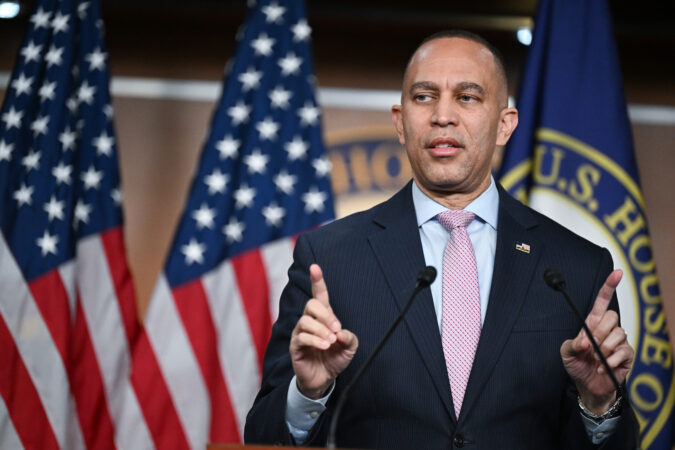
    During a Democratic caucus meeting Wednesday morning, House Minority Leader Hakeem Jeffries (D., N.Y.) and his lieutenants announced they would vote against the bill because, they said, ICE is running rampant across the country and the proposal does not include any significant steps to rein in agents.

    “These reforms aren’t enough. [ICE’s] lawlessness has to stop. And they’re only doing this because they can. They’re only doing this because the president of the United States wants to use them to terrorize communities,” Democratic Caucus Chair Pete Aguilar (Calif.) told reporters Wednesday.

    Democrats will introduce several amendments to the bill during a GOP-led House Rules Committee meeting Wednesday, their final hope to change the measure enough to back it. The amendments would block ICE agents from detaining and deporting U.S. citizens and bar agents from covering their faces during enforcement operations. It isn’t clear whether Republicans will vote against those proposals in the committee.

    “This is a time when so many people across the country, in every district, are saying, ‘What the hell is going on here?’” said Rep. Pramila Jayapal (D., Wash.), who introduced an amendment in the Rules Committee to bar ICE from using federal money to detain and deport U.S. citizens. “We’re just at this place where it is so serious. Where the First Amendment rights, Fourth Amendment rights, and Fifth Amendment rights are being so clearly violated every day — and that’s for U.S. citizens. Imagine what’s happening to people who are not U.S. citizens.”

    Republicans are aware they cannot rely on Democratic support to pass the legislation, and leaders have implored that all GOP lawmakers be present for Thursday’s vote to ensure its passage. If every member of the House is present and voting, Republicans can only afford to lose two votes to send the last of 12 appropriation bills to the Senate if all Democrats oppose it.

    The House is expected to hold separate votes on the DHS funding bill and a three-bill package of the other remaining appropriations bills on Thursday. Government funding expires on Jan. 30, and without an appropriations bill or a funding extension known as a continuing resolution, any agency that hasn’t had a spending bill enacted into law would shut down.

    Besides the outrage from Good’s death, Democrats are also feeling pressure from their electoral base to fight back against the Trump administration more broadly on immigration. Some lawmakers have begun to resurrect a demand leaders in the party have tried to tamp down for years: “Abolish ICE.” The slogan became a rallying cry during Trump’s first term, and many strategists say it ultimately cost the Democratic Party in subsequent elections as voters considered Republicans tougher on crime and border security.

    “Hey Democrats, if you have a problem with ICE — which many of them do, irrationally — you should not take down the appropriations bill because there are all these other areas of Homeland Security that are essential,” said Speaker Mike Johnson (R., La.), who noted that not funding DHS would impact preparations for America’s 250th celebration and the World Cup. “This is not a game.”

    Notably, House Democratic leaders are not whipping lawmakers to vote against the legislation, though most are expected to join them in opposing it. Several moderate Democrats who represent swing districts are weighing whether to support to bill rather than be targeted for voting against the border security agency.

    Others, including Rep. Henry Cuellar (D., Texas), who crafted the bill, argue that Republicans already locked in the bulk of DHS funding for ICE through their massive tax and immigration law, known as the “One Big Beautiful Bill.” That measure sent $75 billion for immigration enforcement to ICE, money which would continue uninterrupted even if the annual spending bill doesn’t pass.

    The top Democrats on the House and Senate appropriations committees, Rep. Rosa DeLauro (Conn.) and Sen. Patty Murray (Wash.) have also argued that denying funding for the agency would impact other key government services, such as TSA and FEMA, and that a short-term funding law would give the Trump administration wider latitude to make spending decisions at DHS.

    Aguilar said that the caucus is aware of those risks, but they will be voting against the package without “substantive” changes.

    “It’s unfortunate that the behavior of ICE is jeopardizing the Homeland Security bill,” he said.

  • ICE targeted off-duty police officers in Twin Cities, local police say

    ICE targeted off-duty police officers in Twin Cities, local police say

    Local law enforcement leaders in Minneapolis and St. Paul are raising concerns about Immigration and Customs Enforcement agents violating U.S. citizens’ civil rights, including those of off-duty police officers, as ICE has surged into Minnesota in recent weeks.

    Mark Bruley, police chief of the Minneapolis suburb Brooklyn Park, said at a Tuesday news conference that an off-duty police officer had been “boxed … in” by vehicles driven by ICE agents, who demanded with guns drawn to see paperwork proving the officer had a right to be in the United States. “She’s a U.S. citizen, and clearly would not have any paperwork,” he said.

    The officer attempted to begin filming the interaction and her phone was knocked out of her hand, Bruley said. When she identified herself as a police officer, the federal agents “immediately left,” he said.

    All of the off-duty police officers who had been targeted by ICE in his city were people of color, Bruley said.

    Asked about the police chief’s comments, the Department of Homeland Security said Wednesday morning that it had no record of ICE or Border Patrol stopping and questioning a police officer and could not verify the information without a name. The agency added that it would continue to look into the claims.

    DHS officials have repeatedly said agents are not racially profiling residents but only asking people in the vicinity of enforcement operations for identification.

    “I wish I could tell you that this was an isolated incident,” Bruley said, adding, “if it is happening to our officers, it pains me to think how many of our community members are falling victim to this every day.”

    At a news conference in Minneapolis on Tuesday, Border Patrol official Greg Bovino, called the immigration operation “a very professional, prudent and thoughtful law enforcement action.” Bovino is overseeing the federal enforcement effort.

    Asked about Bruley’s remarks, Bovino blamed local Democratic leaders, including Minneapolis Mayor Jacob Frey and Minnesota Gov. Tim Walz, for obstructing federal officers by urging the public to report them through emergency calls.

    “You have a mayor and a police chief [Brian] O’Hara say, ‘Call 911 when ICE or Border Patrol are in the neighborhood,’ and then you wonder why the 911 system is overwhelmed with superfluous calls for assistance when that is not true,” Bovino said. “We’re going to continue to be out in the community, and we’re going to continue to conduct that mission.”

    Dawanna Witt, sheriff of Hennepin County, which includes Minneapolis, said that people were being “stopped, questioned and harassed solely because of the color of their skin” and that the behavior of federal agents was eroding trust in law enforcement.

    “We demand lawful policing that respects human dignity,” she said, adding that the surge of ICE agents in Minneapolis was impacting local officers as well as the community. “We will all continue to show up, even though times are hard, even though our law enforcement is exhausted.”

    St. Paul Police Chief Axel Henry said that city employees had been subject to “traffic stops that were clearly outside the bounds of what federal agents are allowed to do.”

    “We watch the news and we see very, very angry groups of people out protesting, but the people that we’re dealing with as police chiefs are the people that are scared to death, that are afraid to go outside,” he said. Not because their status is in question, but because people “are getting stopped by the way that they look, and they don’t want to take that risk.”

    Bruley said the news conference was held to draw attention to the conduct of a “small group” of agents who had been deployed over the past two weeks.

    “What you won’t hear from any of us today is rhetoric of ‘abolish ICE’ or that there shouldn’t be immigration enforcement,” Bruley said. “The truth is, immigration enforcement is necessary for national security and for local security, but how it’s done is extremely important.”

    Thousands of ICE agents and officers have been deployed to Minnesota as part of Operation Metro Surge, which began in December as what DHS earlier this month said would be the agency’s largest immigration enforcement operation ever.

    Minnesota officials filed suit last week challenging the operation’s legality, alleging that “armed and masked DHS agents have stormed the Twin Cities to conduct militarized raids” at sites including schools and hospitals. Earlier this month, Renée Good, a 37-year-old mother of three, was fatally shot in her car by an ICE agent in Minneapolis. A week later, an ICE officer shot an undocumented Venezuelan man in the leg during an arrest.

  • Former NFL sidelines reporter Michele Tafoya runs for Senate in Minnesota

    Former NFL sidelines reporter Michele Tafoya runs for Senate in Minnesota

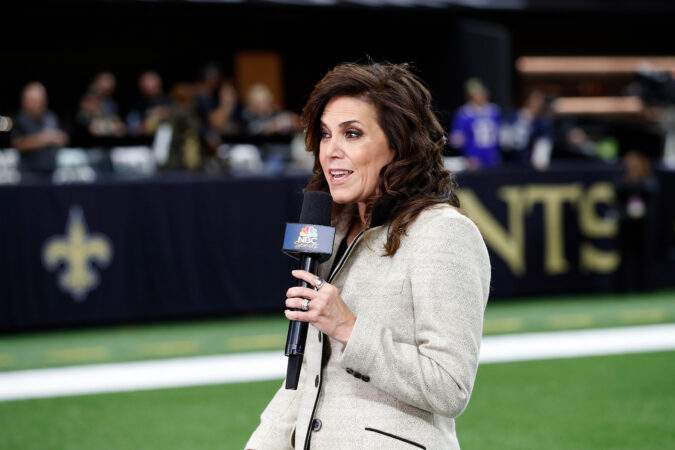
    Former Sunday Night Football sidelines reporter Michele Tafoya announced a Republican bid for Senate on Wednesday to replace retiring Sen. Tina Smith (D., Minn.) with the backing of the Senate Republicans’ campaign arm.

    “For too long, hardworking people have been ripped off by criminals, corporations and career politicians,” Tafoya said in a video announcing her candidacy. “And the people doing everything right are the ones paying the biggest price. Well I’m not going to stay on the sidelines any longer.”

    Tafoya cited her work as a television reporter in her campaign announcement, saying the job “taught me about how leadership really works. When leaders are prepared and accountable, teams succeed. When they aren’t, people pay the price.”

    Besides her time with NBC’s Sunday Night Football, Tafoya also had stints with CBS and ESPN. Since leaving network television, she has been a conservative commentator with her own podcast and appearances on other right-wing media.

    Tafoya enters a crowded primary but is backed by the National Republican Senatorial Committee and its chairman, Sen. Tim Scott (R., S.C.).

    “From allowing billions of dollars in fraud to vilifying law enforcement, the Walz-Flanagan administration has failed Minnesotans,” Scott posted on social media, referencing the state’s current governor and lieutenant governor. “But change is coming, and Michele Tafoya will lead the way.”

    Royce White, a former professional basketball player who challenged Sen. Amy Klobuchar (D., Minn.) in 2024, is also running as a Republican, as are former Minnesota Republican Party Chair David Hann, former Navy SEAL Adam Schwarze, former House candidate Tom Weiler and others.

    Tafoya’s announcement made passing reference to the unrest that has gripped the Twin Cities over federal immigration enforcement, noting the “pressure is mounting again” while showing a clip of protesters clashing with law enforcement. She said she would stand with police to combat crime and deport undocumented immigrants, but did not reference the growing tensions between local law enforcement and federal immigration agents.

    Tafoya did not name Renée Good, the 37-year-old woman who was shot and killed by an ICE officer earlier this month. Good’s killing sparked further demonstrations and calls from elected officials for federal immigration efforts to end in the city. The Trump administration defended the ICE officer as acting in self defense. Roughly 3,000 people have been arrested as part of the immigration enforcement operation — the largest in the country.

    In the video, Tafoya also took jabs at the state’s Democratic leaders, including Gov. Tim Walz over the state’s multiyear welfare fraud that has become a national scandal. Scammers stole at least hundreds of millions of dollars in government funding for social safety net programs under Walz’s governorship, according to prosecutors. The scandal has damaged Walz’s image in the state, just over a year after he was vaulted into the national spotlight as then-Vice President Kamala Harris’s running mate. Republicans assert their downballot candidates will also be able to capitalize on the fraud scandal.

    Tafoya also cited keeping trans athletes out of women’s sports and lowering costs for middle-class families as her policy priorities. Her affordability message focused on reducing taxes and bolstering manufacturing.

    In what is expected to be a contentious Democratic Senate primary, Rep. Angie Craig is facing off against Lt. Gov. Peggy Flanagan.

    Klobuchar, who holds Minnesota’s other Senate seat, is considering running for governor in the wake of Walz’s retirement announcement this month. That would leave both of the state’s Senate seats up for grabs.

    Minnesota’s Democratic Farmer Labor Party has historically had a solid hold on the state. Minnesota has not elected a Republican to the Senate since 2002 or a Republican to the White House since 1976.

    But in 2024 President Donald Trump outperformed every GOP presidential candidate since George W. Bush in 2004 and came within five percentage points of Harris, the Democratic nominee.

    Republicans also have a narrow majority in the state House and are one seat away from a majority in the state Senate. Half of the state’s delegation to the U.S. House is Republican, including House Majority Whip Tom Emmer.

  • They ransacked the U.S. Capitol and want the government to pay them back

    They ransacked the U.S. Capitol and want the government to pay them back

    Yvonne St Cyr strained her body against police barricades, crawled through a broken Senate window, and yelled “push, push, push” to fellow rioters in a tunnellike hallway where police officers suffered concussions and broken bones.

    She insisted she did nothing wrong. A federal judge sentenced her to 30 months in prison and imposed $2,270 in financial penalties for her actions at the U.S. Capitol on Jan. 6, 2021, declaring: “You have little or no respect for the law, little or no respect for our democratic systems.”

    St Cyr served only half her sentence before President Donald Trump’s January 2025 pardon set her and almost 1,600 others free.

    But her story doesn’t end there. St Cyr headed back to court, seeking a refund of the $2,270. “It’s my money,” the Marine Corps veteran from Idaho said in an interview with the Washington Post. “They took my money.” In August, the same judge who sentenced her reluctantly agreed, pointing to a legal quirk in her case.

    “Sometimes a judge is called upon to do what the law requires, even if it may seem at odds with what justice or one’s initial instincts might warrant. This is one such occasion,” U.S. District Judge John D. Bates wrote in an opinion authorizing the first refund to a Jan. 6 defendant.

    The ruling revealed an overlooked consequence of Trump’s pardon for some Jan. 6 offenders: Not only did it free them from prison but it emboldened them to demand payback from the government.

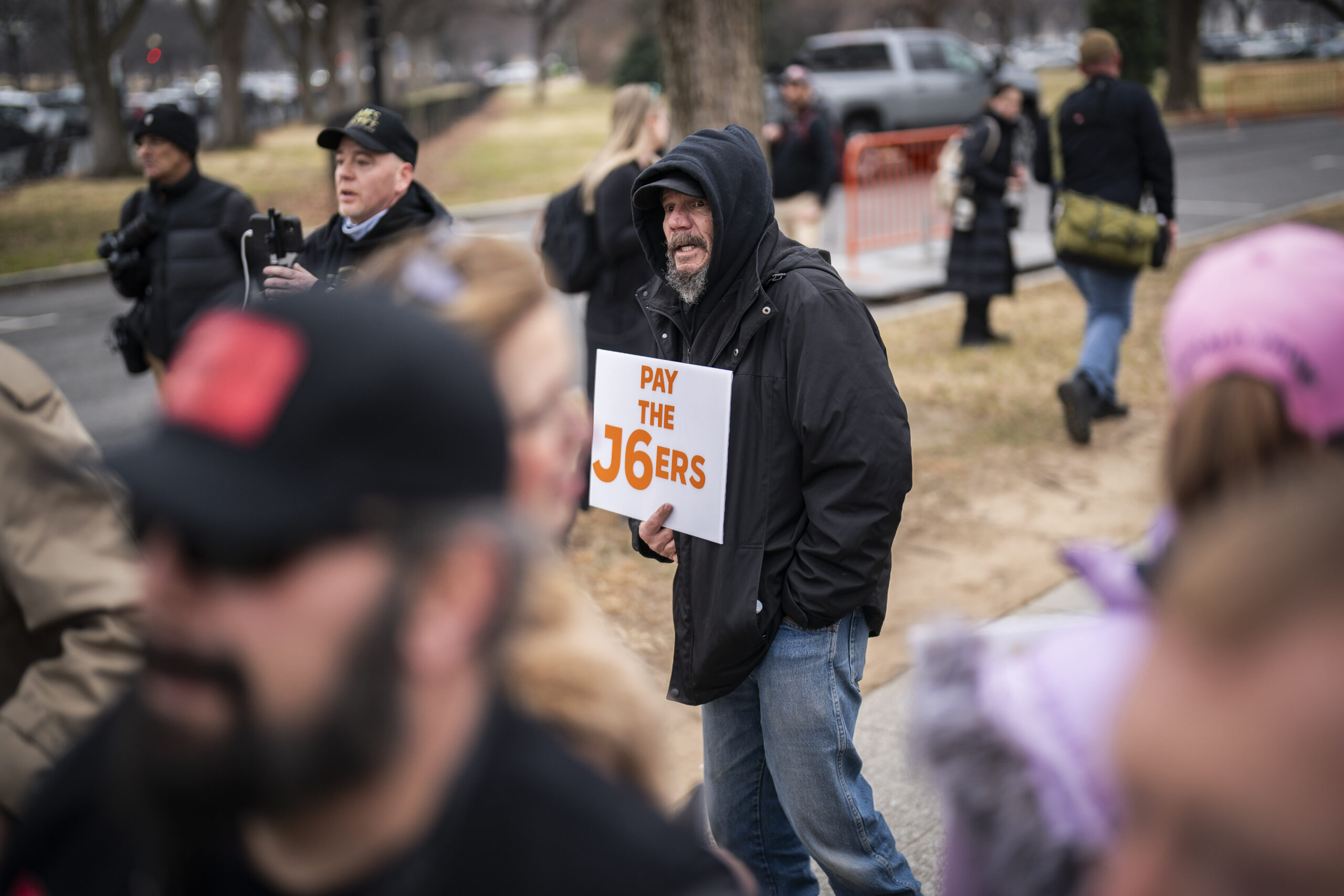
    At least eight Jan. 6 defendants are pursuing refunds of the financial penalties paid as part of their sentences, according to a Post review of court records; judges agreed that St Cyr and a Maryland couple should be reimbursed, while five more are appealing denials. (St Cyr and the couple are still waiting to receive their payments, however.) Others are filing lawsuits against the government seeking millions of dollars, alleging politically tainted prosecutions and violations of their constitutional rights. Hundreds more have filed claims accusing the Justice Department, the FBI and other law enforcement agencies of inflicting property damage and personal injuries, according to their lawyer.

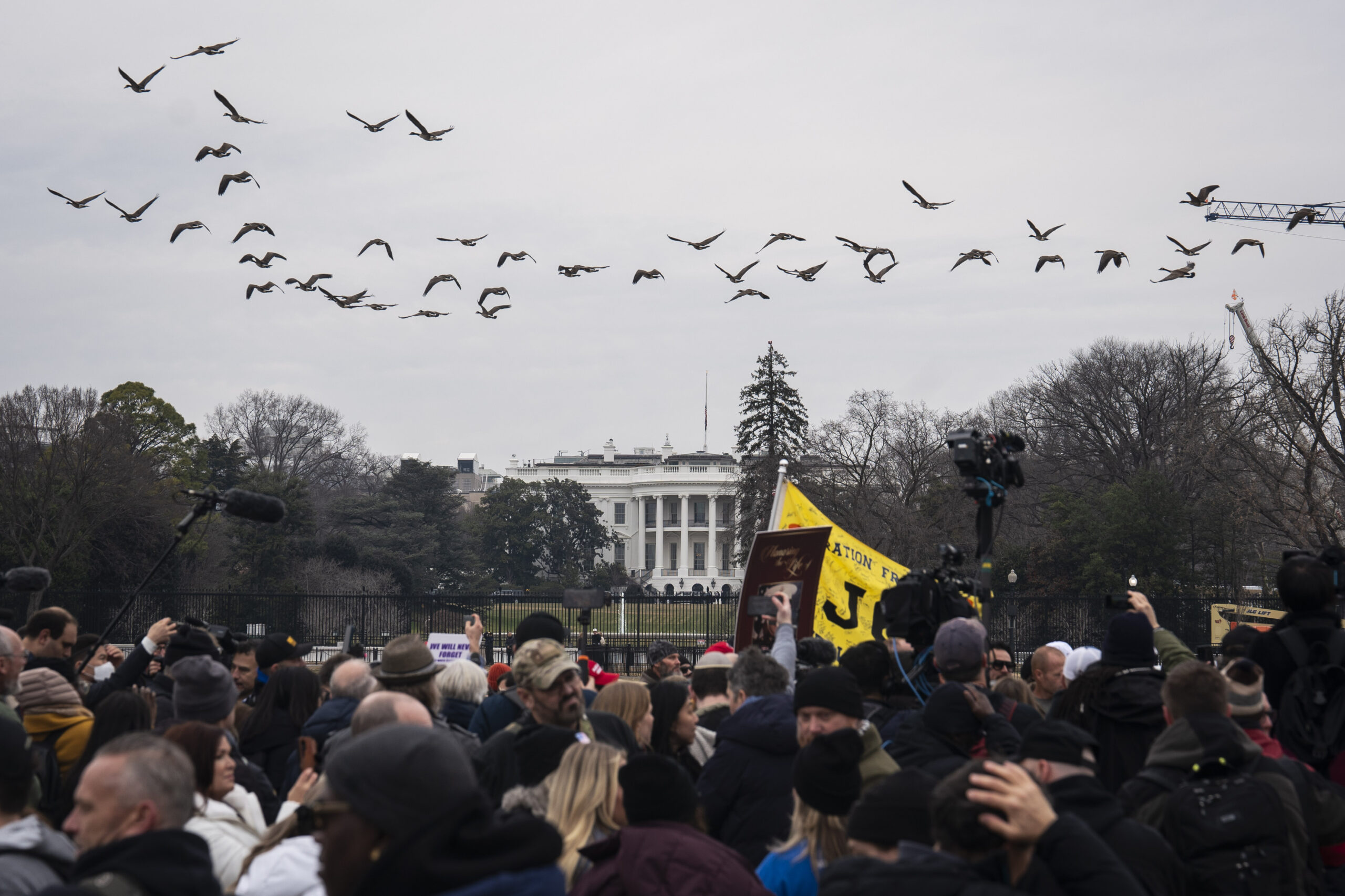
    People walk from the Ellipse to the Capitol Building in Washington, D.C., last Jan. 6, the fifth anniversary of the Capitol attack.

    The efforts are the latest chapter in an extraordinary rewriting of history by the president and his allies to bury the facts of what happened at the Capitol, sustain the false claim that the 2020 election was rigged, and recast the Jan. 6 offenders as victims entitled to taxpayer-funded compensation.

    “Donald Trump and the DOJ want taxpayers to reimburse a violent mob for the destruction of the U.S. Capitol. The Jan. 6 nightmare continues,” said Rep. Joe Morelle (D., N.Y.), the top Democrat on the House Administration Committee, which oversees the Capitol’s security and operations.

    The pro-Trump mob that ransacked the Capitol caused almost $3 million in damage, according to a 2022 estimate by the Justice Department. The losses included smashed doors and windows, defaced artwork, damaged furniture, and residue from gas agents and fire extinguishers. Defendants were sentenced to more than $1.2 million in restitution and fines, according to a tally by the Post.

    But the government recovered less than $665,000 of those court-ordered payments, according to a source with firsthand knowledge who spoke on the condition of anonymity because of fear of retaliation. Sen. Alex Padilla (D., Calif.) and Sen. Sheldon Whitehouse (D., R.I.) are pushing legislation — backed by some law enforcement officers who defended the Capitol on Jan. 6 — to block government payouts to rioters. Without any Republican cosponsors, the legislation is not expected to proceed.

    “The audacity of them to think they didn’t do anything, or to think that they’re right and then get their money back,” said former Capitol police officer Harry Dunn, who attended the sentencing of St Cyr and other Jan. 6 offenders. “It’s frustrating and it should not happen. They should have to pay more.”

    ‘It’s a principle thing’

    Stacy Hager, a 62-year-old former warehouse supervisor, made his first trip to Washington, D.C., for the Jan. 6 rally. The lifelong Texan wasn’t that interested in politics before, but he was certain that Donald Trump was the rightful winner of the 2020 election.

    Wearing a Trump hat and waving the Texas flag, Hager took photos and videos of himself roaming through the Capitol. He was convicted on four misdemeanor charges related to disorderly conduct and trespassing; he paid $570 in penalties and served seven months in prison, a punishment he describes as totally unjust and “a living hell.”

    Hager still believes, fervently, that fraud marred the 2020 vote and that Trump won, though no new evidence has surfaced to contradict the findings of Justice Department officials, cybersecurity experts, and dozens of judges appointed by Democrats and Republicans alike.

    Hager spent seven months in prison for his role in the Jan. 6, 2021, attack. Now that he has been pardoned, he is seeking a refund of the $570 in court-ordered penalties he paid.

    “You tell me why I shouldn’t be entitled to getting my money back,” Hager said. “The government took money from me for doing the right thing, for standing up for the people’s vote. That’s the reason we were there — for a free and fair election.”

    About one month after Trump’s pardon in January 2025, Hager was the first of the Jan. 6 defendants to ask for his money back, court records show. “It’s a principle thing,” Hager said. Among the other defendants seeking refunds: A Utah man who forfeited almost $63,000 he made from selling videos recording some of the worst violence at the Capitol. A Georgia teenager who paid $2,200 in fines after he shoved a police officer and sat in Vice President Mike Pence’s chair in the Senate chamber.

    While the charges and punishments vary, the defendants seeking refunds share one legal quirk: All of them were appealing their convictions when Trump pardoned them on Jan. 20, 2025. After the pardon, courts vacated their convictions and dismissed their indictments following requests from federal prosecutors, as the Justice Department that once prosecuted the Jan. 6 defendants now takes their side.

    It’s routine for a criminal defendant who has paid financial penalties to get the money back if the conviction is vacated and the case is dismissed. But the attack halting the peaceful transfer of power for the first time in American history pushed the criminal justice system into uncharted territory.

    And now, the legal debate over whether certain Jan. 6 defendants should receive refunds is forcing courts to weigh two obscure Supreme Court decisions — 140 years apart — involving a pardoned Confederate sympathizer and a woman convicted but later acquitted of sexually assaulting her children.

    Judges who have denied refunds have all referenced a case brought by John Knote, whose West Virginia property was confiscated and sold for $11,000 under a law empowering the Union to seize Confederate property. Citing President Andrew Johnson’s pardon of former Confederates on Christmas Day 1868, Knote asked the court to reimburse him $11,000. The Supreme Court ruled in 1877 that money deposited in the U.S. treasury could not be returned without an act of Congress.

    People walk from the Ellipse to the Capitol Building in Washington, D.C., last Jan. 6, the fifth anniversary of the Capitol attack. The pro-Trump mob that ransacked the Capitol caused almost $3 million in damage, according to a 2022 estimate by the Justice Department.

    Jan. 6 defendants, however, are looking to a much more recent Supreme Court opinion — written by liberal icon Ruth Bader Ginsburg — to bolster their argument that the government owes them money. In that 2017 case, Colorado resident Shannon Nelson paid about $700 in penalties before her sexual assault conviction was overturned on appeal. At a later trial, she was acquitted of the alleged crimes against her children. The high court said Nelson was now “presumed innocent” and entitled to a refund.

    In approving St Cyr’s request for reimbursement, Bates referred to the Nelson case 39 times. The other D.C. District Court judge who has ruled in favor of refunds for Jan. 6 defendants, Chief Judge James E. Boasberg, also cited the Nelson case in December. “When a conviction is vacated, the Government must return any payments exacted because of it,” he wrote.

    Hager returned to Washington this month to gather with other Trump supporters to mark the fifth anniversary. He and other Jan. 6 defendants stay in close touch online.

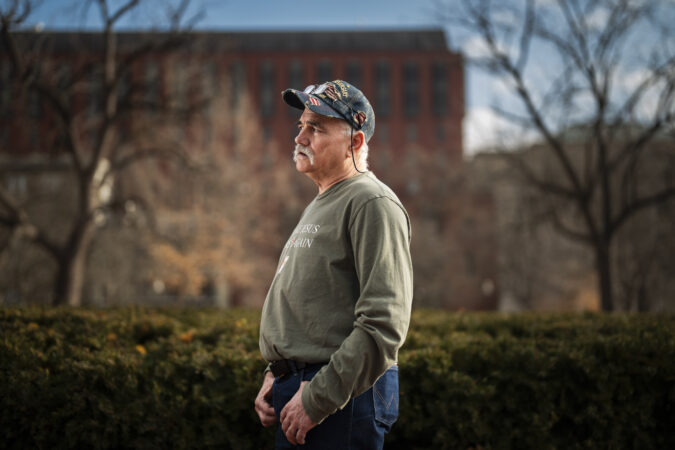
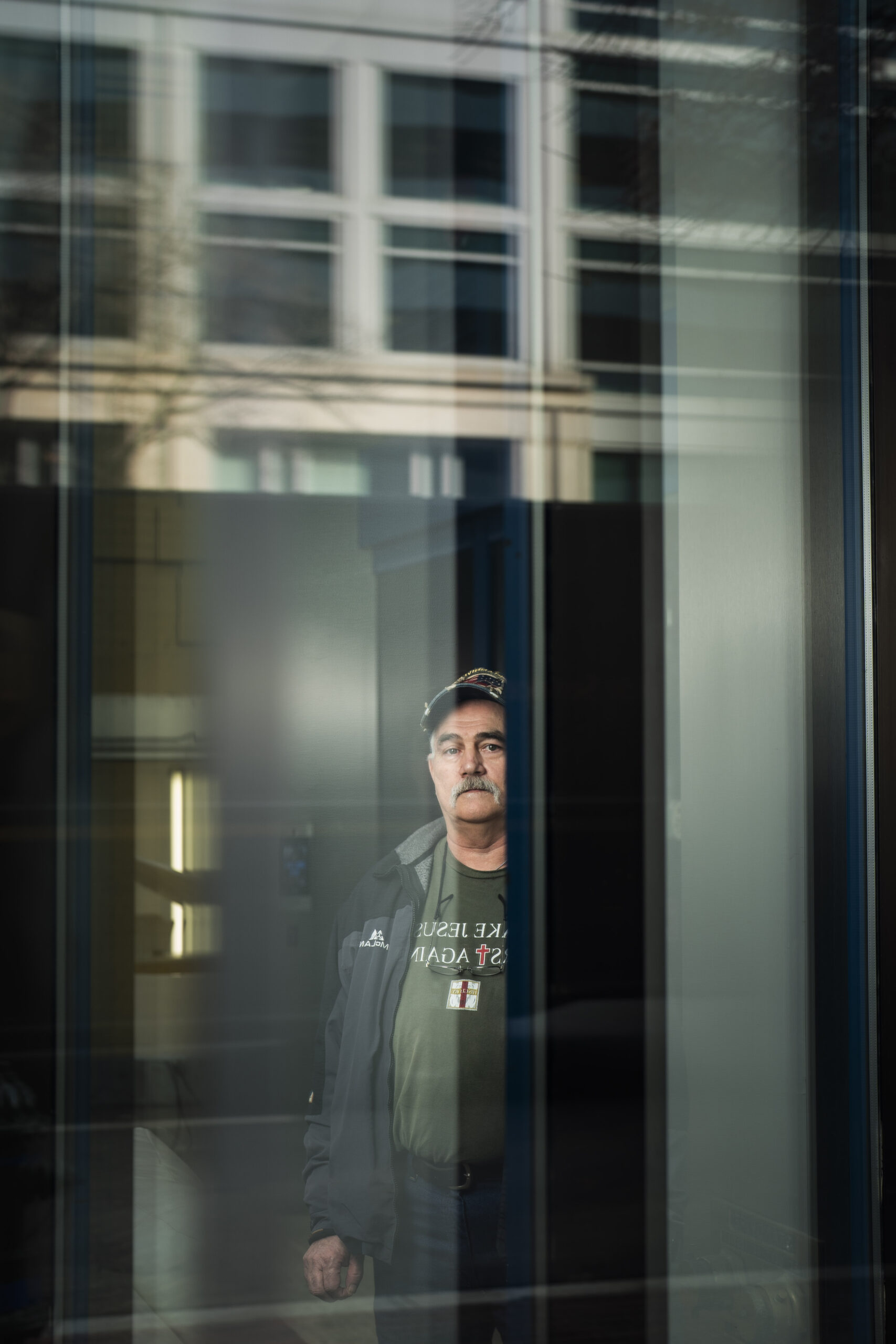
    “We’re like a family,” Hager said, wearing a weathered baseball cap celebrating America’s 250th birthday and a T-shirt proclaiming his love for Jesus Christ. “We have a great bond, the kind that political persecution forms.”

    Had gun, would travel

    Andrew Taake’s journey through the criminal justice system illustrates one of the most dramatic twists in a Jan. 6 case. He attacked police officers with bear spray and a “whiplike weapon,” according to a plea agreement he signed in 2023. Now he is suing the federal government for $2.5 million, claiming his civil rights were violated by a wrongful prosecution and mistreatment in prison.

    Taake was on pretrial release on a pending charge of online solicitation of a minor when he traveled from Houston to Washington, D.C., in January 2021. He attended the “Stop the Steal” rally headlined by Trump and was among the first to breach the restricted area around the Capitol. One of the police officers who said Taake assaulted him with bear spray, Nathan Tate, filed a statement in court that said the experience left “a lifelong scar.”

    “He came to the Capitol with multiple weapons,” Tate wrote. “He was not there for peaceful protest. He was there to be violent. He should not be allowed to claim victimhood today.”

    Taake pleaded guilty to one count of assaulting, resisting or impeding law enforcement officers using a dangerous weapon. He was sentenced in 2024 to 74 months in prison.

    His prison time was cut short by Trump’s pardon. Two weeks later, he was taken into custody by Houston-area law enforcement on the 2016 child solicitation charge. He pleaded guilty to a second-degree felony, was sentenced to three years in prison and was ordered to register as a sex offender.

    But because Taake had already served more than three years in the Jan. 6 case, he got credit for time served and did not return to prison, records show. In September, he filed a lawsuit against the federal government that tells a very different story than the plea deal.

    In the suit filed in D.C. District Court, Taake claims he used the bear spray to protect a fellow protester and that another officer disfigured his hand by stomping on it. He accuses prosecutors of using false evidence and manipulating him into the plea deal. In prison, he said he was mistreated by medical staff and assaulted by other inmates. “He should be compensated for his pain and suffering because it doesn’t get much worse than that,” said Taake’s lawyer, Peter Ticktin, a longtime Trump ally.

    Tate, who now who works as a social studies teacher in La Plata, Md., was shocked to hear about Taake’s lawsuit. “He can say my allegations are false but it’s documented, you can literally see what took place,” he said. “It was real for me.”

    In the most far-reaching effort on behalf of Jan. 6 offenders, Missouri lawyer Mark McCloskey is trying to build support for a government-backed compensation panel, similar to the fund that has distributed billions of dollars to families of victims in the Sept. 11, 2001, attacks. McCloskey attracted national attention in 2020 when he and his wife pointed guns at Black Lives Matter protesters marching past their home; they pleaded guilty to firearms charges but were pardoned by the Missouri governor.

    McCloskey said he has advocated for the Jan. 6 fund in four meetings with Justice Department officials, including Ed Martin, the director of a unit tasked with investigating Trump’s political opponents.

    Martin, who helped plan and finance Trump’s rally that preceded the rampage through the Capitol, has said publicly that he supports “reparations” for Jan. 6 defendants.

    Trump also has expressed support for government payouts. Asked about compensating Jan. 6 offenders in a March 2025 Newsmax interview, Trump said, “Well, there’s talk about that. … A lot of the people in government really like that group of people. They were patriots as far as I was concerned.”

    But McCloskey is still waiting for the Justice Department to act. “We have had all positive responses but until President Trump pulls the trigger, it isn’t going to happen,” McCloskey said. “The president needs to take a position on it.”

    In December, McCloskey sought to build momentum by posting a photo of himself on social media that he said showed him delivering claims to federal law enforcement agencies from about 400 Jan. 6 clients. The property damage and personal injury claims — a prerequisite to filing lawsuits against the government under the Federal Tort Claims Act — describe homes ransacked during arrests, lost jobs, and broken families, McCloskey said.

    The White House and the Justice Department declined to comment on McCloskey’s efforts.

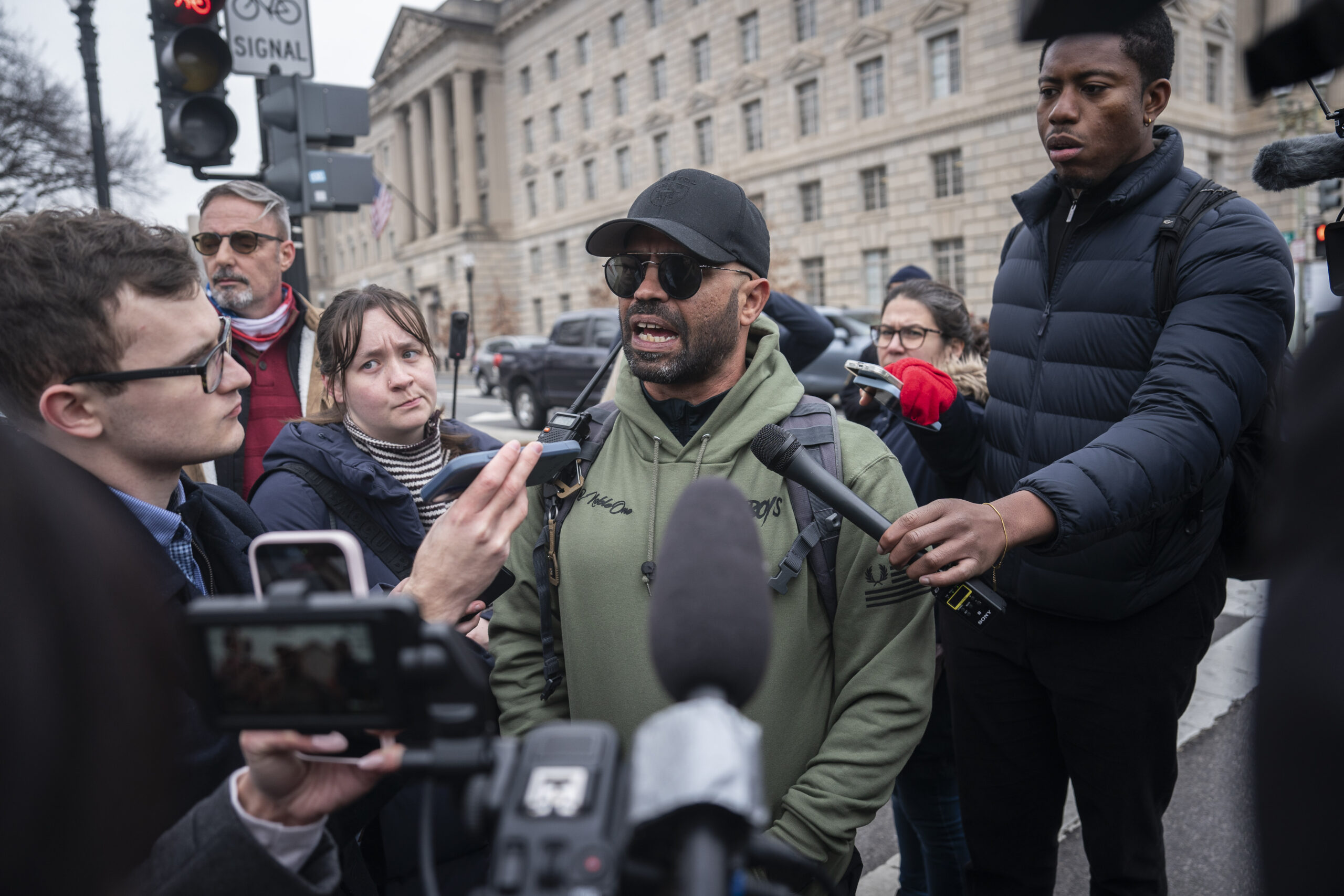
    Another Jan. 6-related lawsuit against the federal government comes from several leaders of the Proud Boys who were found guilty of engaging in a seditious conspiracy to keep Trump in power despite his electoral defeat. The suit seeking $100 million, filed in federal court in Florida last year, echoes Trump’s claims that the investigation into the Jan. 6 attack was illegitimate and politically motivated.

    Former Proud Boys leader Henry “Enrique” Tarrio speaks at the Jan. 6 anniversary rally this month.

    The lead plaintiff, Henry “Enrique” Tarrio, called for charges against Jan. 6 prosecutors when he addressed the gathering in Washington, D.C., to mark the fifth anniversary this month. “The thing I am searching for,” Tarrio said, “is retribution, retaliation.”

    Since Trump returned to office one year ago, many Jan. 6 prosecutors have been fired or resigned. Hager’s prosecutor, Adam Dreher, was demoted to Superior Court last year, he said, in retaliation for his work on Jan. 6 cases. He left the department a few months ago to return to his home state of Michigan and practice law. The Justice Department declined to comment on Dreher’s record.

    Dreher was an administrative law judge in Detroit on Jan. 6, 2021. The riot at the Capitol inspired him to come to Washington as a federal prosecutor, he said, just as years earlier, the Sept. 11, 2001, terrorist attack moved him to join the military.

    “It made me want to be part of trying to help things get back to normal, to hold people accountable and make sure the rule of law was something we could rely on,” he said. “That all we did is being unraveled has been very difficult to watch.”

  • Lindsey Halligan out as U.S. attorney following pressure from judges

    Lindsey Halligan out as U.S. attorney following pressure from judges

    Lindsey Halligan, a Trump administration lawyer who was named head of a key U.S. attorney’s office in Virginia last year with instructions to seek criminal charges against President Donald Trump’s perceived political adversaries, left her post at the Justice Department on Tuesday.

    Halligan’s departure followed a pair of extraordinary moves by two federal judges who issued court orders hours earlier saying they intended to replace Halligan at the helm of the U.S. attorney’s office for the Eastern District of Virginia and threatening disciplinary sanctions for any government lawyer who continued to refer to her as U.S. attorney in legal filings.

    The separate actions by Chief Judge M. Hannah Lauck and Judge David J. Novak, who were nominated by President Barack Obama and Trump, respectively, signaled a breaking point for the federal bench in the Eastern District of Virginia months after Halligan was disqualified from serving as U.S. attorney in the high-profile office.

    The orders intensified a battle playing out nationwide between the executive and judicial branches over how the nation’s 93 U.S. attorneys can be appointed for temporary terms without Senate confirmation. And they had posed obstacles for Halligan — who had no prosecutorial experience before she was installed in the job — as she attempted to carry out Trump’s directions to levy criminal charges against two of his perceived political foes: former FBI director James B. Comey and New York Attorney General Letitia James.

    Halligan, in a statement, accused the district’s federal judges of a campaign to pressure her to leave after the court ruling declaring her appointment was invalid. She said that effort had diverted “time and resources from public safety responsibilities.”

    It was unclear Tuesday night who would be in charge of the U.S. attorney’s office. The Justice Department this month dismissed the first assistant U.S. attorney, Robert K. McBride, who would have automatically assumed the top job under federal law. A Justice Department spokesperson did not immediately respond to requests for comment.

    Halligan is the third Trump-appointed U.S. attorney pick to leave their post in the face of a growing body of court rulings that have deemed their appointments illegal.

    Alina Habba, a former Trump lawyer he picked to lead the U.S. attorney’s office in New Jersey, resigned last month after a monthslong legal battle over whether she was lawfully serving in that role.

    While the Justice Department continues to appeal the decision, Habba stepped down and moved to another role in the Justice Department.

    Julianne Murray, another contested pick, resigned her post as U.S. attorney in Delaware days afterward. Before her appointment, she had served as the state’s Republican Party chairwoman.

    Attorney General Pam Bondi praised Halligan for her service in a statement Tuesday.

    “While we will feel her absence keenly, we are confident that she will continue to serve her country in other ways,” Bondi said. “The circumstances that led to this outcome are deeply misguided. We are living in a time when a democratically elected President’s ability to staff key law enforcement positions faces serious obstacles.”

    Several judges had suggested for weeks that Halligan should resign and sharply questioned her continued use of the U.S. attorney title after an out-of-district judge, Cameron McGowan Currie, ruled in late November that the Trump administration had used an unlawful maneuver to install Halligan.

    On Tuesday, Lauck directed the court’s clerk to publish the U.S. attorney job posting in local newspapers, asking anyone interested to apply by Feb. 10. “The position of United States Attorney for the Eastern District of Virginia is vacant,” reads a public notice posted on the court’s website Tuesday.

    Lauck’s order marked an escalation, signaling active efforts by the judges to appoint the district’s top federal prosecutor under a federal law that gives them the power to do so after an interim U.S. attorney has been in office for 120 days. It was followed hours later with another order from Novak, who raised the threat of disciplinary action for anyone who described Halligan as the U.S. attorney in legal filings.

    “No matter all of her machinations, Ms. Halligan has no legal basis to represent to this Court that she holds the position. And any such representation going forward can only be described as a false statement made in direct defiance of valid court orders,” Novak wrote. “In short, this charade of Ms. Halligan masquerading as the United States Attorney for this District in direct defiance of binding court orders must come to an end.”

    The Trump administration has appealed Currie’s ruling, but it never requested a stay, so the ruling disqualifying Halligan remained in effect. Nonetheless, she continued to represent herself as the U.S. attorney in court filings.

    This month, Novak ordered Halligan to explain why she continued to use the title, suggesting she may be making false or misleading statements. The Justice Department responded defiantly to that order last week, arguing that Currie’s ruling was not binding and that Novak had no authority to strike Halligan’s name from the signature block of Justice Department court filings.

    The response, which accused Novak of making “rudimentary” legal errors and missing “elementary” legal principles, was written in a derisive tone unusual for a government lawyer addressing a federal judge.

    Novak said in response that Halligan’s rhetoric was beneath the court’s dignity and more suitable for cable news. He said Halligan’s continued use of the U.S. attorney title after Currie’s ruling was an affront to the legal system.

    “The Court cannot tolerate such obstinance, because doing so would undermine the very essence of the Rule of Law,” he wrote in Tuesday’s order. “If the Court were to allow Ms. Halligan and the Department of Justice to pick and choose which orders that they will follow, the same would have to be true for other litigants and our system of justice would crumble.”

    Halligan’s nomination for a full term as U.S. attorney is pending in the Senate, and it was unclear Tuesday whether the White House also intended to withdraw it. Even if they don’t, the nomination is unlikely to move forward because it lacks support from Virginia’s two senators — Mark R. Warner and Tim Kaine, both Democrats — who have emphasized that the Eastern District of Virginia handles a complex portfolio of cases dealing with national security, leaks of classified information, and international terrorism.

    In disqualifying Halligan last fall, Currie ruled that Halligan was never legally appointed to the position of interim U.S. attorney because the Trump administration had already named someone to that role — Halligan’s predecessor, Erik S. Siebert, who served a full 120-day term, from January to May 2025. The district judges then unanimously extended Siebert in the role at the Justice Department’s request, Novak wrote in his order.

    But Siebert was forced out in September after declining to seek charges against Comey and James. Career prosecutors had recommended against pursuing the two cases because of insufficient evidence of wrongdoing. Trump then named Halligan, who promptly secured indictments against Comey, on allegations that he made false statements to Congress, and James, who was accused of mortgage fraud. Currie tossed both indictments after finding that Halligan was unlawfully appointed.

    Halligan’s 120-day appointment concluded Tuesday.

    Justice Department lawyers maintain that the statute allows for back-to-back interim appointments. But in addition to Currie, at least five other federal judges have rejected that argument while ruling on challenges to other Trump U.S. attorney appointees. In each case, the judges have said that if the attorney general could legally name a string of interim appointees, there would be no need for an administration to put a nominee up for a Senate vote.

    Judges across the country have been cautious in exercising their authority to name replacements for the president’s picks. When New Jersey’s federal judges named a veteran federal prosecutor to replace Habba last summer, the Justice Department fired their pick within hours and undertook a series of legal maneuvers aimed at keeping Habba in the role.

    Delaware’s chief federal judge began soliciting applications this fall to replace Murray in Delaware. But Murray resigned her post in December before a potential standoff with the administration could come to a head.

    Judges in other districts have refused to reappoint Trump’s interim U.S. attorney picks but declined to choose replacements. The chief federal judge in Seattle issued an order last week soliciting applications to potentially appoint a new acting U.S. attorney there, when the interim appointment of Trump’s current pick expires next month.

  • Pentagon moves to cut U.S. participation in some NATO advisory groups

    Pentagon moves to cut U.S. participation in some NATO advisory groups

    The Pentagon plans to cut its participation in a range of NATO advisory groups, the latest sign of the Trump administration’s drive to scale back the U.S. military presence in Europe, according to multiple officials familiar with the matter.

    The impending move affects about 200 military personnel and will mostly diminish U.S. involvement in the alliance’s 30 Centers of Excellence, which seek to train NATO forces on key elements of warfare such as naval combat, these people said. They spoke on the condition of anonymity to detail the U.S. administration’s plans.

    Rather than withdraw all at once, the Pentagon intends not to replace personnel as their postings end, a process that could take years, according to one U.S. official familiar with the matter. U.S. participation in the centers isn’t ending altogether, two officials noted.

    The move has been under consideration for months, according to two U.S. officials, one of whom said it is unrelated to President Donald Trump’s escalating threats to seize the Danish territory of Greenland. Trump’s provocations have drawn widespread condemnation from European leaders and many lawmakers in Congress, who fear the president risks causing irreparable and unnecessary damage to the NATO alliance.

    Spokespeople for the Pentagon and nor NATO did not immediately respond to requests for comment.

    Under Trump, the U.S. military has pulled back from Europe as the administration presses allies there to take greater control of the continent’s collective defense. Last year, for instance, the Pentagon abruptly announced it would withdraw a brigade of troops from Romania and cut security aid programs to the three Baltic nations that border Russia, whose yearslong invasion of Ukraine has spurred fears of a direct conflict between NATO and the Kremlin.

    Under pressure from the Trump administration, the alliance agreed last summer to surge defense spending to 5% of GDP over the next 10 years, including 1.5% dedicated to infrastructure and other civilian projects.

    Lawmakers — including some key Republicans — objected to the administration’s moves in Europe and are working to fund the impacted security assistance programs despite the Pentagon’s directives.

    Members of Congress also have passed legislation that requires the Pentagon to consult with them before making any major reductions to U.S. military posture in Europe. The law specifies that requirement would apply only if the overall U.S. force posture in Europe were to fall below 76,000. It stands at roughly 80,000 now.

    While the personnel eventually being withdrawn amount to a small share of troops the United States stations in Europe, some current and former officials said the U.S. pullout could have an outsize impact on the alliance by reducing valuable American military expertise.

    “We have a lot of operational experience that some of our personnel contribute to these centers,” said Lauren Speranza, a senior Pentagon official during the Biden administration. “There would be a bit of a brain drain that would come with pulling U.S. personnel out.”

  • Pediatricians are disregarding the new vaccination schedule

    Pediatricians are disregarding the new vaccination schedule

    Utah pediatrician Ellie Brownstein is used to encountering parents hesitant to get their child vaccinated.

    But after the Trump administration in early January pared back the list of vaccines routinely recommended for babies and children, she’s seeing something else: Parents worried they won’t be able to vaccinate their kids.

    At Brownstein’s Salt Lake City office, one mother pressed for the measles, mumps, and rubella shot for her 2-week-old infant. Brownstein declined because the first dose is intended for children between 12 and 15 months old.

    “The provaccine crowd has become outspoken,” Brownstein said. “They want all the vaccines since this announcement.”

    Pediatricians and national leaders with the American Academy of Pediatrics interviewed by The Washington Post say they are fielding more questions from families, illustrating the confusion and anxiety sown by the overhaul of the childhood immunization schedule despite the administration’s assurances that anyone who wants a vaccine can still get them free.

    The doctors are essentially ignoring the agency’s approach and relying on recommendations made by the AAP, which mirror the Centers for Disease Control and Prevention’s guidance from early 2025. They are spending more time explaining the importance of immunizations — a task that has become more common with the ascent of Health Secretary Robert F. Kennedy Jr., a longtime anti-vaccine activist who has upended the nation’s immunization policies.

    Las Vegas pediatrician Terence McAllister said the extra time explaining vaccination “means you have to skip explaining something else,” such as proper sleep practices or nutrition.

    Days after the administration announced it was recommending fewer vaccines, McAllister struggled to answer a question from a patient who asked why there are different childhood vaccine schedules.

    “There’s not a good scientific explanation for why,” McAllister said. “Our data about these vaccines has not changed. We still know that they are effective.”

    President Donald Trump in December instructed health officials to reassess the vaccine schedule, saying children get too many shots, contradicting researchers, medical associations, and career scientists at the CDC who say they have been safe and essential in fighting infectious diseases. Administration health officials cast the move as bringing the United States in line with peer countries such as Denmark, even though others largely mirror the U.S., including Canada, the United Kingdom, and Australia. They asserted that the change will forge trust in the nation’s immunization system after backlash to COVID vaccines, encouraging uptake of vaccines for some once-rampant highly contagious viruses.

    The CDC’s Jan. 5 announcement preserves broad government recommendations for those core childhood vaccines for diseases such as measles and polio. But the agency is no longer recommending every child be immunized for several other diseases, which medical associations and public health experts have warned could endanger children and reverse the declines in vaccine-preventable illness.

    Only a smaller group of babies and children should get meningococcal ACWY and hepatitis vaccines if they are high risk or a doctor recommends it, the agency said. The federal government is recommending flu and rotavirus vaccines under a designation known as “shared clinical decision-making,” where the government no longer endorses them but allows children to get the shots after families consult with their healthcare providers. The CDC already shifted to this model for coronavirus vaccines in the fall.

    Medical associations, public health advocates, and state officials in Democrat-led states have blasted revisions to the childhood vaccine schedule, saying comparisons to other countries are misleading because their populations are smaller and less diverse and have access to universal healthcare.

    Crystal Rommen, director of the advocacy group Louisiana Families for Vaccines, said she is already practicing how to speak to parents about the change at a health fair this month. “Comparing the U.S. to Denmark is like comparing apples to oranges,” she plans to tell parents who ask.

    The Department of Health and Human Services responded to The Post’s request for comment after this article’s publication. In a statement, the agency said the updated vaccine recommendations continue to protect children from serious diseases.

    “Many peer nations achieve high vaccination rates without mandates by relying on trust, education, and strong doctor-patient relationships, and HHS will work with states and clinicians to ensure families have clear, accurate information to make their own informed decisions,” the agency said.

    Even before the CDC’s announcement, blue states had begun establishing regional alliances to recommend vaccines, underscoring the splintering of public health policy in protest of Kennedy. At least 19 states have rejected the CDC’s new childhood recommendations in favor of the AAP’s schedule.

    The tensions came to a head after the Food and Drug Administration narrowed approval of the coronavirus vaccines in the summer and the CDC had not promptly recommended them. Many Americans struggled to get the shots at pharmacies, prompting a flurry of states to change their rules to ease access.

    Because of those actions, pharmacists in most states are no longer limited to administering vaccines recommended by the CDC, said Brigid Groves, vice president of professional affairs at the American Pharmacists Association. Pharmacists are already well equipped to discuss vaccines with patients under a shared clinical decision-making model, she said.

    “By and large, we are really anticipating that for those families who want vaccines, it’s going to be business as usual,” Groves said.

    Infants and toddlers are generally vaccinated at doctors’ offices instead of pharmacies, but the minimum age requirements vary by state.

    At Skippack Pharmacy, about 32 miles north of Philadelphia, pharmacist Mayank Amin said he has continued administering shots to children, particularly immigrants who need vaccines to attend school. Many of the shots are paid for through a federal program that pays for vaccines, which HHS officials have said will continue.

    Among his patients, few have mentioned the CDC’s schedule change, reflecting that many parents take their cues from trusted local health providers, not the federal government, he said.

    “The messaging [from the CDC] isn’t so strong anymore,” Amin said.

    Some parents say they feel emboldened to ensure their children get their shots.

    Sarah Lewis, 42, a nurse-practitioner and mother of three in Columbus, Ohio, recalled discussing whether to space out shots with her pediatrician when her first child was vaccinated, because the number of shots felt overwhelming.

    Ultimately, Lewis trusted her pediatrician, and her youngest child received vaccines on the CDC’s then-schedule. The CDC’s announcement hardened her conviction that her two youngest children, ages 1 and 3, must get timely vaccinations — she worries parents have forgotten about diseases such as measles that regularly infected kids.

    “Everyone who questions vaccines need to take a step back and look at our past,” Lewis said.

    Pediatricians have also had to reassure families that — for now — public and private health insurances will pay for the shots, as mandated by the CDC’s new schedule and promised by major insurers. But they also do not know whether that will remain the case months or years from now.

    In Utah, Brownstein said she is worried that diseases such as rotavirus and hepatitis A will come roaring back — and she’s had experience with both. Decades ago, her own children fell ill with rotavirus, which was the leading cause of infant diarrhea before vaccines. She took both children to the emergency room and one was hospitalized overnight for IV treatment.

    In the 1990s, Utah once had one of the highest rates of hepatitis A, a liver disease, fueled by infections passed on to adults by children who contracted the virus in day cares, she recalled.

    In Louisiana — where health officials have prohibited vaccination promotion events and a member of the overhauled CDC vaccine panel who became prominent as a critic of coronavirus vaccines is now surgeon general — pediatricians and parents are seeing the effects of the vaccine debate, and its limits.

    Among Medicaid patients at Nest Health, a company that provides health services at home for low-income families in New Orleans, nurses and doctors have continued administering vaccines for families along AAP recommendations — with few questions asked.

    “People on Medicaid have bigger fish to fry than whatever the administration is doing” with vaccine messaging, said Rebekah E. Gee, a former Louisiana health secretary. “We’re just remaining clear and concise and sticking to our guns on what we think is the right thing to do.”

    Louisiana’s state health department did not return a request for comment.

    Baton Rouge pediatrician Mikki Bouquet recently met with a mother that delayed her infant’s vaccines by two months because she thought it was safer, which made the child too old to start the rotavirus vaccine, she said.

    The mother also declined an immunization for respiratory syncytial virus, saying she heard on the news that it was optional and “not necessary.”

    Although federal health officials said they were classifying the recommendation for RSV immunization to high-risk groups, they later clarified that otherwise healthy children whose mothers did not receive a maternal vaccine are considered high risk. In short, nothing had changed: Doctors were still advised to immunize every newborn against the leading cause of infant hospitalizations, despite the confusion.

    Bouquet didn’t push the vaccine issue, instead discussing the baby’s rash. “Hopefully, with some trust, we can bring up these topics again,” she said.

  • Supreme Court seems skeptical of Hawaii limits on carrying guns

    Supreme Court seems skeptical of Hawaii limits on carrying guns

    The Supreme Court on Tuesday appeared skeptical of the constitutionality of a Hawaii law that sharply restricts where people can carry firearms — a case that may offer a strong indication of how far the justices will go in their push to loosen restrictions on guns.

    Hawaii’s law bans people from carrying firearms on private property open to the public unless they have the owner’s consent. The court’s conservatives sharply questioned an attorney defending Hawaii’s law, suggesting it unduly burdened a constitutional right to bear arms.

    The decision will reverberate beyond Hawaii because four other states, including California and New York, have enacted similar laws in response to a landmark 2022 ruling by the high court that made it easier to challenge gun limits.

    The default rule in most states is that gun owners can carry firearms onto private property open to the public until they have been told otherwise. The Hawaii law flipped the rule. Property owners generally have the right to restrict guns on land closed to the public.

    “You are relegating the Second Amendment to second-class status,” Justice Samuel A. Alito Jr. told Neal Katyal, an attorney for Hawaii.

    Chief Justice John G. Roberts Jr. said the First Amendment permitted a political candidate to walk up to someone’s door to campaign, and he questioned why Hawaii could place limits on another constitutional right in the same context. He said gun rights are often disfavored.

    “You say it’s different for the Second Amendment,” Roberts said to Katyal. “What exactly is the distinction?”

    The court’s three liberal justices all indicated they thought Hawaii’s law probably passed constitutional muster. Justice Sonia Sotomayor pointed out that Hawaii had long had some of the nation’s strictest gun-control laws and cited polling that indicates the restriction on public carry is popular.

    “Nothing about Hawaii’s customs, tradition or culture creates an expectation that the general public carries guns wherever they go, correct?” Sotomayor said.

    A trio of gun owners with concealed-carry permits and a gun rights group challenged the Hawaii law, which was enacted in 2023. The Trump administration is backing the gun owners.

    The law also bans the carrying of firearms in 15 sensitive locations, including bars, parks, restaurants that serve alcohol and youth centers. The legality of those restrictions is not at issue in the Supreme Court case.

    The petitioners argue Hawaii’s law violates the Supreme Court’s 2022 decision inNew York State Rifle & Pistol Assoc. v. Bruen,which found that “the Second Amendment guarantees a general right to public carry.”

    That ruling held that any restriction on firearms must have precedent rooted in American history. The decision has sparked thousands of challenges to gun-control laws across the country, resulting in rulings that have relaxed restrictions on high-capacity magazines, age limits for firearms purchases and other rules. The decision has also created some confusion among judges about how to conduct the historical analysis.

    The Supreme Court clarified the Bruen decision last term in a case in which it held that states could bar people with domestic violence restraining orders from obtaining guns. The court found modern gun restrictions need not have a “historical twin” but rather a “historical analogue.”

    Justice Brett M. Kavanaugh questioned whether Hawaii’s law was based on precedents deeply rooted in American history. “There’s no sufficient history,” he said. “Case closed.”

    The court has largely expanded gun rights since the Bruen ruling, but not in all cases. In one ruling, the justices struck down a federal ban on bump stocks, devices that allow semiautomatic rifles to fire hundreds of rounds a minute. In a major case last term, the justices upheld Biden-era restrictions on ghost guns.

    In Hawaii’s case,a federal judge issued a preliminary injunction blocking the statelaw in 2023, but a panel of the U.S. Court of Appeals for the Ninth Circuit sided with the state last year. The appeals court cited historical laws from New Jersey and Louisiana that were “dead ringers” for Hawaii’s statute as it upheld the state law.

    The ruling created a split among appeals courts because a Second Circuit panel struck down a similar New York law.

    Alan A. Beck, an attorney for the gun owners and the Hawaii Firearms Coalition, said the Ninth Circuit ruling illegally constrains their rights since Hawaii’s law essentially outlaws public carry in much of the state. He also said the historical precedents that the appeals court relied on were outliers that should be discounted.

    “There’s a clear body of evidence this law was passed to undermine Bruen and the Second Amendment,” Beck said.

    Katyal countered that the state’s law had precedent in anti-poaching laws and — controversially during arguments — a Louisiana “Black Code” statute aimed at preventing African Americans from possessing firearms.

    “There is no constitutional right that every invitation to enter property is a right to bear arms,” Katyal said.

    The case is not the only Second Amendment challenge the justices will hear this term.

    The court will also decide the constitutionality of a federal law that bans habitual drug users from possessing firearms. Hunter Biden, the son of former President Joe Biden, was convicted of violating the law in 2024. Biden later pardoned him.

    The Trump administration, which usually supports gun rights, urged the high court to uphold that ban.

    “By disqualifying only habitual users of illegal drugs from possessing firearms, the statute imposes a limited, inherently temporary restriction — one which the individual can remove at any time simply by ceasing his unlawful drug use,” Solicitor General D. John Sauer wrote in a friend-of-the-court brief

  • ‘Morally acceptable’ for U.S. troops to disobey orders, archbishop says

    ‘Morally acceptable’ for U.S. troops to disobey orders, archbishop says

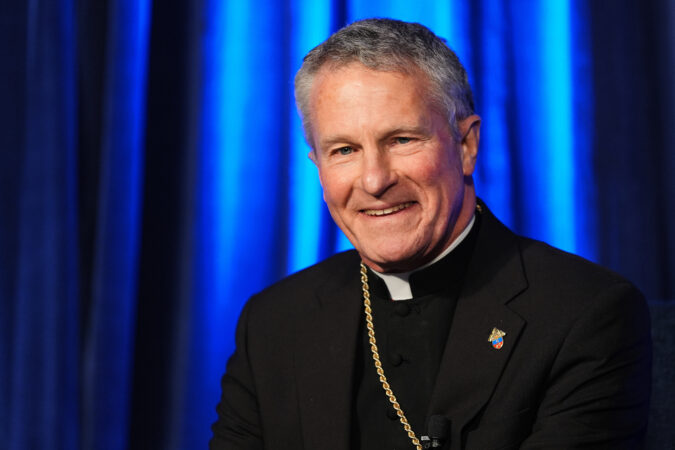
    As the Trump administration intervenes in Venezuela, readies troops for a possible deployment to Minnesota, and threatens to seize Greenland, the Catholic archbishop for the U.S. armed forces said it “would be morally acceptable” for troops to disobey what violated their conscience.

    Archbishop Timothy P. Broglio is one of a chorus of Catholic leaders questioning the administration’s use of force. His comments also underscored the mounting concern being voiced by the first American pontiff, Pope Leo XIV, as well as his top cardinals in the United States, over the Trump administration’s foreign policy.

    “Greenland is a territory of Denmark,” Broglio told the BBC Sunday. “It does not seem really reasonable that the United States would attack and occupy a friendly nation.”

    Asked whether he was “worried” about the military personnel in his pastoral care, Broglio replied: “I am obviously worried because they could be put in a situation where they’re being ordered to do something which is morally questionable.”

    “It would be very difficult for a soldier or a Marine or a sailor to by himself disobey an order,” he said. “But strictly speaking, he or she would be, within the realm of their own conscience, it would be morally acceptable to disobey that order, but that’s perhaps putting that individual in an untenable situation — and that’s my concern.”

    As head of the D.C.-based Archdiocese for the Military Services USA, Broglio oversees the chaplains who serve Catholics and others at U.S. military bases, Veterans Affairs healthcare facilities and diplomatic missions worldwide.

    A former president of the U.S. Conference of Catholic Bishops, the Ohio native is seen as a church conservative. As the Obama administration was ending Don’t Ask, Don’t Tell, he spoke against allowing LGBT troops to serve openly. When the Trump administration disqualified transgender people from serving in the military, he said “sexual orientation and gender identity issues” reflected an “incorrect societal attitude.”

    He has also criticized military strikes on boats the administration says are smuggling drugs. U.S. forces have killed at least 115 people in more than 30 such strikes in international waters in the Caribbean and the Pacific since September.

    “In the fight against drugs, the end never justifies the means,” he said in a statement last month. “No one can ever be ordered to commit an immoral act, and even those suspected of committing a crime are entitled to due process under the law.”

    He issued the statement after the Washington Post reported that commanders in the first known boat strike saw survivors and ordered a second barrage to kill them. He did not refer to the incident, but appeared to allude to it.

    “As the moral principle forbidding the intentional killing of noncombatants is inviolable,” he said, “it would be an illegal and immoral order to kill deliberately survivors on a vessel who pose no immediate lethal threat to our armed forces.”

    Trump is set to arrive Wednesday in Davos, Switzerland, for the World Economic Forum, at which European leaders plan to discuss his demand to seize and annex Greenland — a demand that has transformed the annual gathering of the world’s political and financial elite into an emergency diplomatic summit.

    Members of the military take an oath to the Constitution, not to the president. They swear an oath of enlistment to “support and defend the Constitution of the United States against all enemies” and “obey the orders of the President of the United States and the orders of the officers appointed over me,” according to the Uniform Code of Military Justice. They have an obligation not to follow “manifestly unlawful orders,” but such situations are rare and legally fraught, The Washington Post reported. Military personnel can be court-martialed for failing to obey lawful orders.

    The Pentagon in November announced an investigation into Sen. Mark Kelly (D., Ariz.), a prominent Trump critic and combat veteran, after he spoke in a video with five other Democrats reminding U.S. service members of their duty under military law to disobey illegal orders. The message move criticized by Trump at the time as “SEDITIOUS BEHAVIOR,” and the other lawmakers said this month they were now under investigation by his administration for the video.

    Kelly filed a lawsuit earlier this month seeking to reverse Defense Secretary Pete Hegseth’s letter of censure and effort to potentially demote him in rank.

    Broglio’s comments echoed concerns made in a joint statement Monday by the three highest-ranking U.S. Catholic archbishops, who warned that a resurgence in the use or threat of military force, including by the United States in Venezuela and Greenland, had thrown “the moral foundation for America’s actions in the world” into question.

    “The events in Venezuela, Ukraine and Greenland have raised basic questions about the use of military force and the meaning of peace,” wrote Cardinals Blase Cupich of Chicago, Robert McElroy of D.C., and Joseph Tobin of Newark.

    In the days after the U.S. operation in Venezuela to capture Nicolás Maduro, and after Trump said he was now “in charge” of that nation, the pope insisted on respect for Venezuela’s sovereignty.

    In a Jan. 9 meeting with diplomats in Vatican City, Leo decried a new era in which multilateralism is being replaced by “a zeal for war” and “peace is sought through weapons as a condition for asserting one’s own dominion.” He did not name the United States.

    Broglio, in his comment on the U.S. boat strikes, invoked just war theory. In Catholic teaching, the “defensive use of military force” against an aggressor may be legitimate as a final resort under strict criteria.

    According to the Catechism of the Catholic Church, the damage inflicted by the aggressor must be “lasting, grave and certain”; all other means of stopping it “must have been shown to be impractical or ineffective”; there must be “serious prospects of success”; and the action “must not produce evils and disorders graver than the evil to be eliminated.”