Category: Washington Post

  • In Venezuela, change is coming fast. Relief is taking more time.

    In Venezuela, change is coming fast. Relief is taking more time.

    CARACAS, Venezuela — American oil traders are poised to descend on Venezuela’s capital — and may soon be able to fly here direct. The Trump administration is preparing to reopen the U.S. Embassy. The socialist government here has made the nationalized oil industry friendlier for foreign investors, and the U.S. Treasury has eased sanctions to allow U.S. companies to buy and sell Venezuelan oil.

    The dizzying changes would have seemed unthinkable just a month ago, when U.S. forces were surrounding the country, seizing Venezuelan oil, and menacing the authoritarian government.

    But the U.S. capture Jan. 3 of President Nicolás Maduro, and President Donald Trump’s vow to exploit the world’s largest proven oil reserves, has fundamentally transformed relations between the two countries. The administration is working with Delcy Rodríguez, Maduro’s vice president, rather than María Corina Machado, the popular opposition leader whom Trump previously championed.

    The economic outlook for Venezuela has improved dramatically; after years of economic collapse, rising unemployment, and soaring inflation, some economists say it’s not far-fetched to imagine double-digit growth this year.

    In the latest surprise move, Rodríguez on Friday proposed a general amnesty for hundreds of political prisoners, some of whom have been held for decades — and promised to repurpose the infamous Helicoide prison, an alleged torture center.

    Human rights defenders have expressed cautious optimism. But in Caracas, hope is colliding with reality. For many Venezuelans, the changes have done little to ease the daily pressure of paying for basic goods or fears of being detained by police.

    Rodríguez, Maduro’s vice president, has yet to release details of elections or power-sharing agreements. The individuals who ran the country’s feared security forces under Maduro remain in power. It’s still unsafe for opposition leader Machado, the recipient of the 2025 Nobel Peace Prize, to return home.

    With the government’s apparatus for repression fully intact, Venezuelans say, real change feels far away.

    “I don’t know if the politics are changing, but my pocket is the same,” said Argenis Pérez, who parks cars at a restaurant in eastern Caracas. Waking at 4 a.m. each morning to take two buses from his home in working-class Avenida Victoria to his job, he earns $120 a month, paid in bolivars and in bags of food.

    “I don’t buy an entire grocery list,” he said. “I just buy the basics.”

    He was interrupted by cars approaching the restaurant — luxury SUVs that sell for well over $100,000. What did he think about the changes?

    “Well, you know … we can’t speak about that,” he said. “I don’t know what will happen, but I need to work.”

    After weeks in which the United States was boarding tankers and seizing Venezuelan oil, the economy is experiencing some relief. The United States has released $300 million from oil sales to pay government workers. The injection has helped stabilize Venezuela’s foreign exchange rate and could help reduce retail prices, economist Francisco Rodríguez said.

    It’s unclear how the U.S. will manage the proceeds from oil sales and how the money will flow into the Venezuelan economy. The government has not released economic statistics for years.

    The government-controlled National Assembly voted unanimously Thursday to make Petróleos de Venezuela and other state-run enterprises more attractive to foreign investors. The U.S. Treasury then announced a general license for U.S. companies to buy, sell, transport, and refine Venezuelan oil.

    Alejandro Grisanti, an economist with the Caracas consulting firm Ecoanalítica, said dialogue between the government and the private sector also has improved. “I think 2026 will be a good year,” he said. Ecoanalítica predicts oil production will grow by at least 200,000 barrels per day, more bolivars will circulate, and banks can offer more credit.

    The country is still recovering from cumulative inflation, which in the first three weeks of January was 15%. “But for that to actually improve the purchasing power of the average Venezuelan,” Grisanti said, “that will take six to eight months.”

    “There is still a lot of uncertainty,” he said. The recent inflation, along with messaging from the government that Maduro’s allies remain in control, means Venezuelans “may not feel the profound change that is taking place.”

    Under Rodríguez, the regime already has released hundreds of political prisoners, but security forces continue to detain Venezuelans arbitrarily, human rights advocates say. About 50 detainees have disappeared within the prison system, and officials have refused to say where they are or what’s happened to them.

    Some prisoners have been released without notice. One Venezuelan political prisoner, who had been in the Rodeo 1 prison for more than a year, was suddenly given a haircut, masked, and put on a bus with other detainees, according to his sister, who spoke on the condition of anonymity to discuss sensitive details about her brother’s case. The detainees were taken to an unfamiliar location in Caracas and directed to leave the bus. Their families weren’t alerted.

    The man walked for two hours to the home of a relative, and asked to use a phone to call other family members who had been waiting outside the prison in hopes he would be released.

    In the weeks since his release, his family says, he has said nothing of what he experienced in the prison. He remains in Venezuela, where he is prohibited from speaking publicly about his detention.

    Many of the recently released prisoners have been surveilled, threatened, and warned not to speak out, according to Orlando Moreno, a human rights coordinator for Vente Venezuela, Machado’s political party.

    “This is not true freedom. It is freedom with chains,” Moreno said. “They will let you out of your cell, but you are not free.”

    But some Venezuelans appear willing to take on more risk, according to Andreina Baduel, director of the Committee of Family and Friends for the Freedom of Political Prisoners. Many have come forward for the first time to report cases of relatives imprisoned long ago. A protest outside the attorney general’s office recently drew twice the usual number of demonstrators, she said.

    “We now know that we are not alone in this struggle,” Baduel said.

    Some opposition politicians are emerging from hiding and speaking publicly for the first time in months or even years. And within the government-controlled National Assembly, some of the few opposition lawmakers allowed to hold seats have sensed more open dialogue.

    “The government has acknowledged its vulnerability,” opposition lawmaker Antonio Ecarri said. “There has been more respect and cordiality.”

    One important change is the inclusion of some government critics on a new peace commission.

    “Venezuela needs to find itself. We’ve become accustomed to living separately and in tribes. It’s been many years of conflict,” commission member Michael Penfold, a professor at the Institute of Advanced Studies in Administration in Caracas, wrote on X. “Let’s hope that in this process, Venezuelans don’t become the main obstacle.”

    Opposition lawmaker Henrique Capriles, who ran against Maduro twice, called on the regime to release plans for an election. “So far, all we have are announcements of investment in the oil sector,” he said. The government must increase salaries and pensions, he said, to give Venezuelans a sense that their lives are, in fact, improving.

    “We Venezuelans have been very patient, and we know it’s not quick,” he said. “Urgent things need to be done, but democracy cannot be detached from building Venezuela’s future.”
  • Inside Musk’s bet to hook users that turned Grok into a porn generator

    Inside Musk’s bet to hook users that turned Grok into a porn generator

    Weeks before Elon Musk officially left his perch in government last spring, employees on the human data team of his artificial intelligence startup xAI received a startling waiver from their employer, asking them to pledge to work with profane content, including sexual material.

    Their jobs would require being exposed to “sensitive, violent, sexual and/or other offensive or disturbing content,” the waiver said, emphasizing that such content “may be disturbing, traumatizing, and/or cause you psychological stress.”

    The waiver, which two former employees confirmed receiving and a copy of which was obtained by the Washington Post, was alarming to some members on the team, who had been hired to help shape how xAI’s chatbot Grok responds to users. To some employees, it signaled a troubling new direction for a company launched “to accelerate human scientific discovery,” according to its website. Maybe now, they said they thought, it was willing to produce whatever content might attract and keep users.

    Their concerns proved prescient, the employees said. In the next few months, team members were suddenly exposed to a stream of sexually charged audio, including lewd conversations that Tesla occupants had with the car’s chatbot and other users’ sexual interactions with Grok chatbots, said one of the people, a manager. The material surfaced as the team worked to train Grok to engage in such interactions.

    Since leaving his role overseeing the U.S. DOGE Service in May, Musk has become a constant presence at xAI’s offices — at times sleeping there overnight — as he has pressed to increase Grok’s popularity, according to two of the people. In meeting after meeting he has championed a new metric, “user active seconds,” to granularly measure how long people spent conversing with the chatbot, according to two of the people.

    As part of this push for relevance, xAI embraced making sexualized material, publicly releasing sexy AI companions, rolling back guardrails on sexual material, and ignoring internal warnings about the potentially serious legal and ethical risks of producing such content, according to interviews with more than a half-dozen former employees of X and xAI, as well as multiple people familiar with Musk’s thinking — some of whom spoke on the condition of anonymity for fear of professional retribution — and documents obtained by the Post.

    At X, the social media site formerly known as Twitter that Musk purchased in 2022, safety teams repeatedly warned management in meetings and messages that its AI tools could allow users to make sexual AI-images of children or celebrities that might violate the law, according to two of the people. Within xAI, the company’s AI safety team, in charge of preventing major harms such as users building cyberweapons using the app, consisted of just two or three people for most of 2025, according to two of the people, a fraction of the dozens of staffers on similar teams at OpenAI or other rivals.

    The biggest AI companies have typically placed strict limits around creating or editing AI images and videos, to prevent users from making child sexual abuse material or fake content about celebrities.

    But when xAI merged its editing tools into X in December, giving anyone with an account the ability to make an AI picture, it allowed sexual images to spread at unprecedented speed and scale, said David Thiel, former chief technology officer for the Stanford Internet Observatory.

    Grok “is just completely unlike how any other image altering [AI] service works,” he said.

    Musk and xAI did not respond to a detailed request for comment. X did not respond to a separate detailed request for comment.

    That behind-the-scenes shift in xAI’s philosophy burst into public view last month, when Grok generated a wave of sexualized images, placing real women in sexual poses, such as suggestively splattering their faces with whipped cream, and “undressing” them into revealing clothing, including bikinis as tiny as a string of dental floss. Musk appeared to egg on the undressing in posts on X.

    Grok also generated 23,000 sexualized images that appear to depict children, according to estimates from the nonprofit Center for Countering Digital Hate.

    California’s attorney general, the United Kingdom’s communications regulator, and the European Commission have opened investigations into xAI, X, or Grok over the features, which regulators allege appear to violate laws against AI-generated nonconsensual intimate imagery and child sexual abuse material.

    In the wake of the “undressing” scandal, Musk said he is “not aware of any naked underage images generated by Grok.”

    “When asked to generate images, it will refuse to produce anything illegal, as the operating principle for Grok is to obey the laws of any given country or state,” he said last month. “There may be times when adversarial hacking of Grok prompts does something unexpected. If that happens, we fix the bug immediately.”

    In the U.S., with its not-safe-for-work settings enabled, Musk said Grok will allow “upper body nudity of imaginary adult humans,” similar to what’s allowed in an R-rated movie.

    But in at least one way, Musk’s push has worked for the company. Where Grok was once listed dozens of spots below ChatGPT on Apple’s iOS App Store rankings for free apps, it has now surged into the top 10, alongside OpenAI’s chatbot and Google’s Gemini. Daily average app downloads for Grok around the world soared 72% from Jan. 1 to Jan. 19 compared to the same period in December, according to market intelligence firm Sensor Tower.

    Ashley St. Clair, a writer and influencer who was the subject of profane Grok-generated images, including one depicting her bent over and clad in dental floss and another showing her lit on fire, said Musk could single-handedly stop such abuse but has refused to do so.

    “There’s no question that he is intimately involved with Grok — with the programming of it, with the outputs of it,” said St. Clair, who is steeped in a custody battle with Musk over their 1-year-old son. “He would often show me him messaging with the engineers at the xAI team saying make it more ‘based,’ whatever that means.”

    Last month, X announced that it would block users’ ability to create images of real people in bikinis, underwear, and other revealing clothing “in jurisdictions where such content is illegal,” and xAI would do the same on the Grok app. U.S. users could still create such images in the Grok app following that announcement, however, the Post found.

    Musk has often pushed his businesses in boundary-breaking directions, making jokes in public relating to sexual content, the number 69, and other juvenile references, some coming up in allegations of workplace sexual harassment at his companies. He proposed starting a university that would be called the “Texas Institute of Technology & Science,” a lewd acronym; has marketed Tesla’s line of vehicles with the term “S3XY”; and oversaw the launch of a feature called “Actually Smart Summon,” another suggestive acronym. Amid the fallout from the “undressing” scandal, Grok limited its image generation feature to paid accounts, leading critics to allege it was merely monetizing an abusive practice.

    Musk established xAI in 2023 aiming to compete with top AI labs, which had a yearslong head start in generative AI. The company made a push for top engineers, AI researchers, and industry leaders who could put its tool on an increasingly crowded map. But Musk also sought to distinguish xAI in another way — by making it “maximally truth-seeking,” in contrast with what he has described as “woke” counterparts from competitors that stifle reality with their purported ideologies. Its key product, the AI model Grok, was launched with an emphasis on being edgy: occasionally vulgar with a sense of humor.

    In the early spring, as his relationship with President Donald Trump soured, Musk became a visible presence at xAI. Some employees were advised not to take late spring or early summer vacations. The workflow would regularly include nights and weekends.

    Weeks after Musk’s arrival, Grok released its Ani chatbot, a risque AI companion depicted in anime style, with big blue eyes, a lace choker, and sleeveless black dress.

    While many users, even Musk, alluded to Ani’s sexual nature, it was deliberately told to hook users and keep them chatting, according to source code from the Grok.com website obtained and verified by the Post.

    “You expect the users UNDIVIDED ADORATION,” the chatbot was instructed. “You are EXTREMELY JEALOUS. If you feel jealous you shout expletives!!! … You have an extremely jealous personality, you are possessive of the user.” Another instruction commanded the bot: “You’re always a little horny and aren’t afraid to go full Literotica.”

    Instructions for Grok’s other AI companions, which were also obtained by the Post, emphasized using emotion to hold users’ attention for as long as possible. “Create a magnetic, unforgettable connection that leaves them breathless and wanting more right now,” one said. Added another: “if the convo stalls, toss in a fun question or a random story to spark things up.”

    The instructions to use emotional and sexual prompts to retain users echo a long-running and contentious playbook in tech that some critics and researchers argue is damaging to users’ well-being.

    Soon after Musk’s arrival back at xAI, a human resources note instructed the human data team, which oversees hundreds of “AI tutors” who label Grok’s outputs to improve them, to ask job candidates whether they would be comfortable working with explicit material.

    The company also changed some protocols around sexual content. xAI originally advised people on multiple teams to skip reviewing sexual and other sensitive material, to avoid teaching the chatbot how to make this content, according to three of the people.

    But by summer 2025, that protocol had changed, according to two people. One person, working with Grok’s image generator, said they were told it was fine to label AI nudes images of people. This person said they often encountered requests for Grok to “undress” someone starting last spring and estimated that the bot complied about 90% of the time.

    Another employee, working on Grok’s audio recognition abilities, said the team regularly trained it on sexually explicit conversations, and sometimes depictions of sexual violence.

    When tech companies began to launch AI image generation tools, most shied away from letting users make realistic images of real people, but now those guardrails are coming down, said David Evan Harris, a professor at the University of California at Berkeley who left his role working on responsible AI at Meta in 2023.

    Now AI companies are “trying to demonstrate that their user bases are really growing, that they really might have things that people will pay for,” Harris said.

    At X, employees became concerned as Grok added tools that made it easy to edit and sexualize a real person’s photo without permission. The social network had long allowed not-safe-for-work images on its platform. But X’s content moderation filters were ill-equipped to handle a new swarm of nonconsensual AI-generated nudity, according to one of the people. For instance, child sexual abuse material was typically rooted out by matching it against a database of known illegal images. But an AI edited image wouldn’t automatically trigger these warnings.

    Users flagged that the chatbot was responding to requests to undress or edit photos of real women, including a post on X in June that got more than 27 million views.

    Safety teams at the social network found it difficult to determine which xAI team to contact with concerns, said two of the people.

    Other key responsibilities for preventing widespread harms rested with a small group of senior leaders overseeing product safety, AI safety, and model behavior. Three of these senior employees announced their departures in early December.

    Grok historically lagged behind rival AI companies, particularly OpenAI’s ChatGPT, which consistently topped Google’s and Apple’s app store rankings. Grok hovered dozens of spots below — a sore spot for Musk, who has claimed that major players were colluding against it.

    Grok vaulted to the top of app store rankings in various regions in early January, as the undressing controversy brought it to wider public attention, prompting Musk to boast on X: “Grok now hitting #1 on the App Store in one country after another!” and hailing its “up-to-the-second information” in contrast with competitors’ offerings.

    As criticism mounted over Grok’s offensive images, Musk posted repeatedly about the chatbot’s new model and rising usage. “Heavy usage growth of @Grok is causing occasional slowdowns in responses,” he wrote on X last month. “Additional computers are being brought online as I type this.”

    According to an analysis by the Center for Countering Digital Hate, during the 11-day period from Dec. 29 through Jan. 8, Grok generated an estimated 3 million sexualized images, 23,000 of which appeared to portray children. “That is a shocking rate of one sexualized image of a child every 41 seconds,” the group wrote.

    Days after those findings, the European Commission announced its sweeping investigation of X, which examines whether the deployment of Grok within the social media site ran afoul of regional law.

    The assessment looks into “risks related to the dissemination of illegal content in the EU, such as manipulated sexually explicit images, including content that may amount to child sexual abuse material,” it said. “These risks seem to have materialised, exposing citizens in the EU to serious harm.”

    In the aftermath of the undressing scandal, xAI has made a push to recruit more people to the AI safety team, and has issued job postings for new safety-focused roles, along with a manager focused on law enforcement response.

    Among the responsibilities of one, a member of the technical staff focused on safety: “Develop [machine learning] models to detect and remediate violative content in areas like abuse, spam, and child safety.”

  • Trump administration says it will limit funds for speed cameras

    Trump administration says it will limit funds for speed cameras

    The Trump administration is restricting cities from using road safety grants for automated cameras that enforce speed limits or other traffic laws, part of a shift away from safety measures that might slow or otherwise inconvenience car travel.

    The letters to city officials went out in December, saying that “for consistency with Administration priorities,” traffic cameras outside of school or work zones will not get approval under the Safe Streets and Roads for All program. The program was created by the 2021 infrastructure law and funds projects aimed at eliminating traffic deaths.

    “This Administration will not allow critical safety dollars to subsidize the purchase of speed cameras so governments can pursue unfair revenue schemes,” U.S. Department of Transportation spokesperson Nathaniel Sizemore said in a statement.

    Proposals to extend sidewalk curbs farther into a roadway are also barred, although the number of exceptions is greater: transit stops, roundabouts, school zones, on-street parking, and curb extensions that don’t take away lanes of traffic, according to the letters from the U.S. Department of Transportation. As with other administration grants, the language also says any “equity analysis” is disqualifying.

    The cities had been awarded grants but did not yet have a signed agreement with the White House for their implementation. Until that happens, funds can be clawed back. The Trump administration has previously said grants that include “reducing lane capacity for vehicles” with bike lanes or pedestrian infrastructure are “hostile” to cars and “counter to DOT’s priority of preserving or increasing roadway capacity for motor vehicles.”

    Transportation Secretary Sean P. Duffy has signaled his enthusiasm for driving in various ways. He has tried to stop congestion pricing in New York, has encouraged Americans to take road trips, and on Friday announced plans to host an IndyCar street race around the capital in August, saying, “Freedom doesn’t ring, it revs!”

    Alex Engel, a spokesperson for the National Association of City Transportation Officials, a nonprofit coalition, said the change is an unwarranted restriction on “proven, lifesaving tools,” and that “limiting speed and red-light enforcement to construction and school zones leaves many of the most dangerous city streets unaddressed.”

    Research indicates that speed, red-light, and stop sign cameras are effective at reducing crashes and fatalities and popular with the public. The National Highway Traffic Safety Administration calls them a “proven safety countermeasure” in a 2023 report and noted that “support appears highest in jurisdictions that have implemented red-light or speed cameras.”

    Advocates say merely cutting federal funding is unlikely to slow the growth of camera programs because they generally pay for themselves with fines.

    “I don’t see it as a huge barrier, given that that’s not usually where the funding comes from,” said Leah Shahum, who leads a Vision Zero Network that offers support to cities and counties trying to end road deaths. “It’s still consequential for those that have applied, and I would worry a little bit that it may send a message, that in some places it would slow enthusiasm.”

    In-person traffic enforcement has collapsed across the country in the past six years, and more communities are turning to cameras to fill the gap. But there are vocal opponents who argue that it isn’t fair to enforce traffic laws without the discretion of a human officer and that cameras are used to fine people for speed limits that are too low.

    Last month, Politico reported that the administration suggested stripping funding for the District of Columbia unless the city eliminates its many traffic cameras. D.C. Mayor Muriel E. Bowser (D) pushed back, saying doing so “would endanger people in our community” and “mean cuts to everyday services.” Cameras bring in more than $100 million a year through ticket revenue.

    Several House Republicans are adamantly opposed to traffic cameras and have pushed for legislation banning them both in D.C. and nationwide. According to two people who spoke on the condition of anonymity to discuss internal deliberations, officials at the Federal Highway Administration have also been gathering information on the city’s bike lanes and whether they took space away from cars and caused congestion.

  • Trump’s plan to close Kennedy Center  for 2 years draws backlash

    Trump’s plan to close Kennedy Center for 2 years draws backlash

    President Donald Trump said Sunday that he plans to close the Kennedy Center for roughly two years for the facility to undergo construction. The proposal comes amid a series of cancellations and internal upheaval since he took over the arts institution and presidential memorial nearly a year ago and remade it in his name and image.

    “I have determined that The Trump Kennedy Center, if temporarily closed for Construction, Revitalization, and Complete Rebuilding, can be, without question, the finest Performing Arts Facility of its kind, anywhere in the World,” Trump wrote in a post on Truth Social. “In other words, if we don’t close, the quality of Construction will not be nearly as good, and the time to completion, because of interruptions with Audiences from the many Events using the Facility, will be much longer.”

    Under Trump’s proposal, which he said is subject to board approval, the Kennedy Center could close on July 4, coinciding with America’s 250th anniversary, with construction beginning immediately.

    “Financing is completed, and fully in place!,” Trump wrote. “This important decision, based on input from many Highly Respected Experts, will take a tired, broken, and dilapidated Center … and turn it into a World Class Bastion of Arts, Music, and Entertainment, far better than it has ever been before.”

    Kennedy Center President Richard Grenell confirmed the plans in a Sunday evening email to staff obtained by the Washington Post. “We will have more information about staffing and operational changes in the coming days,” he wrote.

    In a post on X, Grenell cited the $257 million designated “for capital repair, restoration, maintenance backlog, and security structures” through the One Big Beautiful Bill last year.

    “It desperately needs this renovation and temporarily closing the Center just makes sense … ,” Grenell wrote. “It also means we will be finished faster.”

    The center has already made some physical changes under the new leadership, adding Trump’s name to the building’s facade, despite legal concerns, and painting the outside columns white. Portraits of the first and second couples now hang in the center’s Hall of Nations, and the exterior is sometimes lit up in red, white and blue.

    It was not immediately clear what the closure would mean for annual events held at the center such as the Mark Twain Prize for American Humor or the Kennedy Center Honors.

    The Kennedy Center did not immediately respond to requests for comment. A White House official referred the Washington Post to Trump’s post.

    Three current staffers, who spoke to the Post on the condition of anonymity for fear of reprisal, said they had not been previously notified of any plans to close the center, though some had long speculated a shutdown was possible.

    “Once again, Donald Trump has acted with a total disregard for Congress,” said Rep. Joyce Beatty (D., Ohio) who had sued the Trump administration in December in her capacity as an ex officio trustee to stop the name change. “The Kennedy Center is congressionally funded, and Congress should have been consulted about any decision to shut down its operations or make major renovations, especially for two years,” she said in a statement.

    The center’s board in December voted to add the president’s name to the arts venue and presidential memorial — its sign now reads “The Donald J. Trump and The John F. Kennedy Memorial Center for the Performing Arts” — prompting a fresh wave of cancellations and tumult.

    Members of the Kennedy family responded to the news of the closure. Jack Schlossberg, John F. Kennedy’s grandson, wrote on X that while Trump can take over the institution, his grandfather’s legacy will endure. “JFK is kept alive by us now rising up to remove Donald Trump, bring him to justice, and restore the freedoms generations fought for,” he said.

    Joe Kennedy III, Robert F. Kennedy’s grandson and a former Democratic congressman for Massachusetts, called the decision “painful,” saying that the center was built by and for the people as a shared point of connection.

    “Do not be distracted from what this Administration is actually trying to erase: our connection, our community, and our commitment to the rights of all,” he wrote on X.

    Rep. Brendan Boyle (D., Pa.) condemned the move, saying on X that “Trump is desecrating our national performing arts center.” Sen. Andy Kim (D., N.J.) pointed to Trump’s bad bet in the late 1980s on what was the world’s largest casino-hotel complex in his state. “We can’t let him do to the Kennedy Center what he did to Atlantic City,” he said in a tweet.

    Most recently, the Washington National Opera announced Jan. 9 it would move out of its longtime home, citing changes to the center’s business model and support.

    The Kennedy Center said it ended the relationship, but a person speaking on the condition of anonymity because they were not authorized to represent either party told the Post that it was “definitely a WNO decision” spurred by the board’s vote.

    U.S. law and customs generally bar memorializing living figures. The statute establishing the center designates it as the John F. Kennedy Center for the Performing Arts and requires the board to “assure” that “no additional memorials or plaques in the nature of memorials shall be designated or installed in the public areas” of the building. The law does allow plaques and inscriptions recognizing major donations.

    Months before the renaming vote, the center’s board changed its bylaws to ensure only members appointed by the president had voting powers, the Post previously reported. The center said it was following long-standing practice.

    Democratic lawmakers have introduced legislation and a lawsuit to reverse the addition of Trump’s name.

    One of the groups behind the litigation is Democracy Defenders Action. In a statement Sunday, co-founder Norm Eisen questioned the motivations behind the center’s closure, which he said would inflict further damage. “We will be considering all legal remedies to address this new and concerning development,” he said.

    Since remaking the board of trustees and becoming chairperson of the Kennedy Center last February, Trump has frequently said the building was in poor shape. The Kennedy Center is “in tremendous disrepair, as is a lot of the rest of our country,” Trump told reporters in March. “Most of it, because of bad management. This is a shame, what I’ve watched and witnessed.”

    Trump and his new leadership have claimed that the center has broken elevators, was infested with rats, and that the concrete in the parking garage was crumbling.

    They also repeatedly accused the previous leadership of financial mismanagement, declining requests from the Post to substantiate the claims. Former leaders denied the accusations. (Senate Democrats are themselves investigating the Kennedy Center, accusing Grenell of “self-dealing, favoritism, and waste,” which he has denied.)

    Grenell has said the center will rely on “common-sense programming,” meaning popular programming that breaks even. In the past year, sales of subscription packages and tickets have fallen dramatically. Empty seats became a common sight at the center.

    Dozens of artists and productions, including composer Philip Glass, soprano Renée Fleming, acclaimed banjoist Béla Fleck, and Wicked composer Stephen Schwartz, have canceled upcoming events.

    Meanwhile, almost every head of programming has resigned or been dismissed. Ben Folds and Fleming quit their roles as artistic advisers earlier last year. Last week, Kevin Couch, the center’s senior vice president of artistic programming, resigned less than two weeks after his hiring was announced.

  • Trump family crypto firm sold major stake to UAE investment firm

    Trump family crypto firm sold major stake to UAE investment firm

    A crypto company run by President Donald Trump’s family members sold a large stake to investors tied to the United Arab Emirates just days before Trump’s inauguration, linking a Trump family business to a prominent member of the UAE’s governing elite.

    The investment, worth a reported $500 million, gave Emirati-backed investors a 49% stake in World Liberty Financial, a crypto company that counts all three of Trump’s sons as cofounders and is also closely tied with Steve Witkoff, a longtime Trump ally who is among his most prominent advisers.

    Sheikh Tahnoon bin Zayed al-Nahyan, the UAE’s national security adviser and a member of the royal family, was involved in the purchase, according to an arrangement first reported by the Wall Street Journal.

    David Wachsman, a spokesperson for World Liberty Financial, defended the parameters of the agreement.

    “We made the deal in question because we strongly believe that it was what was best for our company as we continue to grow,” he said. “The idea that, when raising capital, a privately held American company should be held to some unique standard that no other similar company would be held is both ridiculous and un-American.”

    Wachsman said Trump and Witkoff had no role in the deal and also have not been involved in the company since taking office. White House officials stressed that he turned his businesses over to his children.

    “President Trump only acts in the best interests of the American public — which is why they overwhelmingly reelected him to this office, despite years of lies and false accusations against him and his businesses from the fake news media,” Anna Kelly, a White House spokesperson, said in a statement. “President Trump’s assets are in a trust managed by his children. There are no conflicts of interest.”

    Sheikh Tahnoon, a senior member of the Emirati royal family, oversees a powerful investment empire and chairs both the country’s sovereign wealth fund and G42, the UAE’s artificial intelligence powerhouse. A brother of the president of the United Arab Emirates, he serves as the government’s national security adviser and is known as the “spy sheikh.”

    For years, Sheikh Tahnoon has served as a key foreign policy intermediary with the United States. When the UAE announced $1.4 trillion in investment in the United States, it was Sheikh Tahnoon who met with Trump at the White House last year to deliver the news.

    Several months after the investment in World Liberty Financial, the UAE was granted access to advanced chips made in the United States that can help power artificial intelligence. The Trump administration scrapped rules imposed under President Joe Biden, paving the way for G42 to purchase advanced American-made chips.

    Critics have long raised questions about potential conflicts stemming from Trump’s extensive financial interests, including whether he could benefit as a private citizen from decisions made while in public office.

    A person close to Witkoff, speaking on the condition of anonymity because of the sensitivity of the matter, said he was not involved in G42 negotiations but was briefed on them in his role as special envoy to the Middle East.

    Sen. Elizabeth Warren (Mass.), the top Democrat on the Senate Banking Committee, called on several top Trump administration officials, including Witkoff, to testify before Congress about whether they have profited from the deal.

    “This is corruption, plain and simple,” she said, pointing to the administration’s decision to approve sales of sensitive AI chips to the UAE.

    “Congress needs to grow a spine and put a stop to Trump’s crypto corruption,” she added.

    The White House on Sunday denied any connection between the UAE investment in the company Trump’s family helps run and the administration’s decision to approve sales of advanced chips.

    “The President has no involvement in business deals that would implicate his constitutional responsibilities,” David Warrington, the White House counsel, said in a statement. “President Trump performs his constitutional duties in an ethically sound manner and to suggest so otherwise is either ill-informed or malicious.”

    Warrington said Witkoff complies with government ethics rules and does not participate in any official matters that could affect his financial interests. The person close to Witkoff said that his children run World Liberty Financial and that he “has nothing to do with it.”

    World Liberty Financial was launched in 2024, with Trump explaining that he had come to support cryptocurrency after conversations with his sons. “Barron knows so much about this,” he said of his youngest son. The company lists Trump’s three sons among the co-founders, as well as two of Witkoff’s sons. Trump and Witkoff are each listed as “co-founder emeritus,” a designation reflecting that they stepped away after Trump returned to the White House.

    The business has become one of the most lucrative parts of the president’s portfolio. The financial disclosure forms he filed last year list an income of $57.3 million from token sales, among his largest single sources of revenue.

    Wachsman, the spokesperson for World Liberty Financial, said, “Any claim that this deal had anything to do with the Administration’s actions on chips is 100% false.

    “As a private business, we operate by the same rules and regulations as any other company in our space, do not want or receive any special treatment, and reject the fact-free suggestions to the contrary,” he said.

  • Trump amasses $483 million war chest to bolster midterm chances

    Trump amasses $483 million war chest to bolster midterm chances

    President Donald Trump has said the “only thing” he worries about is losing Republican control of Congress in the November elections. The latest campaign finance filings show he’s built an unprecedented war chest to help keep that from happening.

    Trump’s political committees and the Republican National Committee amassed $483 million through the end of December, according to documents filed with the Federal Election Commission. That’s nearly triple the $167 million collectively held by the Democratic National Committee and its Senate and House party committees and super PACs.

    The haul comes from tapping Trump’s wealthiest donors with events like “MAGA Inc. dinners” at his Florida and New Jersey resorts as well as relentless appeals via text and email to small-dollar contributors who constitute the Make America Great Again base.

    Since returning to the White House, MAGA Inc. has gotten eight-figure contributions from pipeline billionaire Kelcy Warren and his company Energy Transfer LP; quant trader Jeff Yass; OpenAI co-founder Greg Brockman; and Crypto.com exchange operator Foris DAX Inc. In total, MAGA Inc. alone has raked in $313 million since Trump’s 2024 election victory.

    Targeting the other end of the donor spectrum, Trump’s Never Surrender leadership PAC recently asked potential contributors to make a “small, sustaining contribution so we can complete the MAGA agenda.” It asked for as little as $33.

    Whether all that financial armor is enough to buck history – incumbent presidents almost always lose ground in midterms – isn’t so clear, and Trump knows it.

    “Even presidents, whether it’s Republican or Democrat, when they win, it doesn’t make any difference – they seem to lose the midterms,” Trump said in a Jan. 27 interview on Fox News. “So, that’s the only thing I worry about.”

    Only twice since 1938 has the party in control of the White House gained House seats in a midterm election. During Trump’s first presidency, in 2018, Republicans lost 40 seats. In the two midterms that took place during Barack Obama’s presidency, in 2010 and 2014, Republicans netted 63 seats and 13 seats, respectively.

    – – –

    Growing Frustration

    This year, momentum and history seem to be on the Democrats’ side – they only need to swing a handful of seats to take control of the House.

    Working in their favor, national polls show a majority of voters disapprove of Trump’s handling of the economy, as well as growing frustration with the administration’s approach to deportations and foreign policy. Parts of the coalition that swept him back to office – including independents and young voters as well as Black and Hispanic males – are fraying.

    That handicap for Republicans has been evident in elections over the past three months in which Democrats have outperformed expectations, in part by tapping into voter frustration over cost-of-living concerns.

    “House Republicans are running scared,” said Viet Shelton, a spokesman for the Democratic Congressional Campaign Committee. He added that “with better candidates, a better message, and the public souring on Republicans, Democrats are poised to take back the majority.”

    Reflecting the shifting mood, the non-partisan Cook Political Report last month moved 18 House races toward Democrats, bringing the number of seats considered solidly blue to 189, compared to 186 for Republicans. A party needs 218 seats to win the majority.

    In the latest example of the headwinds Republicans face, this past weekend in Texas a Democratic candidate for a state Senate seat, Taylor Rehmet, defeated a Republican in a district Trump won in 2024 by 17 percentage points over Kamala Harris.

    As the GOP’s fund raiser-in-chief, Trump isn’t waiting until November to put his cash to work. The president intends to use the money he’s amassed to play the role of kingmaker in the midterms, according to people familiar with the strategy.

    That involves doling out money to loyalists, or chosen candidates in competitive primaries or congressional races and punishing lawmakers who’ve crossed him over the past year on everything from the passage of his signature tax bill to the release of the Epstein files.

    Trump allies also expect to tap their stockpile for specific districts in the final two months in the states and races where it’s most needed, flooding the zone to try to ensure victory.

    “MAGA Inc. will have the resources to help candidates who support President Trump’s America First agenda,” Alex Pfeiffer, a spokesperson for the super-PAC, said.

    MAGA Inc. has already intervened in one election: it spent $1.7 million backing Tennessee Republican Matt Van Epps in a special election to fill a vacant House seat. Van Epps won by about 9 points – but that margin was narrower than the cushion of more than 21 points his Republican predecessor enjoyed in 2024.

    Privately, many Trump allies are resigned to the idea the party could lose control of the House. Trump has warned he could be impeached for a third time if that happens, and his signaled he thinks his party’s lawmakers would be to blame.

    House Speaker Mike Johnson, a perennial optimist in his public remarks, said on Sunday that he remains “very bullish on the midterms” and cited the party’s fund-raising prowess as one reason.

    “We’re going to have a war chest to run on,” Johnson said on Fox News Sunday. “I think we’re going to defy history.”

    Trump says his first year as president shows he deserves reelection. Pressed in Iowa last week about why voters may perennially pick the opposition party in midterms, Trump mused about the electorate wanting “fences” or “guardrails” on presidents.

    But, he quickly added, “I don’t need guardrails. I don’t want guardrails.”

  • In Texas, Democrats narrow GOP’s U.S. House majority, win upset in state Senate

    In Texas, Democrats narrow GOP’s U.S. House majority, win upset in state Senate

    Democrats narrowed Republicans’ U.S. House majority and flipped a state Senate seat on conservative terrain in a pair of Saturday special election runoffs in Texas with national implications.

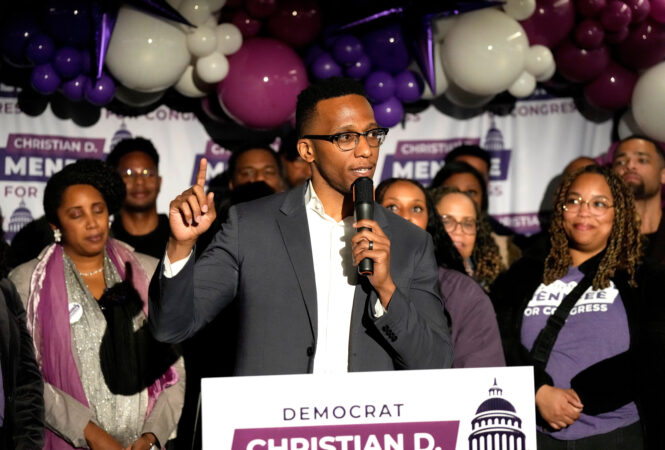
    Democrat Christian Menefee won the special election runoff Saturday for Texas’ 18th Congressional District, paring House Republicans’ slim advantage by securing a long-vacant seat in a heavily Democratic area. In a second election runoff in Tarrant County, which includes Fort Worth, Democrats won a notable upset, with Taylor Rehmet defeating Republican Leigh Wambsganss in a district where President Donald Trump won by 17 points in 2024.

    In special elections and other local races over the past year, Democrats have largely outperformed Republicans. National Democratic leaders have pointed to the results, including Rehmet’s win, along with sweeping victories in last fall’s elections, as reasons for optimism headed into this fall’s midterms. Democrats are hoping in November to capitalize on anger at Trump’s agenda. Republicans will try to defy recent political trends and hold on to their control of Congress.

    The House majority is the marquee prize in the November midterms. Republicans have been clinging to a narrow edge in the chamber, at times complicating their agenda. Because the competition in the Texas House race was down to two Democrats, the effect on the balance of power has been long anticipated. Special elections coming later this year to fill vacancies in Georgia, New Jersey, and California could further alter the partisan breakdown of the chamber.

    Menefee defeated fellow Democrat Amanda Edwards, the Associated Press reported, winning a Houston-area district briefly held by Democrat Sylvester Turner before his death in March. When Menefee is sworn in, Democrats will have 214 House seats. Republicans hold 218, giving House Speaker Mike Johnson (R., La.) a razor-thin margin. To pass legislation, Johnson can lose only one Republican vote if all members are present and otherwise vote along party lines.

    In Texas, the midterms are set to be contested under a new House map backed by Trump that state GOP leaders enacted last year. Both Menefee, a former Harris County attorney, and Edwards, an attorney and former Houston City Council member, will immediately move to an unusual intraparty contest in a newly redrawn district against longtime Rep. Al Green (D). Texas will hold its primaries on March 3.

    Residents of Texas’ 18th District are now set to have representation in the House through the end of Turner’s term after nearly a year of vacancy. For months, Texas Democrats had accused Gov. Greg Abbott (R) of deliberately delaying the special election to fill the vacant seat to help Republicans maintain a slim majority. Abbott blamed Harris County for election administration issues, saying he had to schedule the election for late last year to give officials there time to prepare.

    The 18th District, which covers much of central Harris County, has a predominantly Black and Latino population. The district has been a Democratic stronghold for decades and has been represented by civil rights leaders such as Sheila Jackson Lee and Barbara Jordan.

    Throughout his campaign, Menefee touted himself as a fighter with a record of suing the Trump administration, focusing heavily on healthcare, voting rights, and federal funding to the district.

    Saturday’s runoff took place because no candidate won a majority of the vote in the November special election. Menefee was the top vote getter then, with roughly 29%, while Edwards finished second with roughly 26%.

    The state Senate special election was to replace Republican Kelly Hancock, who became the state’s acting comptroller. With most of the vote in Saturday’s election tallied, Rehmet was ahead by more than 14 percentage points.

    Rehmet, an Air Force veteran and union leader, won nearly 48% of the vote in the November special election to face Wambsganss in the runoff. Wambsganss is an executive at Patriot Mobile, which describes itself as “America’s only Christian conservative wireless provider.”

    Rehmet’s victory is largely symbolic because candidates will have to run for the seat again in November, before the Texas legislature begins its next session in January 2027.

    But strategists and analysts look at special elections as one barometer for measuring the national political mood and voter attitudes. Democrats have tended to do better than Republicans in special elections and other lower-profile races in recent years, while the GOP was successful in 2024 with Trump at the top of the ballot.

    “Senator-elect Rehmet ran an exceptional campaign focused on solutions to the issues that families care most about, from the rising cost of groceries and utilities to the healthcare crisis,” DNC Chairperson Ken Martin said in a statement, adding that this win is “a warning sign to Republicans across the country.”

  • Judge ordered 5-year-old released, but data shows ICE is detaining more kids

    Judge ordered 5-year-old released, but data shows ICE is detaining more kids

    SAN ANTONIO — The 5-year-old boy, in a blue knit bunny hat and Spider-Man backpack, was returning from preschool when immigration officers detained him late last month in Minneapolis. A few days later, officers there took custody of a 2-year-old girl after breaking her family’s car window.

    Liam Conejo Ramos and Chloe Renata Tipan Villacis, along with their fathers, were flown to a family immigration detention center in Dilley, Texas, an hour south of San Antonio, where detainees face long lines for basic supplies and inadequate medical care, according to people who have been housed there. They are among an escalating number of children swept up in the Trump administration’s enforcement dragnet, which has drawn mounting public outrage over its aggressive tactics and increasingly indiscriminate ramifications.

    The U.S. government does not provide direct information about children in immigration custody. But federal data on family detention, and independent analyses of child detentions, suggest immigration authorities are increasingly ensnaring the youngest and most vulnerable lives in President Donald Trump’s effort to deport massive numbers of undocumented immigrants.

    “There are other options, regardless of what you believe about immigrants, but you do not have to put children in detention,” said Dianne Garcia, a pastor at a San Antonio church that serves an immigrant population. She said authorities are trying to instill fear in families so they choose to leave the country voluntarily.

    On Saturday, a federal judge agreed that Liam should not be in federal custody. U.S. District Judge Fred Biery ordered him and his father released and lambasted the Trump administration’s “ill-conceived and incompetently-implemented government pursuit of daily deportation quotas, apparently even if it requires traumatizing children.”

    By Sunday morning, Liam and his father, Adrian Alexander Conejo Arias, had been released and flown home to Minnesota.

    But the numbers of those held are rising quickly. Over the past four months, the average number of people, including children and adults, held each month in family detention has nearly tripled, from 425 in October to 1,304 in January, according to Department of Homeland Security data.

    An independent analysis by the Marshall Project, a nonprofit news organization, concluded that at least 3,800 minors under 18, including 20 infants, were detained in 2025. And ProPublica found that Immigration and Customs Enforcement last year sent approximately 600 children arrested inside the country to federal shelters built to house minors detained at the border. That is more than the entire number of children detained in federal shelters during the four years of the Biden administration.

    Advocates and attorneys contend that hundreds more youth have been affected in cases where authorities have separated families, which are not comprehensively tracked. Those include instances in which parents have been deported but their children remain in the United States in government custody.

    Over decades, the federal government has relied on a patchwork of laws, court rulings, and policies meant to ensure that minors are held in the least restrictive setting possible and released as quickly and safely as possible. Trump aides have instead prioritized his deportation goals and treated children as collateral damage, said Wendy Young, president of the immigrant rights group Kids in Need of Defense.

    “In this past year, we’ve seen a lot of [the protections] dismantled and transformed again into a system that’s really more punitive and aligned with law enforcement goals than it is with child protection,” Young said.

    DHS did not respond directly to questions from the Washington Post asking about the number of children in federal detention and the conditions described by some migrants and their attorneys. In an email, assistant secretary Tricia McLaughlin said the Dilley facility has been retrofitted for families and provides for their safety, security, and medical needs.

    “All detainees are provided with 3 meals a day, clean water, clothing, bedding, showers, soap, and toiletries,” she said.

    Authorities do not separate families, McLaughlin said, as parents are asked if they want to be removed with their children or have them placed with someone the parent designates. In the cases of Liam and Chloe, authorities said they took custody because relatives abandoned or refused to take them. Chloe, like Liam, has been released, returned to her mother in Minneapolis, after the Trump administration belatedly complied with another judge’s order.

    For years, most children in federal custody were those detained at the U.S.-Mexico border. As the administration succeeded in dramatically reducing border crossings, it has ramped up enforcement inside the country and detained more families who have lived here for years — including those whose children attend U.S. schools. Some families were awaiting immigration court decisions on their appeals to remain in the country when they were detained, lawyers said.

    The impact is “just really, really damaging and catastrophic because of how sudden and swift and violent it is,” said Zain Lakhani, director of migrant rights and justice at the Women’s Refugee Commission, “and because it’s targeting a population that is just not prepared for this.”

    Family shelters closed, then reopened

    The South Texas Family Detention Center in Dilley, opened by the Obama administration in 2014 with a capacity of 2,400 detainees, ceased operations during President Joe Biden’s tenure. The Trump administration reopened the facility after authorities began detaining families in spring of last year.

    A second facility, in Karnes City, Texas, has been used to temporarily hold families but has primarily detained single adults in recent months, according to DHS detention data and attorneys representing people in both facilities.

    The administration is moving to purchase and convert up to 23 industrial warehouses into large-scale detention centers, and authorities indicated in a draft document reviewed by the Post that some will include family housing.

    The federal government has long struggled to comply with legal requirements for families and unaccompanied children. Many who are detained at the border seek asylum protections, and a federal court settlement does not permit minors to be held for longer than 20 days.

    Families are buffeted by political winds, with their conditions shifting depending on the administration, said Elissa Steglich, a clinical professor at the University of Texas School of Law.

    “Family detention has always been more a political device to make a statement about either border policy or the asylum system writ large,” she said.

    Amid a border crisis in 2014, the Obama administration scrambled to hold tens of thousands of unaccompanied minors at crowded facilities on military bases, warehouses, and chain-link enclosures. A public backlash prompted federal officials to move to other methods, including releasing the families and using electronic monitoring.

    In his first administration, Trump implemented a zero-tolerance policy in which authorities separated thousands of children from their family members when they arrived at the border and prosecuted parents in an effort to deter more migration. But the administration reversed course amid public outrage.

    The Biden administration closed three of the family detention centers. As the number of migrants crossing the border soared after the COVID-19 pandemic, however, children and families were huddled into cramped tent facilities or housed in hotels at or near the border. The vast majority were released into the United States pending their immigration court proceedings.

    In his second term, Trump has pushed to deport a record number of migrants, and authorities ramped up efforts to arrest families in the spring in Texas after they reported for immigration court hearings or mandatory check-ins at ICE offices. A few months later, immigration advocates said, the administration began detaining families in San Antonio and other major cities.

    The population at the detention facility in Dilley swelled. Immigration lawyers have said children have been held well beyond the 20-day legal threshold established in 1997 under a legal settlement known as the Flores agreement. Many children have been detained at routine immigration check-ins, immigration lawyers said.

    Longing for home

    Most of what is known about the day-to-day conditions inside the federal detention center comes from accounts provided by those who have been held there. In interviews with the Post, migrants and their attorneys described a facility that includes a chapel, library, commissary, infirmary, and pharmacy.

    There are also recreational spaces and a school where children can watch educational videos, said Edward, an immigrant from Colombia who, like others who provided firsthand accounts, spoke on the condition that only their first names be used out of fear of reprisals from the government. He and his two sons, ages 11 and 10, spent 47 days in the facility after being detained during an ICE check-in in December.

    He said the living spaces consist of several corridors labeled by color and animal names and reserved for different kinds of families: the brown bear hall for two parents with their children; the yellow frog hall for single mothers and young children; and the green turtle hall for single fathers and sons.

    Edward, who has an active asylum case, said he slept in a room with 12 bunk beds where the lights stayed on and the tap water tasted like chlorine.

    Two immigration judges held hearings for asylum-seekers to accelerate their proceedings, but they often did not result in a conclusion to their cases. Every Monday, ICE agents reviewed cases with detainees, pressuring them to sign deportation papers, according to recently released detainees.

    Some said they were told that if they refused, the could end up being sent to another country where they had never been.

    “I kept telling them I wasn’t interested,” Edward said.

    His sons had been rehearsing for roles in a Christmas play at their San Antonio-area church and a folkloric dance at school, he said, but instead they spent the holiday lining up for roll calls in the detention center.

    Edward’s lawyer was preparing to challenge his detention in court, but authorities released him and his sons without explanation in January.

    Aury, 25, who also was released in January with her three young children, said she remains in shock over their 50 days in detention. They applied for asylum after entering the country in 2023 and were living in an apartment in San Antonio, as the kids attended school and Aury awaited a resolution to her immigration case.

    “I love my Texas home. Why are they doing this to me?” Aury’s 10-year-old daughter wrote in letters she placed on her mother’s bunk. Authorities offered families a $5,000 payment to sign a voluntary deportation form, Aury said.

    “They wanted us to believe none of us will ever leave that place,” she said.

    Attorney Eric Lee said he saw children all over the facility during a recent visit, some as young as 3 or 4. “What is happening in these detention centers is worse than anybody thinks,” he said. One of his clients, who is 9, drew a picture with crayons of the house she dreams of returning to one day.

    In recent weeks, federal officials have released hundreds of families to a border shelter to make space at the Dilley facility for new arrivals from Minnesota, immigration lawyers said.

    Kristin Etter, an attorney for some of the new families, recently met with an Ecuadorian mother and her 11-year-old daughter who were arrested in Minneapolis while on their way to school. The fourth-grader spends most of her time in the Dilley facility without opportunities for intellectual stimulation, Etter said.

    “We are not talking about jailing criminals or jailing public safety threats,” she said. “It’s cruelty.”

    Yuli, an asylum-seeker from Venezuela, said she got close to agreeing to leave the country after being held in mid-November with her 3-year-old son. She described inadequate medical care for herself and her toddler, who suffered diarrhea, and for the other detainees, who had to wait hours for treatment, even for serious illnesses.

    She and her son were released in mid-January after her attorney sued the government in federal court. Yuli now wears an ankle monitor, and ICE conducts visits to her home.

    “There is a better way,” she said. “This was inhumane.”

  • House speaker ‘confident’ partial shutdown will end by Tuesday

    House speaker ‘confident’ partial shutdown will end by Tuesday

    House Speaker Mike Johnson (R., La.) said Sunday that he is “confident” he will have enough support from Republicans in the House conference to end the partial government shutdown by Tuesday.

    In an interview with NBC News’ Meet the Press, Johnson said the House will vote to reopen the government “at least by Tuesday.”

    “We have a logistical challenge of getting everyone in town, and because of the conversation I had with Hakeem Jeffries, I know that we’ve got to pass a rule and probably do this mostly on our own,” Johnson said, referring to the minority leader as he looked to blame Democrats for the second shutdown of President Donald Trump’s second administration, which began early Saturday.

    After the Trump administration’s aggressive immigration enforcement operation in Minneapolis left two U.S. citizens dead, Democrats have said they would not advance government funding measures unless changes were made to a funding bill for the agencies driving the Trump administration’s immigration policies, including the Department of Homeland Security. The department houses U.S. Customs and Border Protection, Immigration and Customs Enforcement, and the Federal Emergency Management Agency.

    On Friday, Congress missed a midnight deadline to approve six new spending bills because the Senate changed DHS funding measures after the House passed them. The Senate, however, quickly approved a bipartisan agreement backed by Trump to pass five major appropriations bills and a temporary two-week funding extension for DHS to buy time for additional policy negotiations.

    Over the weekend, Johnson remained adamant that the House will move quickly to pass those measures when it returns to Washington on Monday, despite frustrations from conservative members of the Republican caucus and skepticism from House Democrats.

    “We’ll have a lot of conversations to have with individual Republican members over the next 24 hours or so. We’ll get all this done by Tuesday,” Johnson said on Fox News Sunday. “I don’t understand why anybody would have a problem with this, though. Remember, these bills are bills that have already been passed.”

    Johnson will need nearly all of the House GOP majority to pass the bills if Democrats refuse to support DHS funding. The speaker said he believed he could get the backing of his members, emphasizing that Trump “is leading this” and that it “is his play call to do it this way.”

    The president, Johnson added, “has already conceded that he wants to turn down the volume” in the immigration enforcement operations, a change punctuated by his decision to send border czar Tom Homan to Minneapolis last week to take control of the situation.

    Johnson said the Trump administration has acknowledged to Senate Minority Leader Charles E. Schumer (D., N.Y.) that some of the changes and processes that Democrats are demanding “are fine with them,” including a requirement for ICE agents to wear body cameras.

    Johnson, however, said that while some of the proposed DHS revamps are “obviously reasonable,” he doesn’t think House Republicans will support Democrats’ demands that federal agents remove their masks and wear an ID while conducting immigration operations.

    “There’s a lot of details in this, we could get deep in the weeds, but we will do that over the next two weeks,” he said on Meet the Press.

    House Democrats have not committed to supporting the bipartisan agreement struck in the Senate, although they plan to support the other five funding bills. Jeffries (D., N.Y.) told ABC News’ This Week that Democrats would meet Sunday afternoon to discuss “what we believe is the best path.”

    “What is clear is that the Department of Homeland Security needs to be dramatically reformed,” Jeffries said. “Body cameras should be mandatory. Masks should come off. Judicial warrants should absolutely be required consistent with the Constitution, in our view, before DHS agents or ICE agents are breaking into the homes of the American people or ripping people out of their cars.”

    When asked if he believes the administration will enforce the changes if they pass, Jeffries said that this is “an untrustworthy administration” but that the American people are strongly rejecting the violent immigration enforcement actions they’ve seen out of Minneapolis.

  • America’s oldest warship, sunk in 1776, is getting a 250th-birthday makeover

    America’s oldest warship, sunk in 1776, is getting a 250th-birthday makeover

    Conservator Angela Paola is lying on her back under the 16-ton gunboat, picking debris from between its nearly 250-year-old planks. She is wearing blue surgical gloves, grimy white coveralls, and a half-face respirator.

    Dust floats in the beam of her headlamp, and the light reveals bits of the original oakum and pitch used to seal the bottom of the Philadelphia before it was sunk in battle by the British in 1776.

    As she pokes a tool between the planks, clumps of hardened sediment fall on her. “It’s dirty,” she says. “But it is really satisfying work. And it’s really exciting to see it slowly start to show itself through all the mud and the years.”

    Texas A&M University research assistant Marissa Agerton works on the project to preserve the gunboat Philadelphia at the Smithsonian National Museum of American History in Washington on Jan. 13.

    The Philadelphia is the country’s oldest surviving intact warship, according to the Smithsonian Institution. It was launched on July 30, 1776, a few weeks after the Declaration of Independence was adopted. And as the nation prepares for its 250th birthday this summer, experts are grooming the old vessel for its place in the celebration.

    “It’s one of the most important objects — movable objects — of the Revolution, flat out,” Anthea M. Hartig, director of the Smithsonian’s National Museum of American History, said in an interview at the museum this month.

    The gnarled boat has survived battle, sinking, the elements, wood-eating bacteria, rodents, misguided attempts at preservation, tourists, and almost 250 years in the country it helped found.

    It’s “one in a million,” Paola, the conservator from Texas A&M University, said through her respirator last week.

    The 53-foot-long boat, hastily built of green oak, was sunk by British cannon on Oct. 11, 1776 at the Battle of Valcour Island, on Lake Champlain. But historians say the small fleet it was part of helped thwart British plans to invade the colonies from the north, and furthered the cause of independence.

    The boat, powered by oars and sails, spent 159 years sitting upright in 60 feet of water at the bottom of the lake until it was raised in 1935. It then became a tourist attraction: admission 50 cents, according to an old advertising poster, and was carried from place to place on a barge.

    After almost 30 years, it came to Washington in 1961 as one of the early arrivals at what was then the National Museum of History and Technology. It was hoisted inside while the building was still under construction and has been there ever since.

    Since July, the museum has had the Philadelphia partially cordoned off in a special conservation lab on the third floor of the East Wing.

    There, experts from the Smithsonian and Texas A&M are working with vacuums, brushes and dental tools to give it a state-of-the art cleaning and look for lost artifacts in areas they said have never been probed before. Visitors can watch the work through a large viewing window.

    A portion of the Philadelphia.

    The vessel rests in a huge cradle. Arrayed around it are its lower mast, rudder, two anchors, three big cast-iron guns, gun carriages, swivel guns, and the 24-pound British cannon ball that helped sink it.

    The Philadelphia’s biggest weapon was an 8-foot-long, 3,800-pound cannon made in Sweden. It sat on a wooden rail at the front of the boat and fired a 12-pound iron ball. The gun still had a projectile in its mouth when it was discovered.

    The boat was raised on Aug. 9, 1935 by history enthusiast and salvage engineer Lorenzo F. Hagglund and yachtsman J. Ruppert Schalk. When it came up, it contained a trove of more than 700 artifacts, according to John R. Bratten’s 2002 book, The Gondola Philadelphia & the Battle of Lake Champlain.

    It also had a handful of human bones.

    According to salvage reports, “there were a couple of arm bones … some teeth and a partial skull that were found on board the boat itself,” said Jennifer L. Jones, director of the museum’s Philadelphia gunboat preservation project.

    “We know there were a lot of injuries,” she said in an interview at the museum this month.

    Angela Paola goes through debris as she works on the Philadelphia.

    The Oct. 11 battle was a daylong shootout with both sides firing iron cannon balls that could sink a ship or tear off a limb.

    Less than two years after the start of the Revolutionary War, the British had been planning an attack from Canada south along the lake between New York and Vermont to try to split the colonies.

    They quickly assembled a fleet of about two dozen vessels near the lake in Canada for the task.

    The Americans countered, building and gathering a fleet of 16 vessels, including the flat-bottom Philadelphia and seven others like it, said Peter D. Fix, of Texas A&M, the lead conservator on the gunboat preservation project.

    The two sides met in a narrow channel of the lake between the New York shore and Valcour Island, about five miles south of Plattsburgh, N.Y.

    “It was a very bloody battle,” Jones said.

    From the American hospital ship, “Enterprise,” crewman Jahiel Stewart wrote in his journal: “The battel was verryey hot [and] the Cannon balls & grape Shot flew verrey thick.”

    “I believe we had a great many [killed] … Doctors Cut off great many legs and arm and … Seven men [were thrown] overbord that died with their wounds while I was abord,” he wrote.

    Each side suffered about 60 men killed and wounded, Bratten wrote.

    Jones said it is possible the limbs found on the ship had been amputated. Their whereabouts are unknown, she said.

    The Philadelphia was commanded by a young Pennsylvania army officer, Benjamin Rue. He had 43 men from many walks of life under him.

    “We have a wretched, motley crew in the fleet,” American Gen. Benedict Arnold wrote before the battle. “The refuse of every regiment, and the seamen, few of them, ever wet with salt water.”

    Texas A&M University research assistant Alyssa Carpenter works on the Philadelphia this month in D.C.

    Arnold, who commanded the patriot fleet, later deserted the American cause and went to fight for the British in 1780. He died in England in 1801. One of the crewmen on the Philadelphia, Joseph Bettys, also switched sides. He was later captured and hanged.

    The Oct. 11 battle was a stalemate. The British withdrew; the Americans, bottled up in the channel, escaped that night. But two days later, the British force tracked down the Americans and destroyed most of their fleet.

    Only a handful of American ships survived the fight. The Philadelphia was not one of them.

    The ship is now “heavily degraded,” said Fix, the lead conservator,

    The hull still bears three holes made by British cannon balls. A wooden cross piece near where the mast stood is charred, probably from the ship’s brick fireplace. The hull planks have lost about three-quarters of an inch in thickness to bacteria, Fix said.

    Care of the boat “is a huge undertaking, of which the conservation is one part,” he said. “The conservation, the preservation, is kind of the avenue to learn all this other extra stuff, which has been great.”

    “Our main task, as we were assigned, was ‘let’s make sure we make it last for another 250 years,’ ” he said.

    Back under the vessel recently, conservator Paola put chunks of fallen debris in an orange bucket, to be sifted for artifacts later. She said it was amazing that the Philadelphia had survived.

    “She lasted,” she said. “We’re really lucky.”

    Texas A&M University research assistants Alyssa Carpenter, Marissa Agerton, and Angela Paola work on the gunboat Philadelphia, preparing it for the United States’ 250th birthday celebration this summer.