I’ve long been aware that there are other Philadelphias in the world. There’s one in Mississippi, one in South Africa, and one right here in Pennsylvania — New Philadelphia, a rural Schuylkill County borough with a bustling population of 1,008.
Philadelphia is a cool name and it comes with an inherent nickname that’s equally as cool. Who wouldn’t want that for their town? I get it and I’m not even salty about it because when you say Philly, folks know what city you’re referring to, just like when you say “Go Birds,” everybody knows you aren’t talking about the Seahawks.
I always assumed there were places that shared our suburban counties’ names as well, but never in a million Wawa Hoagiefests did I expect there to be another Delco, especially not one that also has its own merch. That’s our weird thing.
But after following up on a tip from my editor — who saw a reference to “Delco, N.Y.” — I found a website for DELCO, “a lifestyle brand celebrating rural culture through fashion, design & authentic content in Upstate NY.”
The company sells shirts and hoodies that read “DELCO NEW YORK,” flags in “John Deer Green” that read the same, and a trucker hat with Calvin (the comic strip character) urinating on the word DELCO.
It’s not clear how this lifestyle brand can produce “authentic content” while soaking in a hot tub full of boiling lies, for there is only one true Delco and it’s here, in Southeastern Pa.
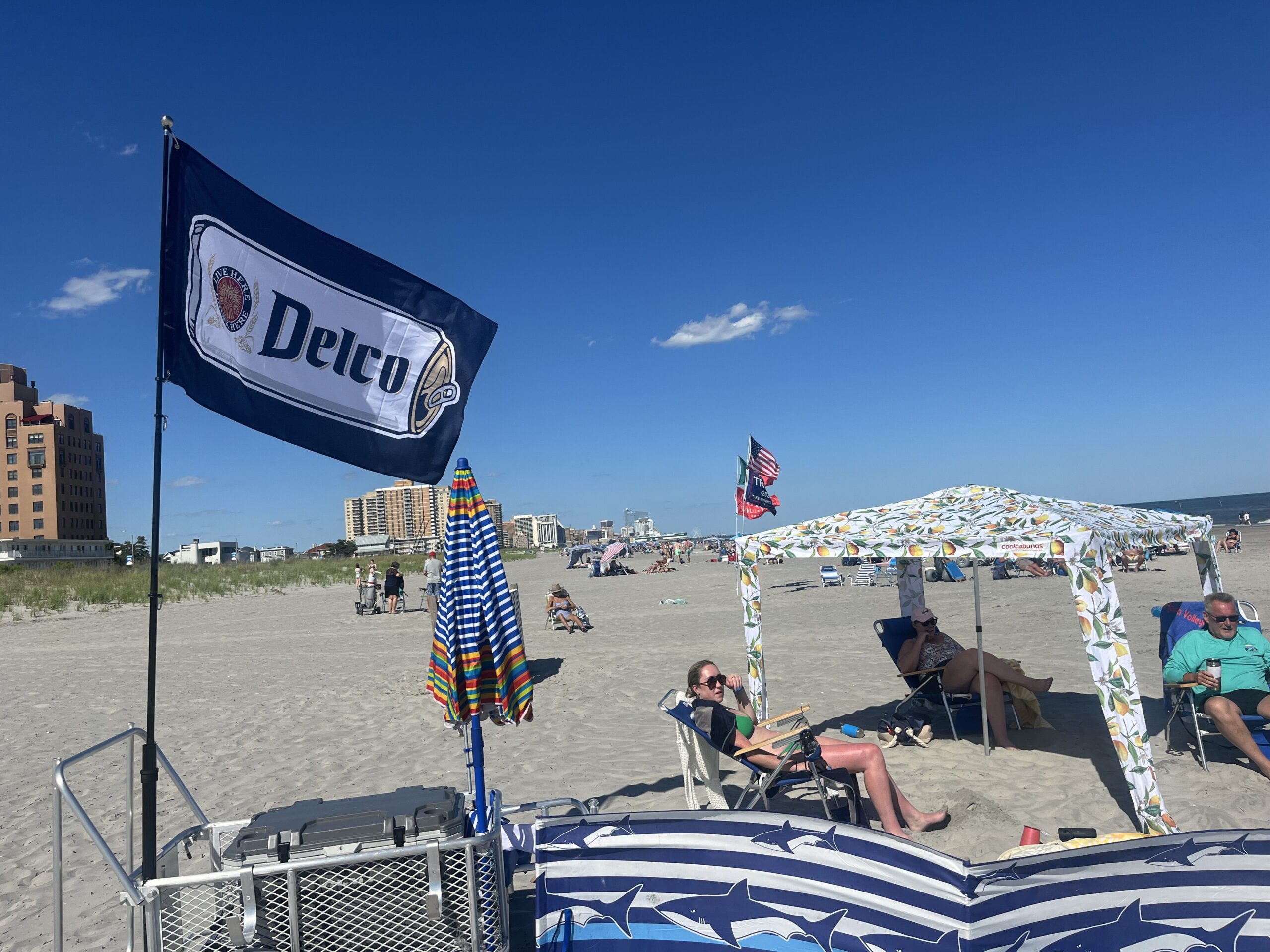
Delco residents haven’t spent years putting the word Delco on everything, receiving national attention for some of the most bizarre crimes imaginable, and staking their giant Delco flags at the Jersey Shore like it was the moon to have some ersatz “Delco” capitalize off their questionably good name.
The Hurley family of Springfield, Pa., flies their Delco flag on the beach in Ventnor in 2024.
“We’ve defined what it means to be Delco,” Rob MacPherson, executive vice president and chief marketing officer for Visit Delco, told me.
Fran McElwee, marketing strategist for the county tourism agency, agreed.
“We are who we are and we know it,” she said. “We’re the OG.”
Requests for interviews with a representative of DELCO, the New York lifestyle brand, and with the president of the board of supervisors for Delaware County, N.Y., were not returned. Isn’t that interesting.
Rural vs. suburban
There are at least six Delaware Counties in the United States, one each in Indiana, Iowa, New York, Ohio, Oklahoma, and Pennsylvania. But ours was the first, having been established in 1789.
While many of those counties also use some form of Delco (DelCo, Del-Co, etc.) for municipal government website URLs or public utilities names, Delaware County, N.Y., appears to be the only one trying to co-opt Delco as a culture.
Our Delco and the one in New York were both named after the Delaware River, which forms the border between the Empire State’s Delaware County in its southern tier and Pennsylvania’s Wayne County, in the far northeast.
Both counties also have municipalities named Middletown, we don’t like New York City folks coming in and mucking stuff up, and we have an affinity for mullets, as evidenced by the models on the DELCO lifestyle brand’s website. But that’s where the similarities end.
Delaware County, N.Y., is rural (which, if you’re from real Delco, would be pronounced so it rhymes with “gurrrl” for emphasis). It’s 1,467 square miles with 29 municipalities and 44,191 residents, so it’s safe to assume there are more deer there than people.
According to the county website, top activities include fishing, snowmobiling, and hiking. Historically, the region was known for its sawmills, dairy farms, and the Western Catskills.
Delco, Pa., on the other hand, is more suburban than a Chevy or a cul-de-sac. It shoves 49 municipalities and 584,882 people into 184 square miles. This county is like a damn clown car. We don’t even know how we all fit in here, we’re just along for the ride.
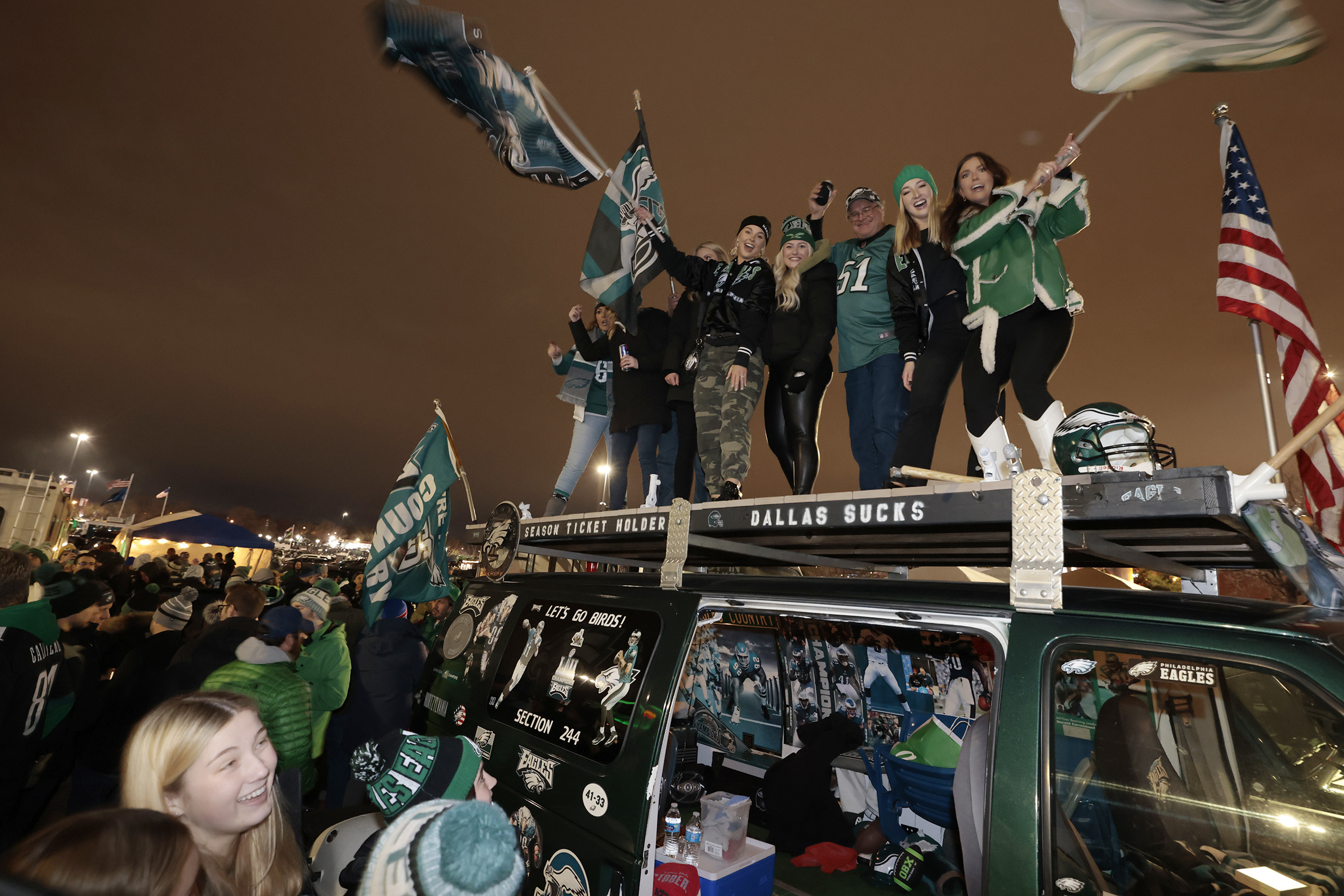
Eagles fans wave team flags from the top of their van while tailgating near Lincoln Financial Field.
But our greatest asset, what makes us the real Delco, is our culture.
People here are so passionate they’ve made a Delco movie, Delco beer, and Delco-set TV shows. Residents get Delco tattoos, there’s a state-recognized Delco Day, and I once interviewed a guy who climbed Mount Kilimanjaro with the sole purpose of waving a Delco flag at the top.
Roddie Cooper’s driving force to climb Mount Kilimanjaro was to get this photograph of the Delco flag at the top.
So whenever “Delco,” N.Y. wants to wave one of its flags in truce, we’ll gladly come take it.
‘A way of life’
“Delco is different, it’s a personality, it’s a way of life, there’s an authenticity about Delco you don’t find in other counties,” McElwee told me.
Zac Beaver, programming and libraries manager for the Delaware County Historical Society, said Delco’s hyperlocal culture sets it apart. It has its own accent, history, and even its own love language.
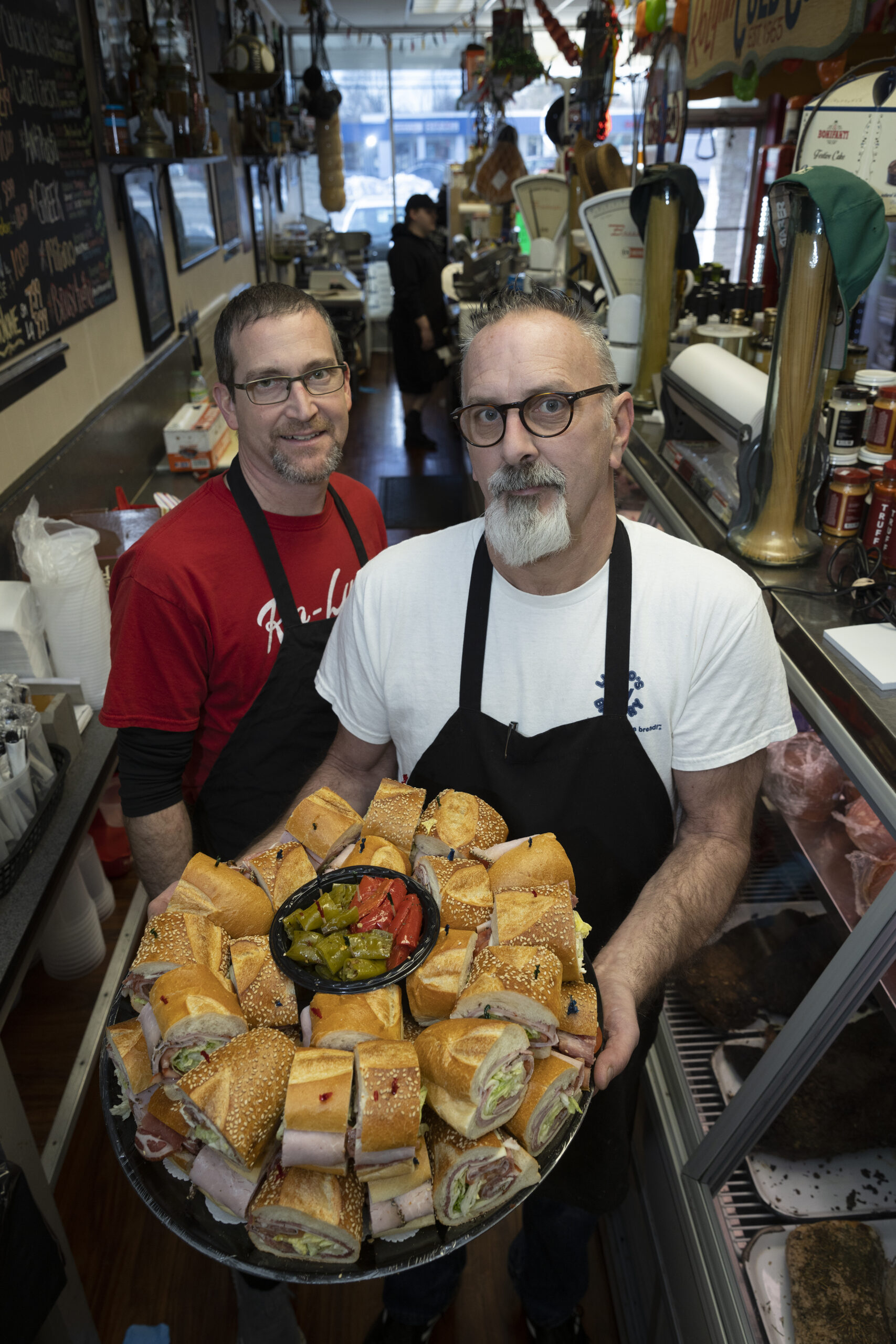
“A hoagie tray is a meaningful unit of generosity,” Beaver said.
Dave Avicolli (left) and Steve Yancey, co-owners of Ro-Lynn Deli in Brookhaven hold a “meaningful unit of generosity,” a Delco hoagie tray.
There are even unspoken rules for Delco neighborhood bars.
“They don’t have a website, only a Facebook page at most,” MacPherson said. “And no more than two IPAs on tap.”
He theorized that part of the county’s strong identity comes from the fact that there are so many municipalities and many folks attended Catholic schools or school districts like Interboro, which cover several townships.
“So your commonality was your county and not your hometown,” MacPherson said. “I think that’s led to the notion of Delco.”
Delco residents “don’t have very lofty ideas about what it means to be from Delco, like [they would] if they were from New York City or California,” Beaver told me, and they may come across to some as brusque, but that’s just because they’re engaged and “as likely to say something negative as positive to you, whereas in the rest of the country they just won’t talk to you,” Beaver said.
Such hyperlocal culture isn’t true of everywhere, Beaver posited.
Actor Brian Anthony Wilson during the red carpet premiere of “Delco: The Movie” at the Media Theatre last year. Yes, “premier” is spelled wrong on the marquee. Yes, that is very Delco.
“If you live in suburban Iowa you might as well live in suburban Nebraska,” he said. “I think it has to do with the flattening of the American experience. I think everyone else has changed more than we have.”
Philly’s other burbs also have their own culture but don’t exhibit the level of outward pride I see in Delco. I asked Beaver if he had any theories.
“Because they’re rich,” he said. “They’ve been desirable places for a long time. Delco was looked down on for a long time … and that makes people proud of it.”
MacPherson agreed.
“The pride comes from having a little bit of a chip on the shoulder,” he said.
‘By sheer force’
It’s unclear when Delco was first used as a nickname for Delaware County, Pa., but embarrassingly, the first Delco reference I can find in The Inquirer’s archives was for a guest from Delco, N.Y. who checked into a Philadelphia hotel in 1860. (I don’t know why newspapers used to print hotel registries, aside from the act we’ve always been nosy little buggers.)
In 1861, The Inquirer referenced a Del.co that appears to be the one in Pennsylvania, and I found subsequent Del.co references in our archives throughout the late 1800s. It’s only shortly after the turn of the 20th century that Delco seems to have come into regular use when referring to things and people from the suburban county.
“There is the Delco Baseball League founded in 1908 and they still exist,” Beaver said.
Delco is also a brand name. There’s ACDelco automotive parts (a remnant of Delco Electronics), Delco flatware, and Delco Foods, an Italian food distributor in Indiana. So there’s a minute possibility “Delco,” N.Y., could have been inspired to take its name from one of them.
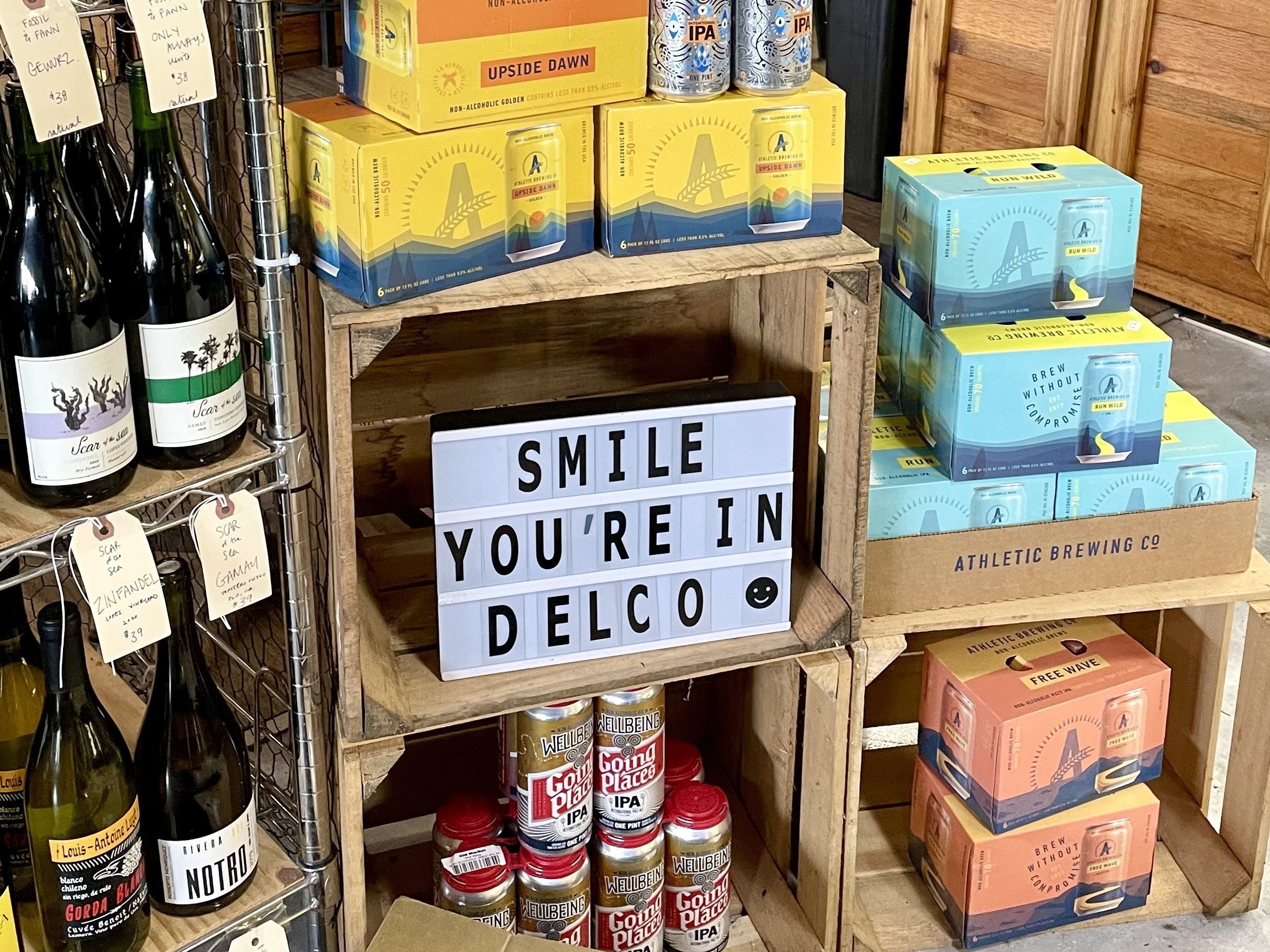
A “Smile You’re in Delco” sign greets the thirsty shoppers at 320 Market Cafe in Swarthmore.
I even found an 1879 reference to a man named Delco in a crime blurb in The Inquirer:
“ … In Cincinnati yesterday two men Jim Dermont, the cook, and Isadore Delco, a server in a Sixth Street restaurant, quarreled over the dignity of their respective positions, and Delco was badly stabbed.”
I didn’t find a follow-up story but I have no doubt Delco survived the fight, because it always does — at least in Southeastern Pennsylvania.
So to this phony flimflam “Delco” — bring it on. We’ve been around longer and we have more people, more pride, and more culture. Plus, as Philly sports fans and Delco residents, we have a chip on our shoulder bigger than a family bag of Herr’s.
“Just by sheer force, we’re winning,” McElwee said.
There were the usual favorites on both sides of the ball — as well as a few new faces — and a grizzled veteran that fans can’t seem to agree on.
Eagles fans want pending free agent linebacker Jaelan Phillips back next season, but they're split over veteran Brandon Graham, who came out of retirement last year.Yong Kim / Staff Photographer
The Eagles have long-since been eliminated from Super Bowl contention, after their wild-card round loss to the San Francisco 49ers. But the conversations around what went wrong with the Birds last year are ongoing, as the team continues to search for a new offensive coordinator and prepares for what’s sure to be a busy offseason.
We asked you, our readers, which Eagles you want to see stay or leave the team for next season. Here’s what we found — and how some of those results compared to what beat writer Jeff McLane expects the team to do …
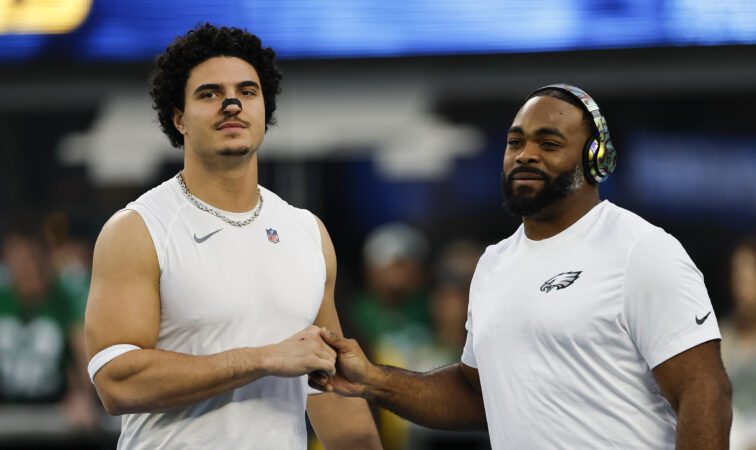
The Eagles’ All-Pro cornerback duo, Quinyon Mitchell (96.4%) and Cooper DeJean (96.1%), graded out the best of any Birds players. But they weren’t alone. Jordan Davis (96.1%) tied DeJean after a breakout year.
The best defense
It’s not just those two. Overall, 19 Eagles earned over 90% stay votes in this year’s poll, despite the early playoff exit — 12 of those players were on defense or special teams, including Zack Baun (95.8%), Jalyx Hunt (95.3%), and more.
On the offensive
There were fewer on offense — seven in total — who received at least 90% stay, including four offensive linemen: Lane Johnson (91.8%), Jordan Mailata (95.9%), Landon Dickerson (93.6%), and Cam Jurgens (91.2%).
Hurts remains popular
Quarterback Jalen Hurts (85.7%), however, was not one of them. That doesn’t mean he’s unpopular — he finished just a few percentage points shy of his Super Bowl MVP season (89.5%), and is not going anywhere.
Brown takes a hit
That’s nothing compared to the dip A.J. Brown (62.3%) saw. The wide receiver came in at 88.8% stay following last year’s Super Bowl run. But after a season wrought with controversy, where Brown looked like he may have taken a step back, fans have soured a bit on Brown.
Tight ends on the move?
Backup tight end Grant Calcaterra (36.8%) fell over 55 points from last season — down from 92.3% stay after 2024 — but fans still love Dallas Goedert (79.4%). However, Jeff McLane thinks both pending free agents will be wearing different colors next year.
Love ’em or hate ’em
Overall, the results on the offensive side paint an interesting picture, with no one player landing in the middle 20%, between 40-60% stay. Fans know what they want.
Special requests
That includes the team’s specialists. An overwhelming majority want punter Braden Mann (94.2%) back next season. The same can’t be said for veteran kicker Jake Elliott (23.2%), who saw the biggest year-over-year drop. McLane thinks the team will agree.
A difference of opinion
Franchise legend Brandon Graham (40.6%) un-retired midway through the 2025 season, and he said after the season that he felt he still had more in the tank. He was one of the most polarizing players in the poll, with a slight majority voting for him to go.
The kids are all right
Howie Roseman also had a good year, according to fans. The Eagles’ rookie class, headlined by Jihaad Campbell (95.6%) and Drew Mukuba (90.3%), graded out well after its first NFL season.
The new guys
The Birds traded for Jaelan Phillips (81.4%) at the trade deadline. While the move didn’t ultimately lead the Eagles to the Super Bowl, the pending free agent quickly became a fan favorite. Running back Tank Bigsby (94.7%) graded even better — and higher than Barkley.
Check out the full results
We’re done breaking it down for you. Let’s put the numbers directly at your fingertips — simply hover over or click on a player on the chart to see not only what percentage of stay votes they received, but also what McLane thinks will happen.
So what does the future hold for these players? The NFL’s new league year begins on March 11 — that’s when teams are permitted to execute trades and begin signing new players. Stay tuned.
“When I did the tour I was just wowed by it,” recalled DiMeo, an attorney at Rosen, Schafer, & DiMeo.
Their corner unit faces southeast, flooding the apartment with natural light through windows that stretch from the floor nearly to the ceiling. The 1,200-square-foot unit features an open-concept floor plan with two bedrooms and two bathrooms.
“We love the city feel, seeing the skyline,” said Levari, a court stenographer. She opens the windows each morning, letting in the fresh air and sounds of the city. “I will follow the light around the apartment throughout the day, finding the sunniest spot to enjoy a good book.”
The kitchen, dining area, and living room, where light pours in from the nearly floor-to-ceiling windows.
“Replacing the old office windows with floor-to-ceiling glass was a complex work sequence but necessary in order to transform the interiors, bringing in natural light and city views that define the new apartments,” said property manager Jennifer Oyola.
The design pays quiet tribute to its origins, honoring the strength and scale of a classic Center City high-rise while reshaping it for the way people live now, she added.
The couple enjoy dining in front of the wall of windows, watching the activity down below. In the evening, they admire the sights of City Hall, Liberty Place, and other buildings lighting up.
The guest bedroom, with views of the street below.DiMeo says dining in the apartment feels like dinner at a fancy restaurant.
“Frank says he feels like he’s at a fancy restaurant with the view, especially at night,” Levari said.
Both love to cook, and Italian food is their specialty. The kitchen is equipped with Samsung appliances, including a smart oven with phone app features, which is especially helpful to ensure they turned the stove off, Levari said with a laugh. There is plenty of counter space for meal prep and a lot of cabinet space.
The apartment’s construction — windows framed in black, light brown luxury vinyl tile plank floors, and plentiful glass — lends itself to a contemporary design.
Levari chose mostly neutral tones with pops of color to complement the look. She enjoys mixing classic pieces with vintage styles.
The Alanda glass coffee table, made by Italian designer Paolo Piva, complements the apartment’s contemporary style.
The living room features a lush velvet navy blue couch, a comfy spot to curl up on weekend nights and watch TV. The couple bought their Alanda glass coffee table, made by Italian designer Paolo Piva, at B&B Italia in New York.
“It’s one of those designs that never goes out of style,” Levari said.
The guest room/office includes the bedroom furniture she shipped over from Italy, where she lived for many years and taught English. It’s a comfortable reminder of the time she spent there. The only drawback is that the mattress is a European size that would be difficult to replace and it’s hard to find sheets that fit.
“I felt it was worth it for the memories, look, and quality,” Levari said. “It’s hard to find pieces of quality that you love. Therefore, the shipping cost made sense.”
The walnut Renaissance revival style cabinet in the primary bedroom came from a vintage shop outside of Como, Italy.
The kitchen provides ample counter space and cabinet storage, with stainless steel appliances and gold details.
Levari and DiMeo appreciate the building’s amenities, starting with the rooftop, which includes a saltwater pool, sauna, and cold plunge.
“You really get the city vibe there because it’s on the 19th floor and you have all the highest buildings in the city surrounding you,” Levari said.
Other amenities include the fitness center with a turfed area for cross training, pickleball and basketball courts, a yoga studio, and sport simulator. A club-style lounge includes a chef’s prep kitchen, private dining room, and billiards table. For furry friends, there’s a pet spa and park.
Decorations on the dining room table echo the gold details in the kitchen.The apartment is decorated in neutral tones with some pops of color, like this throw pillow on the guest bed.
The couple are embracing life in the city, where they can walk to great restaurants, shows, concerts, and the ballet. But they are also happy to come back home.
“Having our corner apartment with the huge windows makes it feel like I’m on vacation,” said DiMeo.
Is your house a Haven? Nominate your home by email (and send some digital photographs) at properties@inquirer.com.
The 2025 Eagles season may be over, but the work to retool the roster and position the team for success in 2026 has already begun.
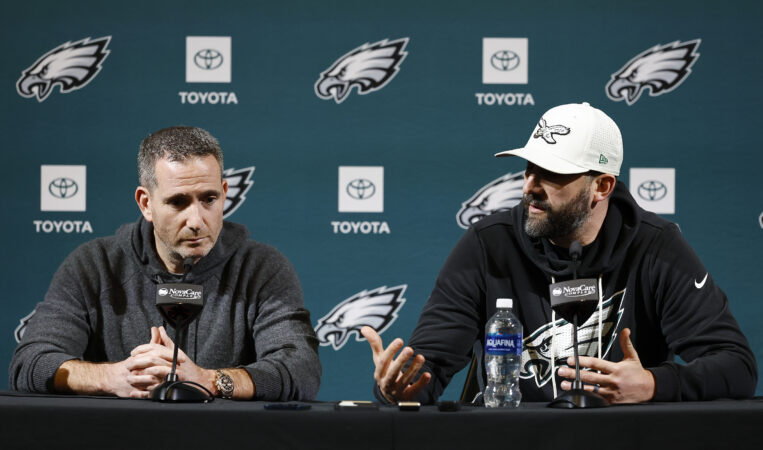
Jeffrey Lurie, Howie Roseman, and Nick Sirianni are tasked with making a variety of staffing and personnel decisions over the next several months in an attempt to return the Eagles to Super Bowl contention next season. The offensive coordinator vacancy is generating the most buzz, but it’s far from the only consequential move they will have to make ahead of training camp in late July.
With the coaching carousel spinning and free agency and the draft looming, here’s where the triumvirate could start with their decision-making:
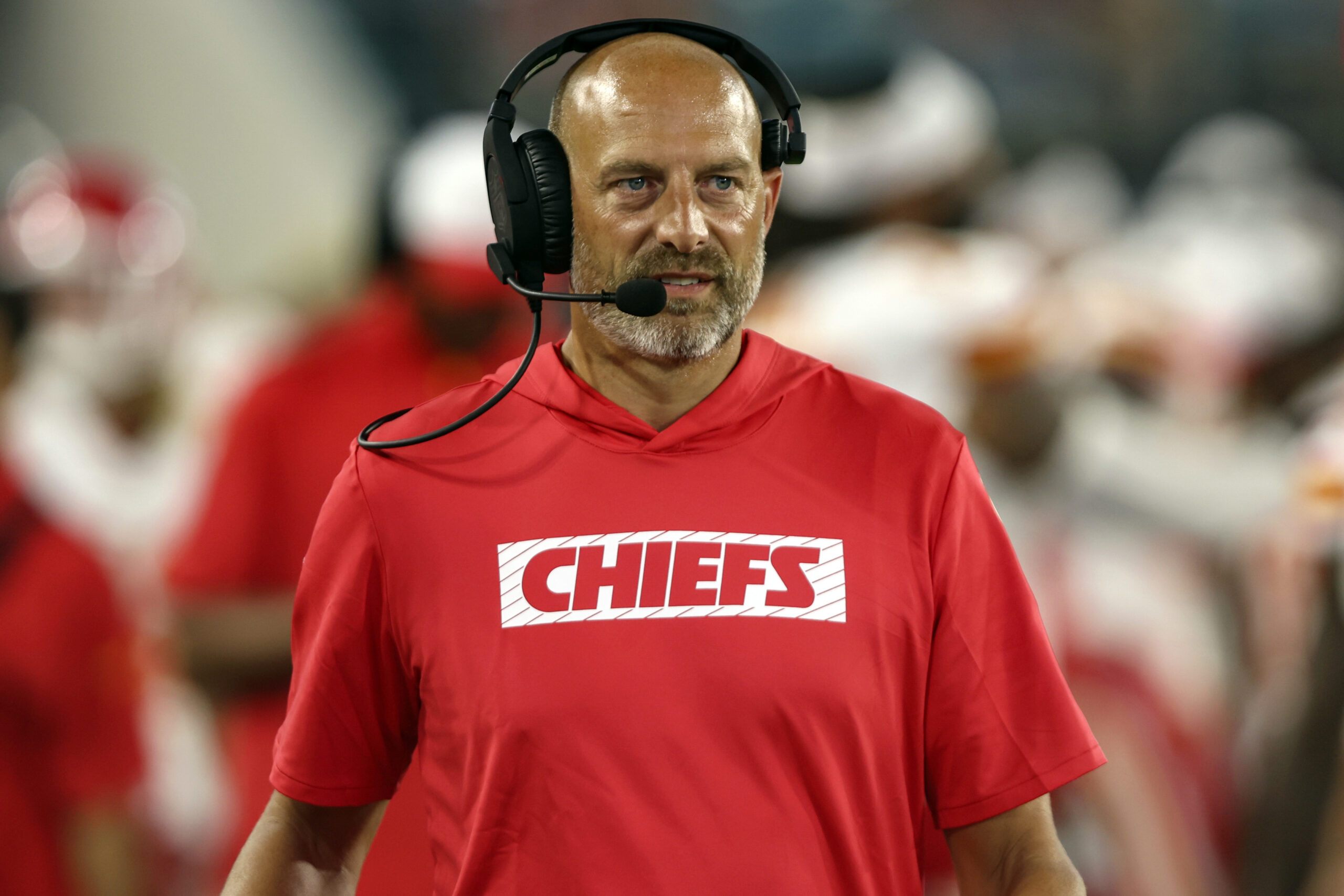
Would the Eagles let a candidate like Matt Nagy cook, and run his own side of the ball the way the team has with Vic Fangio?
Hire the best candidate as offensive coordinator — no matter their expected longevity
The Eagles are well into their interview process as they work to identify their next offensive coordinator. Like Kevin Patullo before he was promoted last offseason, some interviewees have never called plays (including Green Bay Packers quarterbacks coach Sean Mannion), while others have ample experience (such as former Kansas City Chiefs offensive coordinator Matt Nagy).
Play-calling experience shouldn’t be the sole determining factor. The Eagles ought to prioritize the candidate who, in Sirianni’s words, can help “evolve” the offense and make it a more explosive unit than the one that trotted out on the field last year. That candidate ought to put players in positions to work to their strengths while also implementing modern, fresh concepts. That candidate should also have the autonomy to run the offense he envisions.
No, the Eagles shouldn’t necessarily seek out a Vic Fangio-type — a veteran coach with no aspiration to move on to a head coaching job — to fill that role. Who would turn down a candidate who puts them in the best position to field a championship-caliber offense simply because of the threat that he would get poached at the end of the season? The Eagles lost Kellen Moore after the 2024 season but they also won a Super Bowl, an outcome they wouldn’t trade given a do-over. Such is life when the head coach doesn’t call plays.
“It’s a great compliment when guys get head coaching jobs from here because it means we’re having tremendous success,” Roseman said on Jan. 15. “As much as you’d like to have continuity and would like to have guys here for a long period of time, we want to win. We have an urgency to win right now. If that comes with the ramifications that we lose good people because they’ve earned head coaching jobs, we’ll live with that.”
The occasional headaches that come with the A.J. Brown experience don’t outweigh his elite playmaking ability.
Keep A.J. Brown
Will A.J. Brown remain an Eagle in 2026, let alone finish out his contract that runs through 2029?
No one can read Brown’s mind and determine whether he still wants to be in Philadelphia. He hasn’t spoken publicly since Dec. 8 following the Eagles’ overtime loss to the Los Angeles Chargers. Earlier in the season, though, he voiced frustration with the listless offense and his role within it, both online and in interviews with the media. His concerns, especially given the state of the offense, were understandable.
But his performance hit some rough patches this season, especially in the wild-card loss to the San Francisco 49ers. Brown had three receptions on seven targets for 25 yards, including a couple of drops and a spat on the sideline with Sirianni (the Eagles head coach later said he had been trying to get Brown off the field after the offense went three-and-out).
Roseman didn’t explicitly rule out a trade when asked about Brown’s future at the end of the season. There would be short-term financial ramifications that come with a trade, either before or after June 1, but the Eagles would experience some salary cap relief in future seasons.
Still, the Eagles are often at their best offensively when Brown is thriving. He remains one of the best receivers in the NFL, which ought to be a boost to a team fighting to keep its Super Bowl window open. It should be in the Eagles’ interest to keep him in the fold, especially given the difficulty of replacing WR1. Hire an innovative offensive coordinator, ensure that Brown is still on board with the new scheme, and move forward.
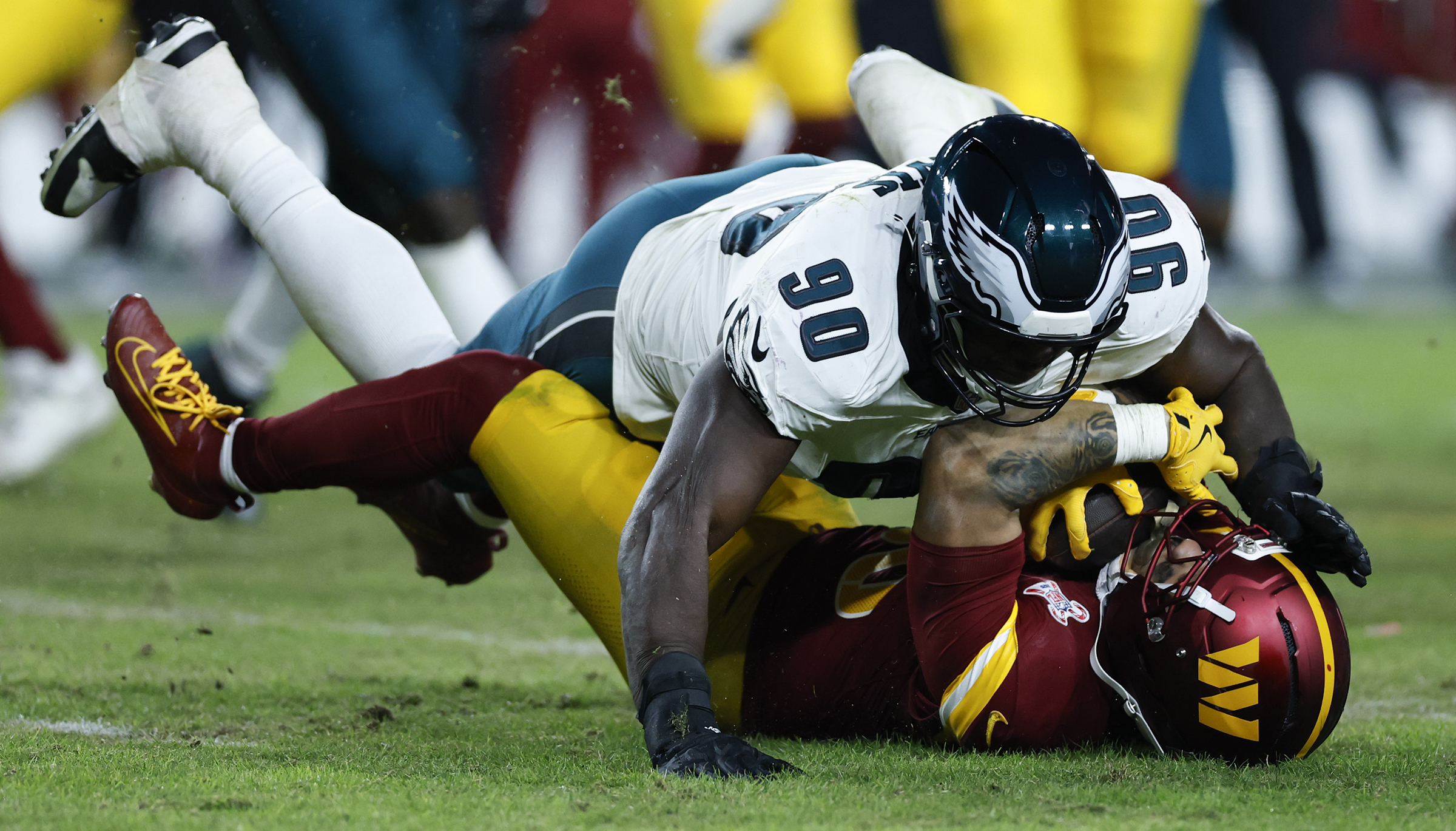
Eagles defensive tackle Jordan Davis (90) comes off a breakout year.
Extend Jordan Davis
In a span of approximately eight months, Jordan Davis showed why Roseman made the right decision by picking up his fifth-year option.
The 6-foot-6, 336-pound defensive tackle ascended into a nearly-every-down role in 2025, his fourth season with the Eagles. He played a career-high 61% of the defensive snaps, and perhaps most importantly, his strong performance was consistent from the outset of the season through its conclusion. Davis finished the year with career highs in run stops (50, according to Next Gen Stats) and sacks (4½).
His rare blend of size and athleticism is just one facet of his importance to the team. Davis stepped into a leadership role and helped set the culture in 2025, too.
“My leadership style … it’s just mainly keeping the guys together and being an example, being a positive influence and being a positive force in the locker room, on the field,” Davis said at locker clean-out on Jan. 12. “That’s not going to stop. That’s how I live life. That’s not going to stop. I’m excited to see where it can go and where it could go and the potential of it all.”
Players like Davis are hard to find. It would behoove Roseman to extend him early, just as he has with other key players in recent years, in an effort to prevent him from testing the open market.
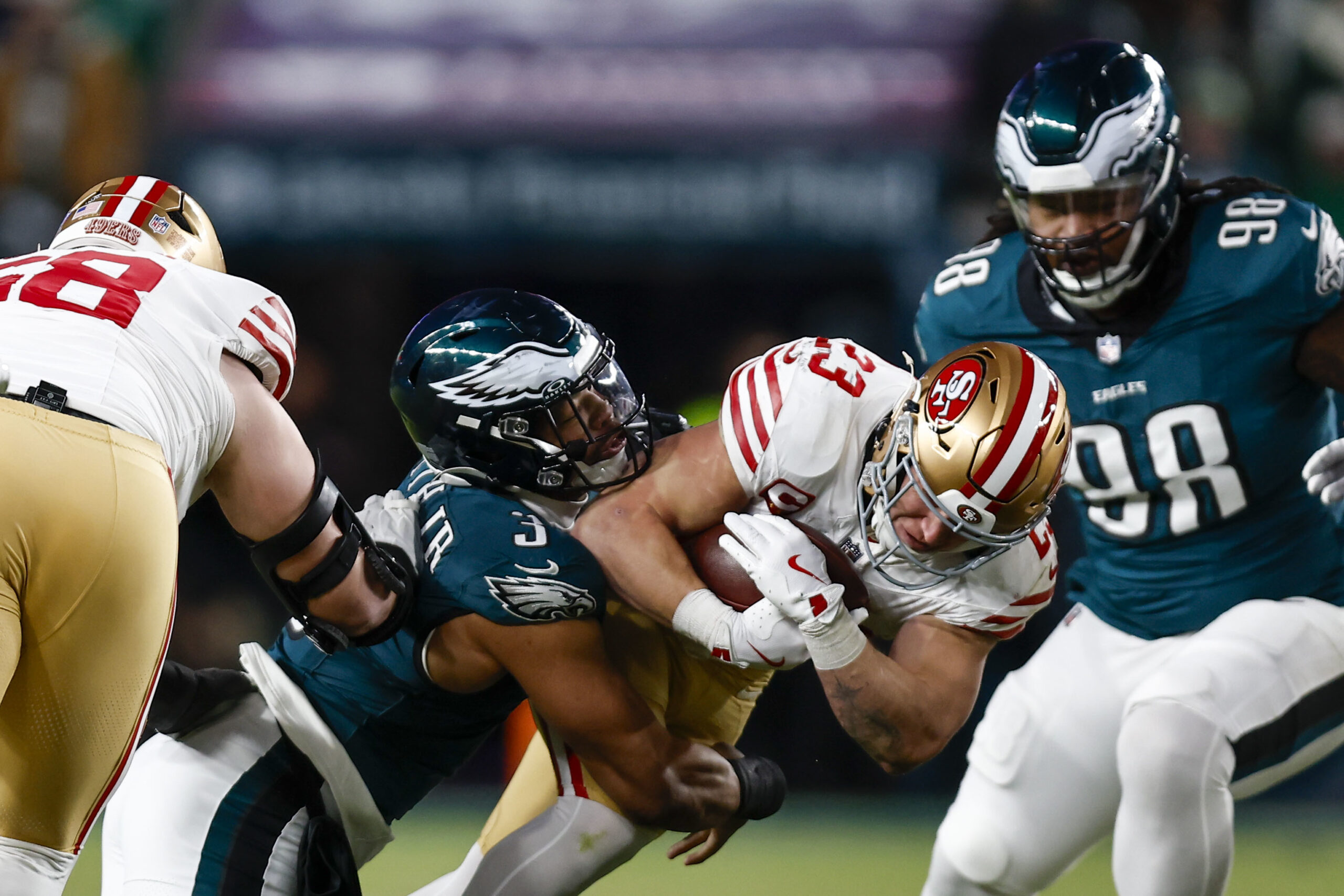
Nolan Smith Jr. (3) and Jalen Carter (98) are approaching option decisions.
Pick up Jalen Carter’s and Nolan Smith’s fifth-year options
Speaking of fifth-year options, Jalen Carter and Nolan Smith are eligible to have theirs exercised this offseason. Roseman will have until May 1 to make that decision on his 2023 first-round draft picks.
The Eagles ought to pick up both, even though Carter and Smith saw their 2025 seasons impacted by injury. Roseman may even consider extending Carter as early as this offseason, provided he’s convinced Carter’s shoulder issues won’t be long-term concerns.
Even though Carter finished the season with a career-low 7.7% pressure rate, according to Next Gen Stats, he played his way into a potential raise in Year 5. Carter was named to his second Pro Bowl on the original ballot this season, which places his fifth-year option in the highest salary tier possible at his position. His fifth-year base salary would be equivalent to the defensive tackle franchise tag value in 2026, which is projected to be $25.6 million, according to Over The Cap.
Smith’s fifth-year option is projected at approximately $15 million, the lowest salary tier among outside linebackers.
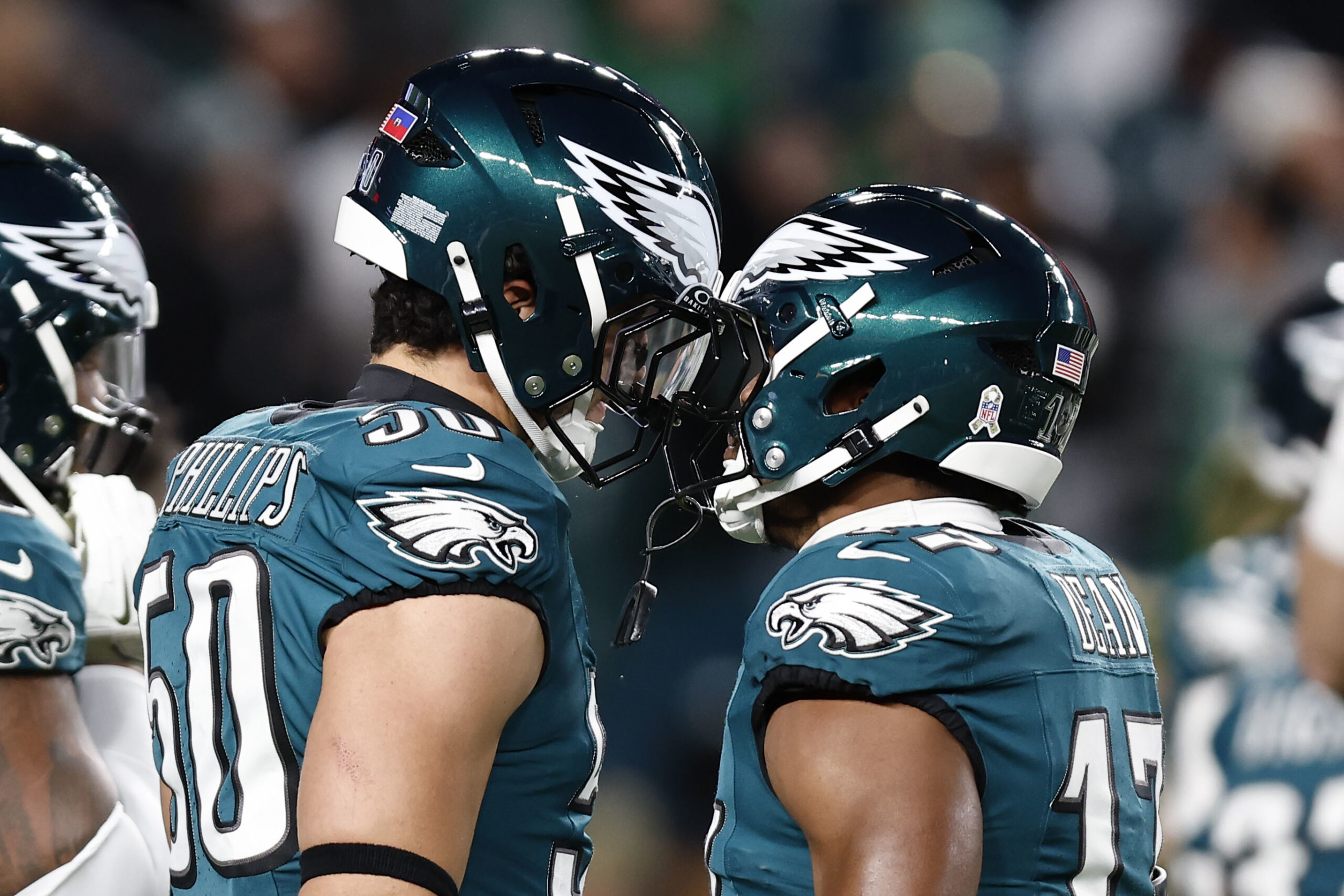
Jaelan Phillips (50) and Nakobe Dean (17) are popular in the Eagles locker room, but a tough business decision around both looms.
Let Nakobe Dean and Jaelan Phillips walk
In the creative writing business, this step would be referred to as “killing your darlings.”
The Eagles have 18 pending unrestricted free agents and Roseman can’t keep them all, nor would he want to bring them all back due to poor performance from certain members of that group. But even some of the team’s more talented, beloved players likely won’t stick around, especially Nakobe Dean.
Roseman has displayed a preference in the past to reward his homegrown talent with extensions. In a vacuum, Dean would be a worthy candidate, given he rebounded from a major injury and proved he’s still a starting-caliber talent in 2025. But with Jihaad Campbell waiting in the wings, Roseman may want to let his 2022 third-rounder out of Georgia walk. Campbell and Baun are a strong starting pair and Jeremiah Trotter Jr. is a capable backup.
What about Jaelan Phillips, the 26-year-old outside linebacker whom the Eagles acquired from the Miami Dolphins at the trade deadline? Phillips led the team with 34 pressures after he joined in Week 10, according to Next Gen Stats. But he turned just two of those pressures into sacks, good for a 5.9% pressure-to-sack conversion rate (10th lowest among 97 defenders with at least 15 pressures since the trade deadline).
Unless the Eagles can bring Phillips back on a team-friendly deal, they may have no choice but to allocate money elsewhere. Spotrac projects Phillips’ market value at $17.3 million annually.
Safety Reed Blankenship’s spot on the 2026 roster is far from assured.
Re-sign Reed Blankenship and Braden Mann, barring unreasonable asking prices
Among the pool of pending free agents, a couple of candidates for extensions stand out who might not break the bank — Reed Blankenship and Braden Mann.
Blankenship, the 2022 undrafted free agent out of Middle Tennessee State, was a captain and a key communicator in the Eagles secondary in 2025. He wasn’t flawless, as evidenced by his late holding penalty in the wild-card loss to the 49ers that eventually led to a touchdown.
Still, the 26-year-old safety has a solid body of work over the course of four seasons. His departure would leave a leadership hole in the secondary and a question mark alongside Drew Mukuba, who is still in the process of proving himself as he rebounds from a fractured fibula that ended his up-and-down rookie campaign.
Of course, whether Blankenship returns will depend on his asking price. The Eagles were eager to get C.J. Gardner-Johnson’s contract off the books this time last year, and he was making $9 million per year. Blankenship has a market value of $7.2 million per year, according to Spotrac’s projection.
Mann, the 28-year-old punter, is also set to become a free agent at the start of the new league year. He undoubtedly earned himself a new deal, potentially with the Eagles, as he averaged a franchise-best 49.9 yards per punt in 2025.
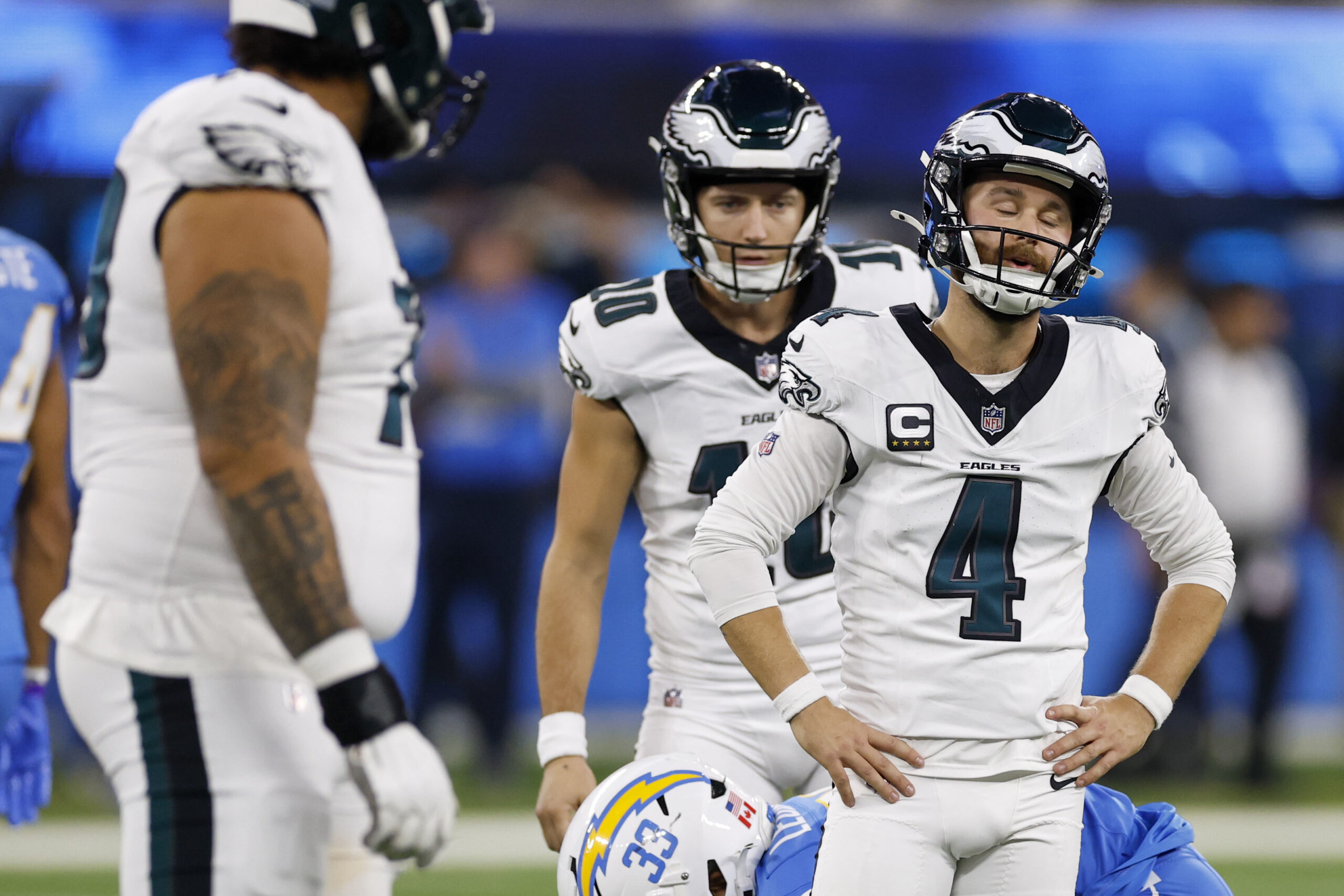
The Eagles can’t assume Jake Elliott’s shaky performance in 2025 was an anomaly.
Bring in competition for Jake Elliott
Even though Jake Elliott had a rough stretch of games in 2024, making 19 of 25 field goal attempts in the final 10 games of the season (76%), the Eagles stuck with him as their kicker in 2025.
This offseason could be different. Once again, Elliott had a shaky showing over a 10-week span during the regular season, going 13-for-20 (65%) on his field goal attempts. Elliott also missed a critical extra point while battling the wind in the wild-card loss to the 49ers. His 74.1% field goal percentage on the season was the second-worst rate of his career (73.7% in 2020, although he only attempted a career-low 19 field goals that year).
Elliott may have some equity given his otherwise robust nine-year Eagles career, but it’s fair to wonder if that equity has run out given his struggles in consecutive seasons. It might be time to evaluate other options at kicker in training camp if Elliott’s best days are behind him.
Given Lane Johnson’s age and recent injury history, the Eagles must do some serious scenario planning at right tackle.
Figure out (and potentially enact) the RT succession plan
After a Lisfranc injury in his right foot curtailed his 13th season with the Eagles, does right tackle Lane Johnson still intend to play in 2026?
Johnson, who turns 36 in May, is technically under contract through 2027. But is he healthy enough to continue playing or is he contemplating retirement this offseason?
Regardless of his decision, Roseman must figure out the succession plan at right tackle. He could have an opportunity to find Johnson’s heir apparent through the draft. The Inquirer’s Devin Jackson identified a handful of tackles (some with guard versatility) the Eagles could target with the No. 23 pick in the draft, including Alabama’s Kadyn Proctor, Utah’s Caleb Lomu, and Georgia’s Monroe Freeling.
Could Roseman look internally to eventually fill Johnson’s role? The Eagles drafted a pair of tackles last year in Myles Hinton (sixth round out of Michigan) and Cameron Williams (sixth round out of Texas). Both players spent a chunk of the season on injured reserve, and only Williams earned playing time, in the season finale against the Washington Commanders. They weren’t blue-chip prospects, but Jeff Stoutland has a history of developing lesser-known players into starting tackles (i.e. Jordan Mailata).
Dallas Goedert and Grant Calcaterra are both set to become free agents.
Figure out (and most likely enact) the TE succession plan
For a second straight year, Dallas Goedert enters the offseason uncertain about his future with the Eagles.
The 31-year-old tight end is set to become an unrestricted free agent at the start of the new league year, which could mark the end of his eight-year career in Philadelphia. Goedert was a revelation in the red zone in 2025, scoring 10 of his 11 touchdowns during the regular season inside the opponent’s 20-yard line. Given his scoring ways, though, he might have earned himself a raise on the open market.
With Goedert, Grant Calcaterra, and Kylen Granson all poised to become free agents, the Eagles will likely have to draft a tight end this year and sign one (or two) in free agency. Given the importance of the ground game in the Eagles offense, it is imperative that the TE1 of the future can run block in addition to his responsibilities as a receiver. Goedert appeared to take a step back in his run-blocking performance in 2025, as did most of the unit that paved the way for Saquon Barkley.
Could some offensive playmakers be in the cards on draft day 2026?
Lean offense in the draft (including a wide receiver and a quarterback) …
Over a span of five years from 2018-22, the Eagles invested loads of premium draft capital into the offensive side of the ball. Roseman hit on a number of early picks, including Goedert (2018), Jalen Hurts (2020), DeVonta Smith (2021), and Landon Dickerson (2021), plus he acquired Brown from the Tennessee Titans in exchange for the 2022 No. 18 overall pick.
Aside from Goedert, each of those players have since been rewarded with contracts that will account for at least 3.4% of the salary cap in 2026 and as much as 10.4% in Hurts’ case. Beginning in 2022, Roseman balanced out what would become his expensive players on offense by adding defensive players on rookie deals, drafting Davis (2022), Dean (2022), Carter (2023), Smith (2023), Quinyon Mitchell (2024), Cooper DeJean (2024), and Campbell (2025). Roseman called this the “natural arc” of the team on Jan. 15.
“I think that when you look at our team, we draft a lot of offensive players, we re-signed a lot of offensive players, [and] we drafted a lot of defensive players that were young on rookie contracts,” Roseman said. “There’s natural transition in what we do.”
It’s time for the draft pendulum to swing back in the direction of the offense. With many of those aforementioned defensive draftees becoming eligible for extensions, Roseman is going to replace costly offensive veterans with players on rookie deals over time.
The Eagles already have an immediate need for a WR3, with Jahan Dotson a pending unrestricted free agent. As previously discussed, the team could also be in the market for a tackle, and even upgrades on the interior offensive line. Plus, with Sam Howell set to become a free agent and Kyle McCord signing a futures deal with the Packers, Roseman may want to add to the quarterback factory through the draft, too, although this year’s class lacks depth.
Is there another Jalyx Hunt in this year’s draft who could help the Eagles off the edge?
… but keep drafting edge rushers
Still, the Eagles have needs to address on the defensive side of the ball. Roseman is seemingly always good for one edge defender in every draft class. Smith and Jalyx Hunt are the only 2025 active-roster edge rushers who are under contract next year, so Roseman will need to make additions through the draft and free agency.
The Eagles will also be on the market for a CB2, as Adoree’ Jackson is set to become a free agent. Kelee Ringo has one year remaining on his rookie deal, but given his inability to win the starting role in Year 3, it seems unlikely that he will earn the job in 2026. While the Eagles could attempt to identify their next starting outside cornerback opposite Mitchell through the draft …
The Eagles might look to an Adoree’ Jackson-type veteran to lock down the opposite corner to Quinyon Mitchell.
Sign a stopgap veteran CB2
… the free-agent route worked well enough for them in 2025, and they could go down that path again in 2026. Few NFL teams invest heavily in all three cornerback spots. Given the Eagles’ needs on offense, Roseman could make another Jackson-esque signing (or even re-sign Jackson) to hold them over for another season or two instead of investing premium draft capital at the position again.
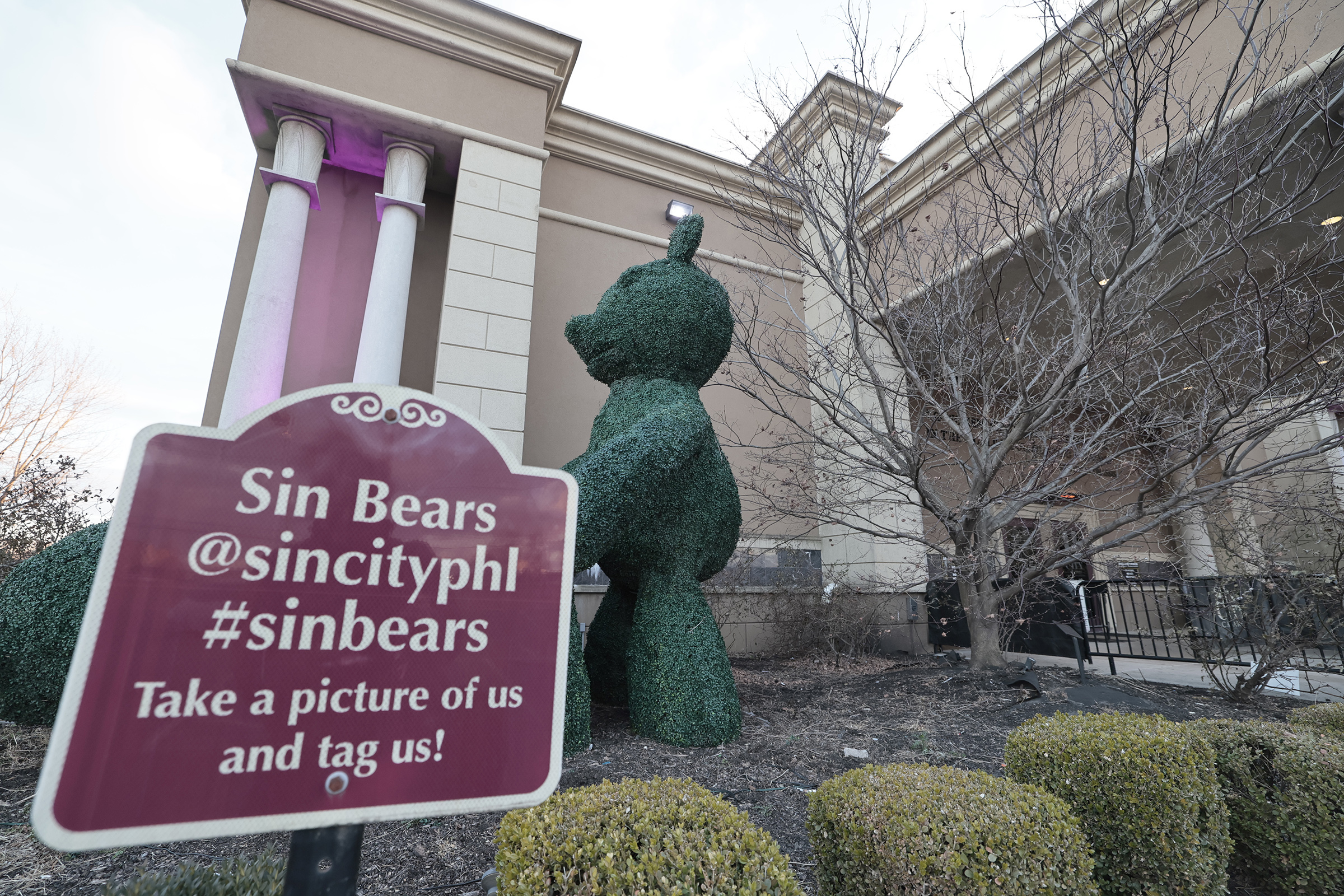
That’s what Gloucester County resident Gabby Weiland recalled thinking after she made a wrong turn while Doordashing in Southwest Philly earlier this month. Instead of finding a customer waiting on the curb for her lunch, Weiland found herself outside of Sin City Cabaret Nightclub at 6130 Passyunk Avenue. One 8-foot-tall topiary Care Bear bending over another greeted her.
“Got lost in Philly and pulled over to see where I was … looked up and —,” Weiland captioned a TikTok that pans from the fourth-base bears back to her face, which appears equal parts mortified and confused. The 12-second clip has racked up more than 1.4 million views — and its fair share of jokes.
“What in the bear necessities?” commented one TikTok user. “They…they’re…playing leapfrog…RIGHT???” wrote another. Others assured Weiland not to worry because the bears are clearly in a committed situationship.
Many, however, knew where the bears were. “Oh, you found Sin City,” read a comment that’s been liked more than 8,600 times. According to strip club owner Gus Drakopoulos, that means the topiaries are working.
“If someone does a double take and posts a video or selfie, then the art did it’s job,” said Drakopoulos, 49, who had the topiaries installed in 2021. “I want images of those bears to be synonymous with the brand Sin City.”
Drakopoulos opened the original Sin City in the Mott Haven section of the Bronx in 2002at age of 25 after a securities fraud conviction sidelined his career as a stockbroker. Almost immediately, the club earned a star-studded reputation: Rapper Cardi B was discovered while performing there, and celebs ranging from Mike Tyson to Philly’s own Meek Mill were regulars.
Sin City owner Gus Drakopoulos poses in front of the 8-foot-tall bear topiaries that sit in front of his nightclub. The bears cost $18,000, Drakopoulos said.
Drakopoulos was forced to close the OG Sin City for good in 2018 after the club lost its liquor license. He relocated it to Philly in 2020 just before the COVID-19 pandemic. The bears came a year later in November 2021, Drakopoulos said, as a way to signal to patrons that Sin City is a more artful, avant-garde gentleman’s club experience.
“The bears are playful and open for interpretation,” he said. “You can say they’re playing football. Go Birds.”
“I fell in love with the idea,” Drakopoulos said. “The bears look so innocent and at the same time, depending on the eye of the beholder, so not.”
Both sets of bears are designed by celebrity topiary artist Joe Kyte, whose 2-acre topiary garden in Tellico Plains, Tenn., has churned out larger-than-life dragons, Formula 1 cars, and semi-realistic bottles of booze for clients ranging from Legoland and Ferrari to Absolut Vodka since 1992.
Kyte got his start working as a subcontractor for Disney parks in the 1980s, he previously told The Wall Street Journal, fashioning hippos and various versions of Mickey Mouse out of materials ranging from ivy to moss. He told The Inquirer that his clients have only gotten raunchier. In 2020, Kyte was commissioned by a Dutch adult magazine to create a photorealistic vagina out of hydrangeas, rosemary, and mullein leaf for a launch party in Holland.
Drakopoulos, Kyte said, was the first strip club owner to ever contact him. It was an immediate yes, he said.
“This is the first time a strip club has paid me. Normally it’s the other way around,” Kyte, 67, joked over the phone.
Drakopoulos paid $18,000 for two bears, which Kyte took two weeks to construct by arranging weather-resistant artificial boxwood atop custom-made metal frames. To finish the job, Kyte and an employee had to drive to 687 miles to Philly to install the bears, at one point getting stuck for hours in standstill traffic on I-81 in Virginia. Bored drivers, Kyte recalled, couldn’t stop taking photos.
“It’s wonderful that the bears are standing the test of time … Wouldn’t you be proud of them?” said Kyte, who is planning another trip to Philly to do maintenance on the Sin City bears later this winter. The sun’s UV rays have bleached parts of the deep-green topiaries.
Another angle of the bear topiaries outside of Sin City Cabaret Nightclub on Passyunk Avenue. “The bears are playful, and open for interpretation,” owner Gus Drakopoulos said.
It’s unclear if the bears have lead to more business for the club, Drakopoulos said, which has a roster of roughly 500 dancers. In 2022, rapper and Super Bowl LIX halftime performer Bad Bunny dropped $50K at Sin City hours before his Made in America performance. It’s not uncommon for some of the Eagles roster to come through, Drakopoulos said, though he declined to name specific players out of respect for their privacy.
Weiland, whose video went viral, was unaware initially that the bears belonged to a strip club. She’s never been to one, though Sin City may wind up being her first.
“Apparently, they have good food,” Weiland said. “And it looked like a very well taken care of place.”
Job hunters beware: Some of the hard-earned skills listed on your resume are going unnoticed by potential employers.
Workers’ profiles on job posting websites often feature general abilities, like leadership, communication, teamwork, and problem-solving, a recent report from the Wharton School says. But they’re not highlighting the “specialized, execution-oriented skills,” employers are seeking. That’s created a “skills mismatch economy.”
“People are not representing their skills in a way that’s necessarily resonating with the skills that employers want,” said Eric Bradlow, the vice dean of artificial intelligence and analytics at the Wharton School, who co-authored the report.
Meanwhile, AI has been speeding the shift from a “role-based labor market to a skills-based economy,” the report outlines, making it all the more poignant to know what skills employers actually want.
Bradlow says generative AI has been “a positively destructive bomb on roles and titles,” by making workers able to carry out tasks that they didn’t know how to do in the past. So “having a specific job title is becoming less relevant.”
The Wharton School worked in partnership with Accenture, a professional services firm, to analyze millions of job postings and worker profiles for the report. The study useddata from Lightcast, a labor market data provider, andthe U.S. Bureau of Labor Statistics. Bradlow spoke with The Inquirer about their findings.
This conversation has been edited for length and clarity.
What are some skills included on resumes that don’t make much difference to employers, because everyone seems to have them?
Do we think it’s important to communicate? Well, yeah, of course, it is. Do we think it’s important to have leadership skills and manage teams well? Yeah, of course. Last time I checked, those were really important parts of the job — but everybody puts that down.
We’re not saying in the report that those skills aren’t important. What we’re saying is there’s an over supply of people stating those skills, as opposed to companies saying these skills are what’s going to get you the job.
Companies are realizing that depth of skill is what’s going to be really important.
Do people lack the specialized skills employers are looking for? Or are they just failing to highlight them on their resumes?
That’s something, trust me, I wish I could answer.
If we had people’s transcript data, or if we knew what courses someone had taken, then we could try to get an understanding of what skills people actually have.
I think two things are going to happen, based on this Wharton-Accenture Skills Index gap report. Number one is, you will see a migration where people [will say,] “I need to acquire those skills, if I don’t have them, if I want a job.” Second, you’ll see [organizations] — whether it’s an academic institution or a for-profit institution — saying, “Wait a second, here, we need more people with this skill. We’ll create a certification program.”
You found that some skills are actually tied to higher-paying jobs. Was that surprising?
I’m not sure I had hypotheses about which skills would be paid higher or lower.
I think maybe the part that surprised me a little bit was that there wasn’t massive swings and variation like “if you have this skill, your salary doubles.” That’s not what we found in the data.
What advice would you give someone crafting their resume?
One is talk about the specific skills you have. Every resume I read says “I’m an effective communicator, experienced leader.” That’s fine, but that’s not what’s going to stick out and become differentiated, because everyone’s going to say that. To the degree that you have specific expertise and depth or skills, those are the kinds of things to put on the resume.
The second thing I would say is that … we should be in the skills acquisition business, be a lifelong learner. Skills will always be valued. Jobs in a particular workflow can go away. People with skills will be hired.
Take, for instance, a customer-support agent in a customer-satisfaction group. If you’re someone with exceptional problem-solving skills, you’re hearing your customer, and you’re able to tie it to some remedy; that skill is not going to go away even if the job you’re currently in happens to go away.
What skills are needed more or needed less because of the adoption of AI recently?
I don’t view it as AI replacing humans. I view AI as that decision-support tool you should use for every decision.
If I were an employer today, I wouldn’t even consider hiring someone that didn’t recognize the power of artificial intelligence as a decision-support aid. I don’t know what business decision — pricing decision, product launch decision, product design decision, possibly even hiring decision — [for which] I wouldn’t use artificial intelligence as a decision-support tool.
I would also say, equally, I’m very concerned about the agentic use of AI — in some sense totally handing over high-stakes decisions.
From where you stand, is AI coming for people’s jobs, as we often hear, or is it coming for their skills? What’s the difference?
Go through the history of mankind.
The train engine came. So you mean we don’t need as many horses? Electricity came. You mean we don’t need as much coal? Green energy came, and so now we don’t need as much nuclear fusion?
Doesn’t technology always come and translate one set of jobs to another set of jobs? It’s not AI is coming for your job. What companies are realizing about AI is there are certain roles and functions that AI can do extraordinarily well, with high accuracy, and in some cases better than humans can do. These tend to be functions, by the way, that many humans don’t like doing anyway.
I don’t see AI coming for your job any more so than any set of technology. This is an extraordinarily disruptive technology, but we’ve lived through periods of extraordinarily disruptive technology.
“Terrible things are happening outside. At any time of night and day, poor helpless people are being dragged out of their homes … Families are torn apart; men, women and children are separated. Children come home from school to find that their parents have disappeared … Everyone is scared … No one can keep out of the conflict … the end is nowhere in sight.”
Donald Trump’s masked marauders murdered another U.S. citizen in Minneapolis on Saturday, a senseless killing in a senseless war playing out in broad daylight on America’s streets.
Cell phone videos showed one of Trump’s immigration enforcement goons violently pushing a woman to the ground. As a man recording the agents tried to intervene, at least seven federal agents surrounded and dragged him to the ground as another beat him with a canister.
As the agents struggled to subdue the man, another agent appeared to remove a gun from the scrum. A Border Patrol agent then shot the man in the back from close range. A third agent pulled out his gun as nine more shots were fired within seconds.
Several agents scampered away as Alex Pretti, a 37-year-old U.S. citizen with no criminal record, lay motionless on the street.
This undated photo provided by Michael Pretti shows Alex Pretti, the man who was shot by a federal officer in Minneapolis on Saturday.
After the shooting, a crowd of protesters shouted profanities at the federal officers, calling them “cowards” and urging them to leave. One officer mockingly responded, “Boo-hoo.”
Pretti’s killing came two weeks after a U.S. Immigration and Customs Enforcement agent in Minneapolis killed Renee Good — a mother of three and a U.S. citizen — as she tried to maneuver her SUV out of the street. A week later, a DoorDash delivery driver was shot in the leg by ICE agents in Minneapolis.
After the two killings, Trump and his loyal lieutenants tried to blame the victims and local Democratic leaders. But cell phone videos showed the truth: Trump’s jackboots have now plainly executed two U.S. citizens.
The American people can see the lawless mayhem with their own eyes.
Trump has unleashed a paramilitary of ICE and Border Patrol agents into American streets with a license to arrest, confront, detain, beat, or kill anyone who gets in their way — even if it is an off-duty police officer or a 5-year-old boy.
Any pretense of federal investigations into abuses by ICE or others doing Trump’s bidding is quickly compromised or shut down. Constitutional rights are ignored. The rule of law is now set by Trump’s morality, which appears to thrive on cruelty.
Federal immigration agents must leave Minneapolis and end their vigilantism. But who will stop them?
There are no checks on Trump’s power, as his administration is stocked with unqualified lackeys competing for his attention.
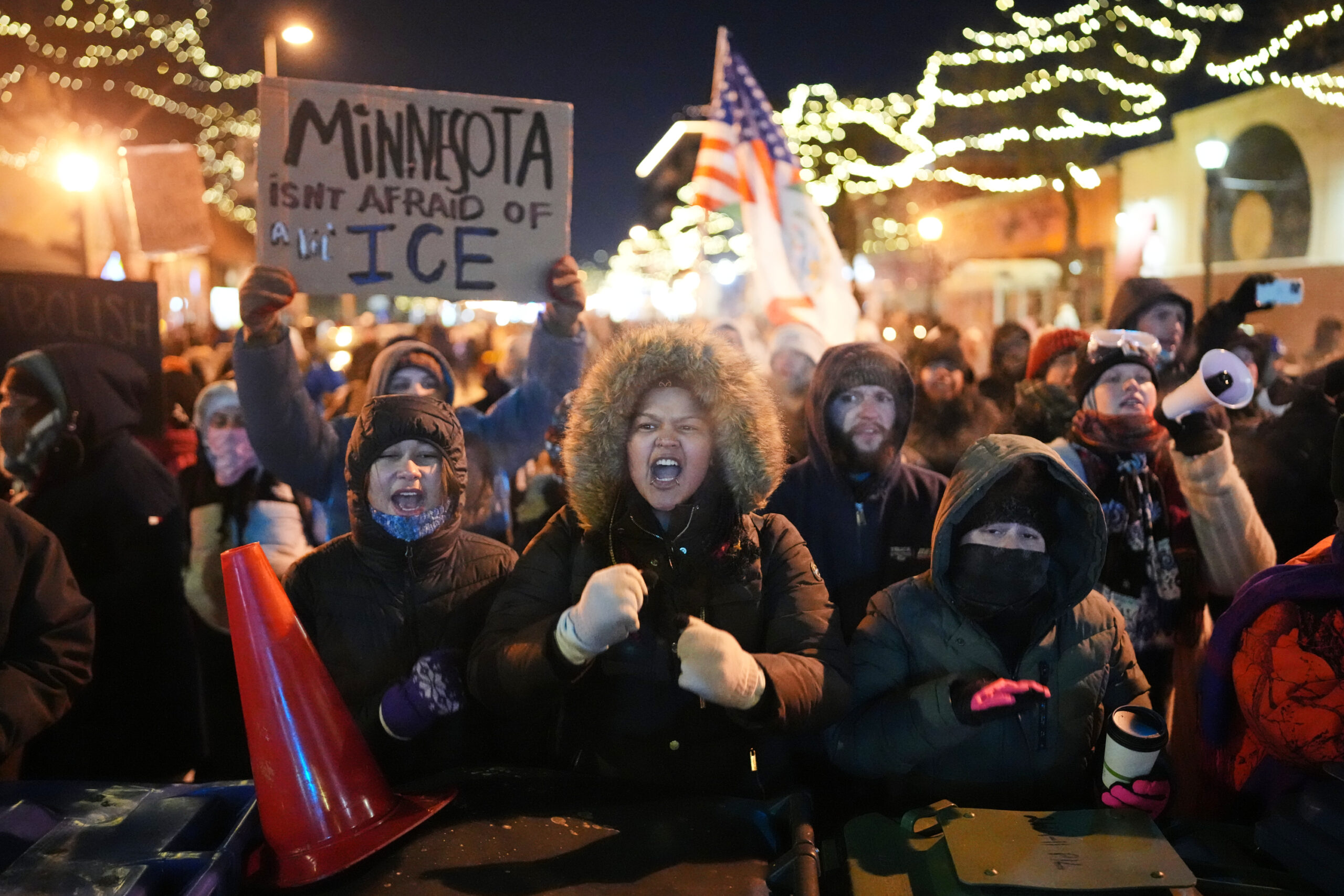
Protesters chant and bang on trash cans Saturday as they stand behind a makeshift barricade during a protest in response to the death of 37-year-old Alex Pretti, who was fatally shot by a U.S. Border Patrol agent earlier in the day in Minneapolis.
The Republicans who control Congress have abdicated their constitutional duty, while conservatives on the U.S. Supreme Court continue to enable the president.
Sadly, justice left town after the U.S. Senate — including Pennsylvania’s John Fetterman and Dave McCormick — confirmed Pam Bondi, one of Trump’s personal lawyers, as attorney general.
The FBI has been decimated by Kash Patel, an unqualified incompetent, pushing conspiracy theories and vendettas. Kristi Noem has turned the U.S. Department of Homeland Security into a Bull Connor-like police force, led by Gregory Bovino in his greatcoat.
The architect behind the draconian ICE crackdown is Stephen Miller, an unelected and unconfirmed senior adviser and speechwriter with a history of white nationalist ties and bigotry.
Republicans enabled the surge in ICE man power and funding when they approved Trump’s Big Beautiful Bill. If the GOP will not stop Trump, then voters must act come November.
ICE was supposed to go after the “worst of the worst” people who entered the country illegally. Instead, Trump and his lawless administration have occupied cities, caused civil unrest, and accomplished essentially nothing.
Tens of thousands of immigrants arrested have no criminal records. Others are collateral damage. After Good was killed, Trump said that “things happen.”
Pretti was among the best in America. He was a nurse in an intensive care unit that served veterans. He died trying to help a woman attacked by a masked thug.
Minneapolis Mayor Jacob Frey asked the question many want to know about the Trump administration’s growing domestic war: “How many more Americans need to die?”
Rollie Massimino “did not mess around” when it came to drawing up defensive schemes against Patrick Ewing … or warding off gambling temptations that might filter through to his Villanova players.
“When we were playing, we had an FBI agent who was a former ’Nova basketball player give talks about gambling,” said Chuck Everson, a member of Massimino’s 1985 Wildcats title team that took down heavily favored Georgetown.
“Rollie did not mess around with that stuff. It wasn’t that far removed from the Boston College [point-shaving] scandal. Rollie brought in the FBI to talk to us. Coach Mass did a great job of teaching us, and it wasn’t all basketball; it was life lessons. And with gambling, it was, ‘Don’t do that.’
“To this day, I have never called DraftKings, or anything like that. I attribute that to being scared straight with Coach Mass.”
Everson, 61, played in an era when sports betting wasn’t legal in most of the country. These days, things are quite different. College athletes are compensated by their schools or through lucrative name, image, and likeness deals, and the legal/illegal gambling culture infiltrates every level of sports.
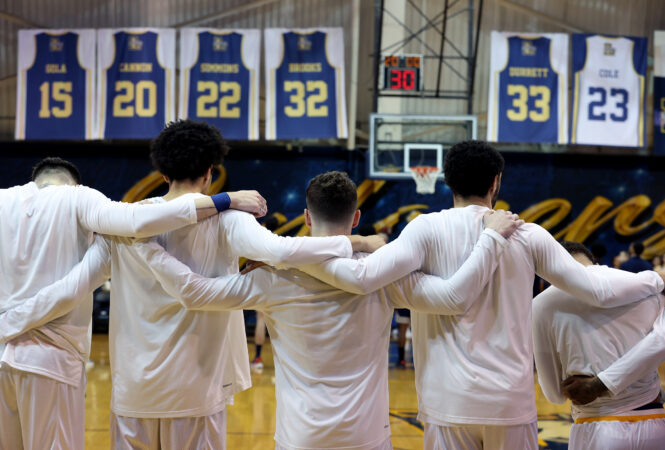
Last Thursday in Philadelphia, federal authorities announced a sweeping criminal indictment and related filings against 26 people on charges related to manipulating NCAA games and Chinese professional games through bribes, some as high as five figures.
It is the fourth federal criminal indictment that involves gambling and sports unsealed in the last six months, and the latest alleged gambling scheme involves one of the storied Big 5 programs: La Salle.
According to the indictment, at least one of the purported rigged games took place in 2024 in Philadelphia between La Salle and St. Bonaventure.
There are at least 39 players from 17 NCAA Division I schools who are alleged to have been involved in the scheme, but the indictment may underscore other, more troubling concerns.
Players at mid-major or smaller Division I programs might earn a fraction in NIL money compared to what their counterparts at elite programs take in, and therefore might be more susceptible to the temptations of illicit paydays. As one former federal prosecutor put it, this alleged scheme might be one of many dominoes waiting to fall.
“Anything that interferes with the integrity of sporting events, you’re going to get action by prosecutors,” said Edward McDonald, who prosecuted those involved in the Boston College point-shaving case in the late ’70s. McDonald, now senior counsel at the Dechert law firm, thinks that mid-major schools, like La Salle and some others in the Big 5, could be particularly vulnerable to gambling and bribery schemes.
“These smaller schools, the compensation to players is not as great [compared to larger programs], even for the better players on the team,” said McDonald, who learned of the Boston College scam through his investigations of organized crime family members with the Justice Department (and played himself in the Martin Scorsese-directed mob film Goodfellas).
“Players going to big-time schools are making 10 times more. A player [at a smaller program] might not be having a good season or might think they’re not going to play in the NBA or professionally, and they might say, ‘What the hell, I might as well cash in now.’”
Prop bets on a La Salle game
According to the court filings, one of the defendants, Jalen Smith, and former LSU and NBA player Antonio Blakeney (who is “charged elsewhere,” according to the indictment), attempted to recruit players on the La Salle men’s basketball team for the point-shaving scheme.
The fixers offered the La Salle players payments to underperform and influence the first half of a game against St. Bonaventure on Feb. 21, 2024, according to the filings.
Prosecutors allege that before the game at Tom Gola Arena, defendants who acted as fixers placed bets totaling approximately $247,000 on the Bonnies to cover the first-half spread. A $30,000 wager was made in Philadelphia at a FanDuel sportsbook, according to the indictment. But those bets failed after La Salle covered the spread.
“Neither the university, current student-athletes, or staff are subjects of the indictment,” La Salle wrote in a statement. “We will fully cooperate as needed with officials and investigations.”
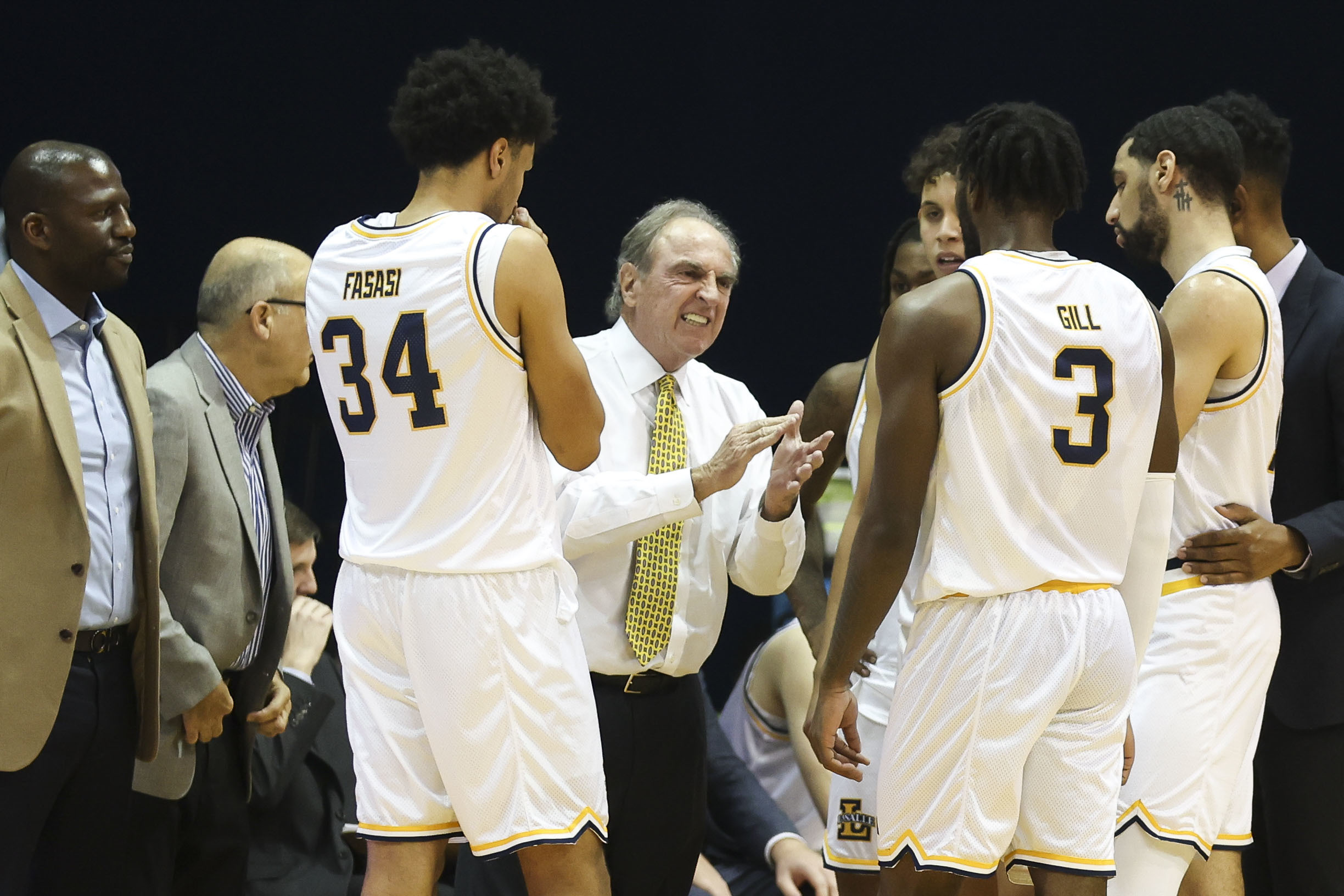
La Salle coach Fran Dunphy directing the Explorers in November 2023. Dunphy retired after last season.
Ohio Gov. Mike DeWine told The Inquirer that several years ago he received complaints from a number of college coaches in his state about online abuse directed at players and threatening calls from gamblers who had lost big.
“I called up [NCAA president] Charlie Baker, and asked him, ‘What do you think of prop betting?’” DeWine said. “He said, ‘We don’t like it.’ And I said, ‘Give me a letter that says that.’
“Under Ohio law, if I can get a letter from a league saying, ‘Don’t bet on certain things,’ that gives me the ability to go to my Casino Commission and they can [enact rules] without any legislation. Charlie sent the letter, I took that to the commission, and that stopped collegiate prop betting.”
The Ohio Casino Control Commission granted the NCAA’s request to prohibit proposition bets on collegiate sports in February 2024, but the decision affected only Ohio.
“It doesn’t really eliminate the problem,” DeWine said.
The ban in Ohio is only a drop in the bucket against a sea of pro-gambling momentum, legislation, and, most significantly, lucrative revenue streams.
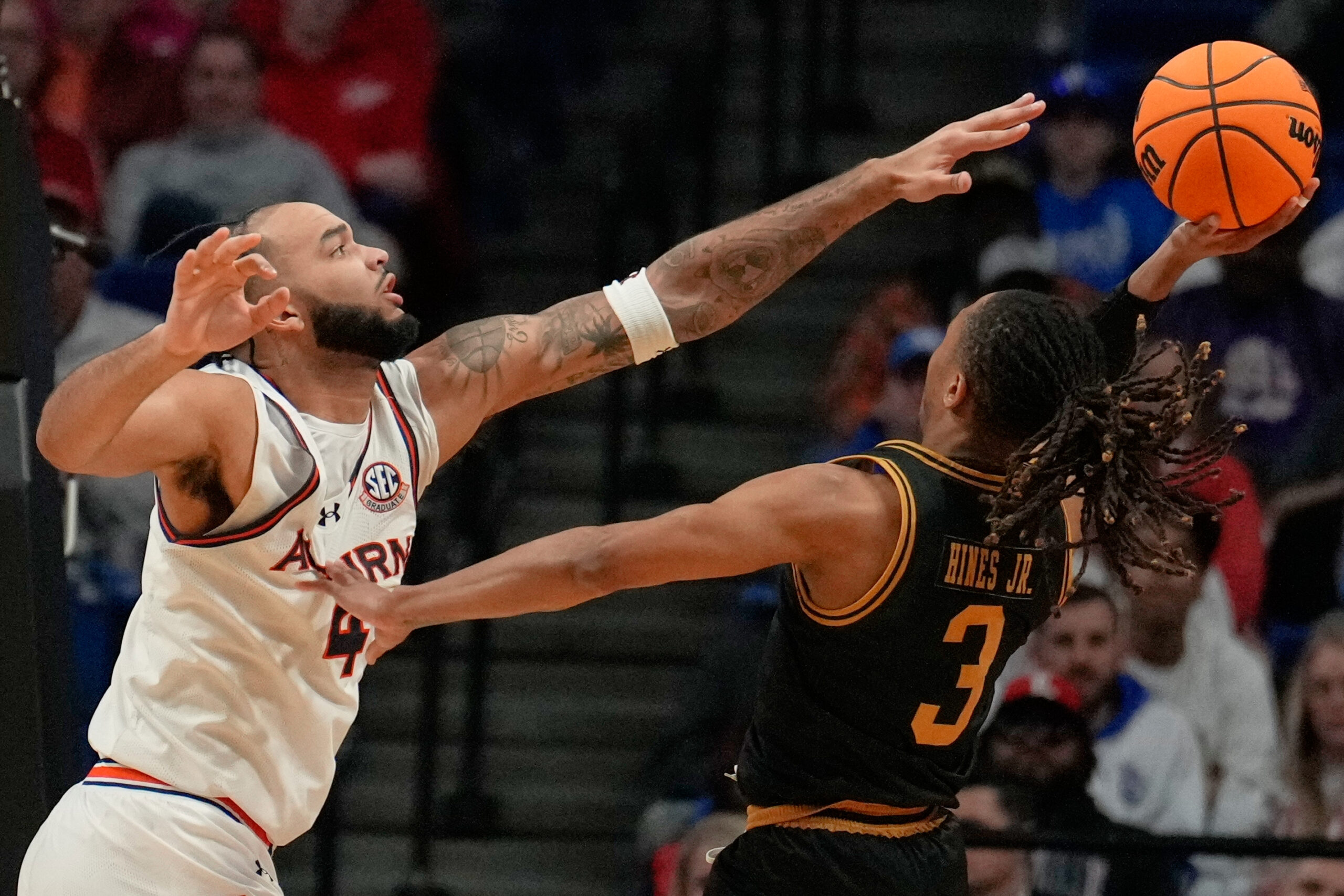
CJ Hines, a guard who was dismissed from Temple’s basketball team on Jan. 16, allegedly participated in a point-shaving scheme during the 2024-25 season while playing for Alabama State, according to the indictment. Hines transferred to Temple in May but didn’t play this season after the university announced that he was under investigation for eligibility concerns before his enrollment.
Former Alabama State guard CJ Hines (3) averaged 14.1 points in 35 starts last season.
The Atlantic 10 Conference — which includes La Salle and St. Joseph’s — weighed in on the latest gambling indictment.
“Any activity that undermines the integrity of competition has no place in college athletics,” commissioner Bernadette V. McGlade said in a release. “The Atlantic 10 and its member institutions will continue to work closely with the proper authorities to combat illegal activities.”
A St. Joe’s spokesperson added: “St. Joseph’s University has not been approached by federal investigators or any other entity about suspicious sports wagering activity involving St. Joe’s student-athletes or team.”
Villanova, which plays in the powerful Big East Conference, has numerous resources and protocols in place to address the sports wagering issue.
Handbooks, which include NCAA rules on gambling, are distributed annually to athletes, who also must sign a sports wagering document before being declared eligible. The athlete must acknowledge he or she won’t engage in activities that influence the outcome or win-loss margins of any game.
In 2021, 2023, and 2025, Villanova brought in speakers who have a history with sports gambling to talk with athletes about the risks and dangers associated with it. Villanova’s athletic compliance office meets twice annually with every athlete to review NCAA compliance standards, including its rules on sports wagering.
Former Villanova basketball star Maddy Siegrist told The Inquirer last year that her college alma mater ingrained in her mind the potential devastating consequences of gambling, values that she continues to adhere to as a WNBA player.
‘The integrity of sports is at risk’
Even after the 2018 Supreme Court ruling that legalized sports wagering state to state, the honesty and integrity component still comes into question when so much is riding on any sports wager.
DeWine, the Ohio governor, is taking a proactive role in trying to address malfeasance in the gaming culture.
“I’m writing letters to all other major [sports] leagues,” DeWine said. “They need to get on this. If they sit back, they’re making a huge mistake. I think the integrity of sports is at risk. I’m continuing to urge these leagues to take care of business, because they’re the ones that are going to get hurt.”
But McDonald said that with the flurry of recent indictments involving sports and gambling, “you have to wonder how pervasive [the illegal gambling problem] really is.”
“This could very well be the tip of the iceberg,” McDonald said.
Rob Thomson served dinner at a soup kitchen in Kensington and read books to students in Germantown. He spoke at banquets in Cherry Hill and Bethlehem. For four days this week, he met fans and talked baseball across the region.
And in case he wasn’t previously aware of the discourse about the Phillies’ offseason, let’s just say the phrase “running it back” came up a few times along the trail.
Thomson’s take:
“We’re going to have three new relievers,” the manager said at one stop of the Phillies’ annual winter tour. “We’ve got a new right fielder. [Justin] Crawford’s going to get every chance to play. We’ve probably got a rookie starting pitcher in [Andrew] Painter. We’ve got Otto Kemp, who wasn’t here at the start of last year. We’re turning over 20 to 25% of our roster.
“So, if you think that’s turning it back, or running it back, whatever the saying is, I can’t help you.”
OK, Thomson isn’t wrong. But two things can be true. The Phillies can change two-thirds of the outfield and half the bullpen and still bring back the guts of a roster that accounted for nearly three-quarters of the team’s plate appearances and almost 70% of its innings pitched last season.
Does that constitute running it back? Maybe. Maybe not.
Regardless, it misses the point. Because whether or not you think president of baseball operations Dave Dombrowski made an appropriate number of changes after a second consecutive NL East title and another loss in the divisional round of the playoffs, the pertinent question is this: Are the Phillies better or worse today than when last season ended Oct. 9 at Dodger Stadium?
The Phillies are replacing Nick Castellanos (right) with Adolis Garcia in right field.
And on that topic, Thomson was less definitive.
“I think it’s to be determined,” he told Phillies Extra, The Inquirer’s baseball podcast. “But I feel better about it.”
It’s a manager’s job to be optimistic — and as importantly, to project optimism to the public, especially in a week when single-game tickets went on sale. Thomson listed reasons to be bullish. He likes the addition of free-agent reliever Brad Keller and suspects new right fielder Adolis García tried too hard to put the injury-wracked Rangers on his broad back last season and is primed to rebound. He also believes Crawford and Painter will bring youthful vigor as rookies with substantial roles.
It surely didn’t help that the Mets followed their backdoor deal with Bichette by trading for center fielder Luis Robert Jr. and top-of-the-rotation starter Freddy Peralta, the biggest splashes in a roster overhaul that needed to happen after a three-month collapse caused them to miss the playoffs last year. Add it all together, and Fangraphs upped its projection of the Mets’ total WAR to 46.7, third-highest in baseball and better than the Phillies’ 43.9 forecast.
Whatever, Thomson said. Step back from the last seven days, and he contends the Phillies’ internal outlook remains as bright as the Florida sun that awaits them in a few weeks.
“There are a lot of really good things going on,” Thomson said. “Because of the Bichette thing, a lot of that stuff gets overlooked a little bit, and I understand that. But we’ve got a really good club. We’ve just got to play better in the playoffs.”
So much will happen before that. In the interim, let’s attempt to answer whether the Phillies are any better with a cast of characters that is one year older but almost as familiar as ever. A few factors to consider:
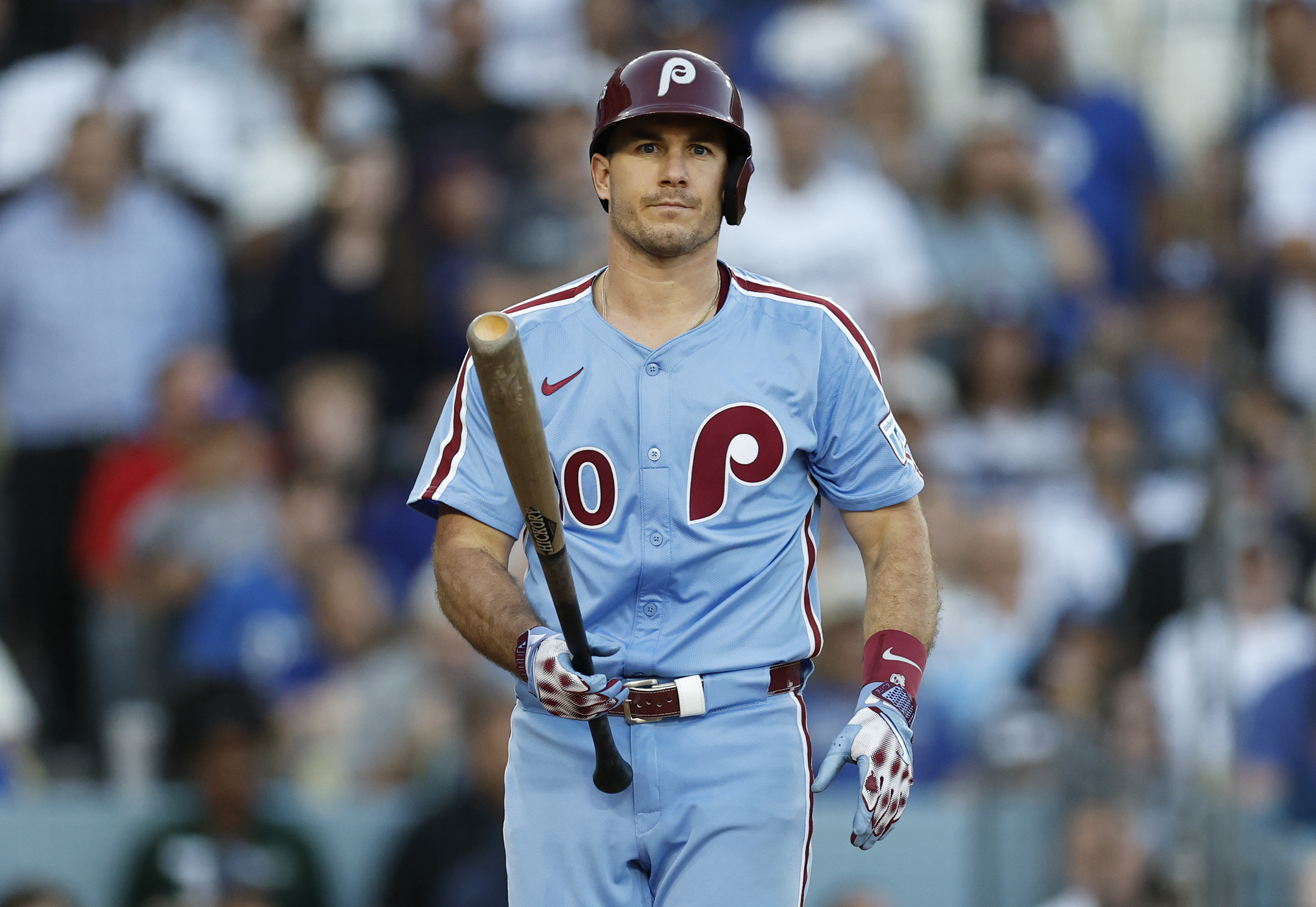
After a long free agency, J.T. Realmuto finally re-signed with the Phillies on a three-year, $45 million contract.
Letting go of Bo
There isn’t much use for the Phillies to cry over the spilled milk of having Bichette slip through their fingers.
But there’s still milk all over the floor.
Signing Bichette would’ve set several dominoes in motion, including a likely trade of third baseman Alec Bohm. J.T. Realmuto almost certainly wouldn’t have been re-signed, with the Phillies getting so far down the Bichette road that Dombrowski phoned Realmuto’s agent, Matt Ricatto, to tell him they were headed in that direction.
“I wouldn’t want him to read about it in the paper,” Dombrowski said.
Within an hour of Bichette-to-the-Mets, Dombrowski called back Ricatto. The Phillies boosted their three-year offer to Realmuto to $45 million, with $5 million per year in incentives, and the iron-man catcher was right back where he has been since 2019.
But there was an underlying awkwardness when the Phillies announced their deal with Realmuto in a video news conference. Such occasions are typically celebratory in nature. Instead, Realmuto sounded like a human consolation prize.
“There’s no secret the Phillies had other opportunities,” he said. “Luckily, after they missed out on an opportunity there at the end, they called back, improved their offer, and got to a place we were happy with.”
Swell. As long as both sides are really happy.
The Phillies have developed a band-of-brothers culture over the last several years, especially since Thomson took over as manager in June 2022. Kyle Schwarber is the leader in the clubhouse; Realmuto on the field. There’s a bond here that players have been eager to join.
But given how much management clearly wanted Bichette, how can anyone be sure that Realmuto, Bohm, and others who may have been collateral damage are in the right frame of mind as spring training begins?
“It’s a good question,” Thomson said. “I think for the most part, our guys, because we’ve got a pretty experienced club, they understand the business side of it. They understand that things happen and things don’t happen, and they have to keep moving forward and stay focused on what they can control. They’ve been through it quite a bit, free agency, trade rumors. That’s all part of the business.
“I think they understand that. And now that we’re past that, I think they’re ready to go.”
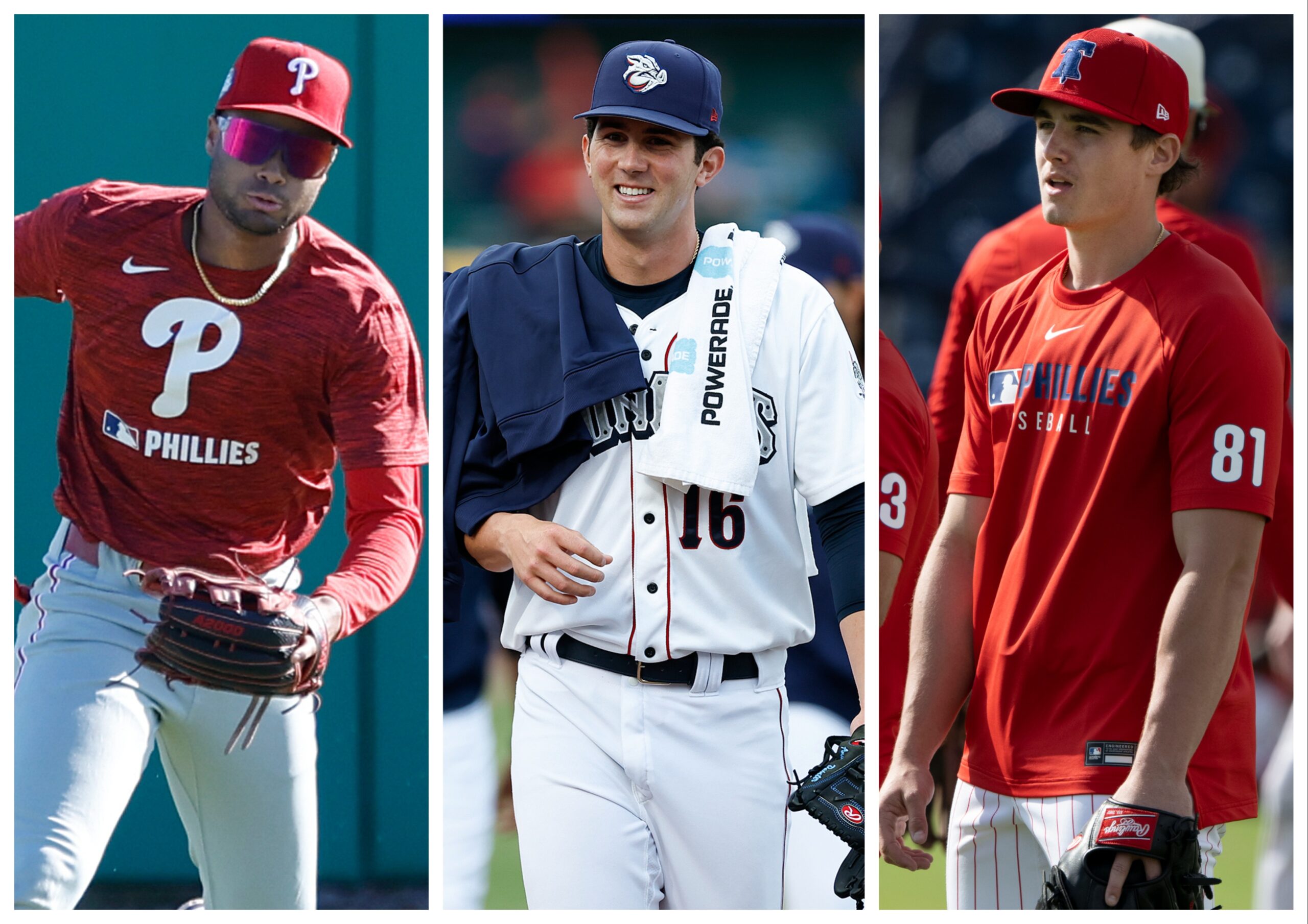
From left: Prospects Justin Crawford, Andrew Painter, and Aidan Miller should all be in the mix for the Phillies in 2026.
In making the playoffs four seasons in a row for only the second time in their 143-year history, the Phillies built this core through free agency. Most of those signings worked out well, save Nick Castellanos and Taijuan Walker. Still, the number of long-term, big-money contracts on the books has limited their flexibility.
If it feels like the Phillies keep running back the same roster, that’s why.
The only way, then, to really alter the mix is to assimilate young, inexpensive players from the minors. And since 2023, the Phillies have had only 12 players make their major-league debuts — fewer than any team, based on Fangraphs research.
Crawford and Painter could change that. The Phillies expect Crawford to win the center-field job out of camp at age 22, which would make him their youngest player in an opening-day lineup since Freddy Galvis in 2012. Painter, 23 in April, could claim a spot in the season-opening rotation.
“If you want to have a really healthy organization,” Thomson said, “I think you have to be able to infuse some youth along the way.”
Thomson witnessed it firsthand a decade ago.
In 2016, he was the bench coach for the Yankees, who had the second-highest payroll in baseball and seven players in their 30s who made 240 or more plate appearances. They contended for the playoffs, but fell short with 84 wins. The roster had become stale.
A year later, the Yankees got younger without rebuilding. Gary Sánchez replaced Brian McCann behind the plate; Luis Severino and Jordan Montgomery emerged as the team’s best starters at age 23 and 24, respectively; a rookie named Aaron Judge took over in right field.
The Yankees changed the mix on the fly, won 91 games, and went to Game 7 of the AL Championship Series against the trash-can-banging Astros.
“There were some warts there, no doubt, some growing pains,” Thomson recalled. “But when we turned it over into ‘17, they just took off and ran with it, and it was really good. I think there’s some similarities there.”
The biggest difference, according to Thomson: Whereas the 2017 Yankees were carried by the kids, the Phillies won’t have to ask theirs to do as much because the stars are still closer to their primes.
“Our core guys are really good, so if Crawford can come in and just kind of do his thing, don’t put too much pressure on him, he’s going to be fine,” Thomson said. “Same thing with Painter. If Painter’s in our [No.] 5 spot to start the season and he just relaxes and just grows with it, he’s going to be fine.
“I’m really excited about it. I love young guys. I just love the enthusiasm, the energy that they bring to the team that filters throughout the clubhouse and into those veteran players. And sometimes they need that.”
The Phillies need it like they need oxygen. You might even say it’s their best chance to be better than last year.
Sinners, Ryan Coogler’s vampiric period film starring Michael B. Jordan, made Academy Award history on Thursday when it was nominated for 16 Oscars, more than any other film in the history of the award ceremony’s 98-year run.
It toppled the 14 nominations previously received by All About Eve (1950), Titanic (1997), and La La Land (2016). In addition to Michael B. Jordan’s best actor nomination and Coogler’s best director nod, Sinners Oscar-winning costume designer, Ruth E. Carter, was also nominated for for her work on the film. It’s her fifth overall Oscar nomination.
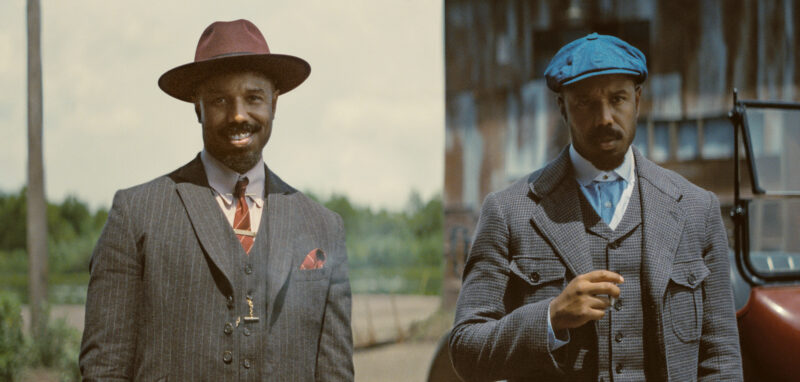
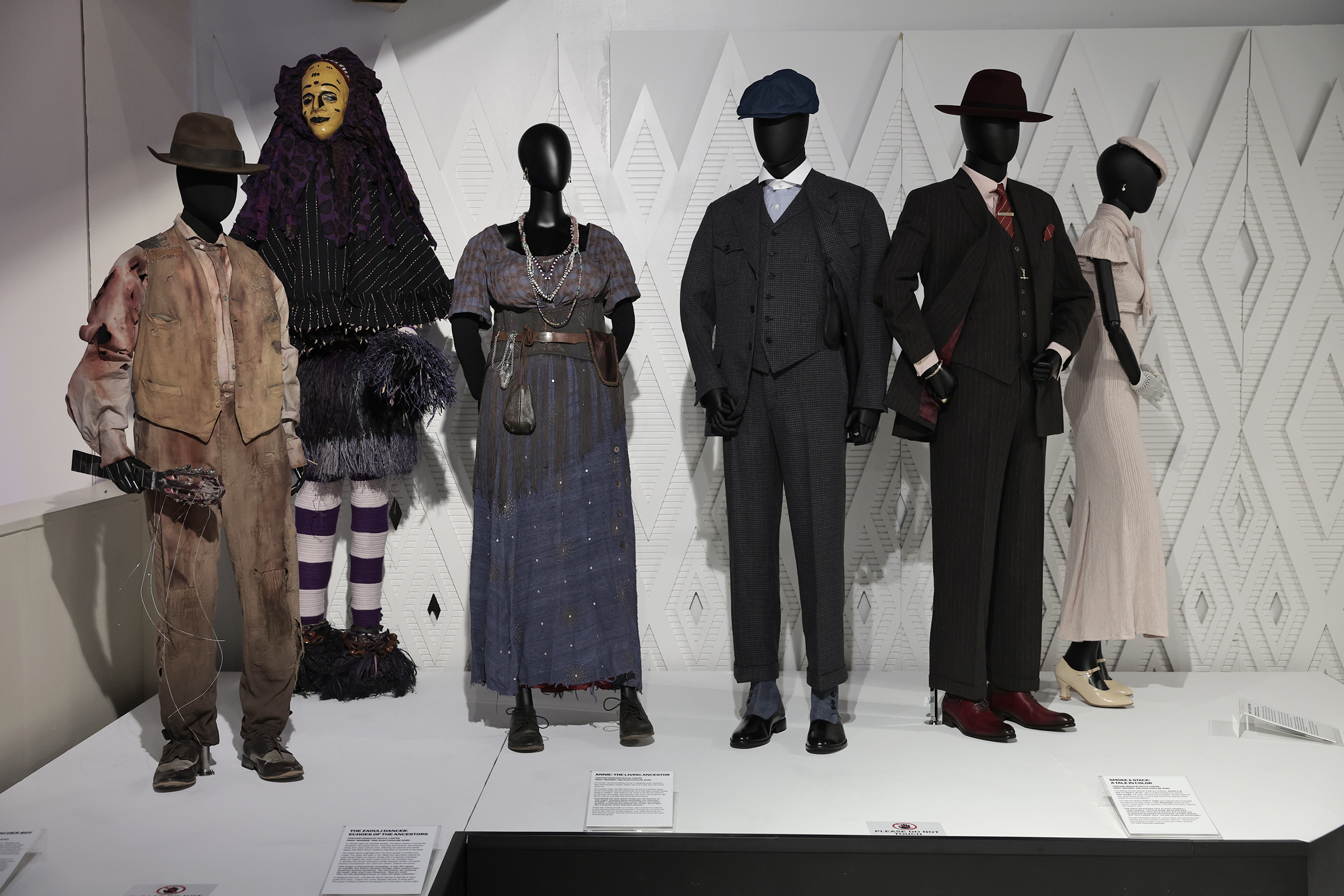
That includes Smoke and Stack’s (twins played by Jordan) memorable 1930s-era three-piece suits, with complementary fedora and newsboy cap, timepieces, and tiepins.
Ruth E. Carter’s Oscar-nominated costumes from “Sinners” starring Michael B. Jordan as twins Smoke and Stack.
Coogler’s only direction to Carter was to dress Smoke in blue and Stack in red, she told The Inquirer in November.
Carter, not one to fret long, dove into her arsenal of research. By the time she began the fittings, she’d amassed an array of blue and red looks befitting of the 1930s sharecroppers-turned-bootleggers and juke joint owners.
“[And] when I put that red fedora on him, Ryan flipped out and said, ‘That’s it!’,” Carter said. “We wanted people to resonate with their clothing and it did.”
The Smoke and Stack effect went beyond Sinners. This Halloween there were tons of social media posts of revelers dressed as the mysterious twins.
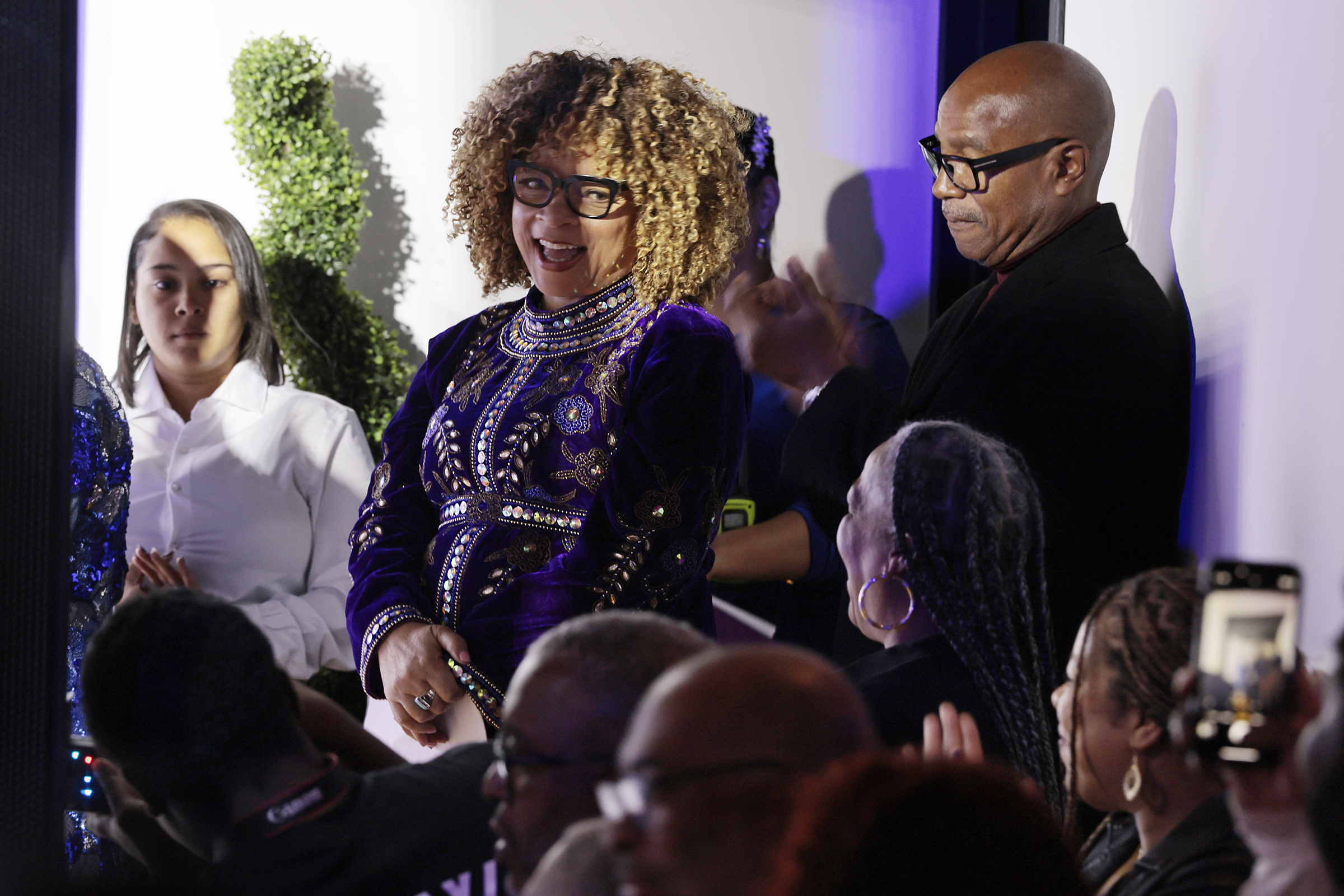
Ruth E. Carter during the “Ruth E. Carter: Afrofuturism in Costume Design” opening gala at the African American Museum in Philadelphia on Saturday, Nov. 1, 2025.
Also a part of AAMP’s Sinners display is the flowy earthy dress that best supporting actress nominee Wunmi Mosaku wore in her role as Annie. Annie is Smoke’s lover and a root woman who discovers the vampires in their Clarksdale, Miss., town.
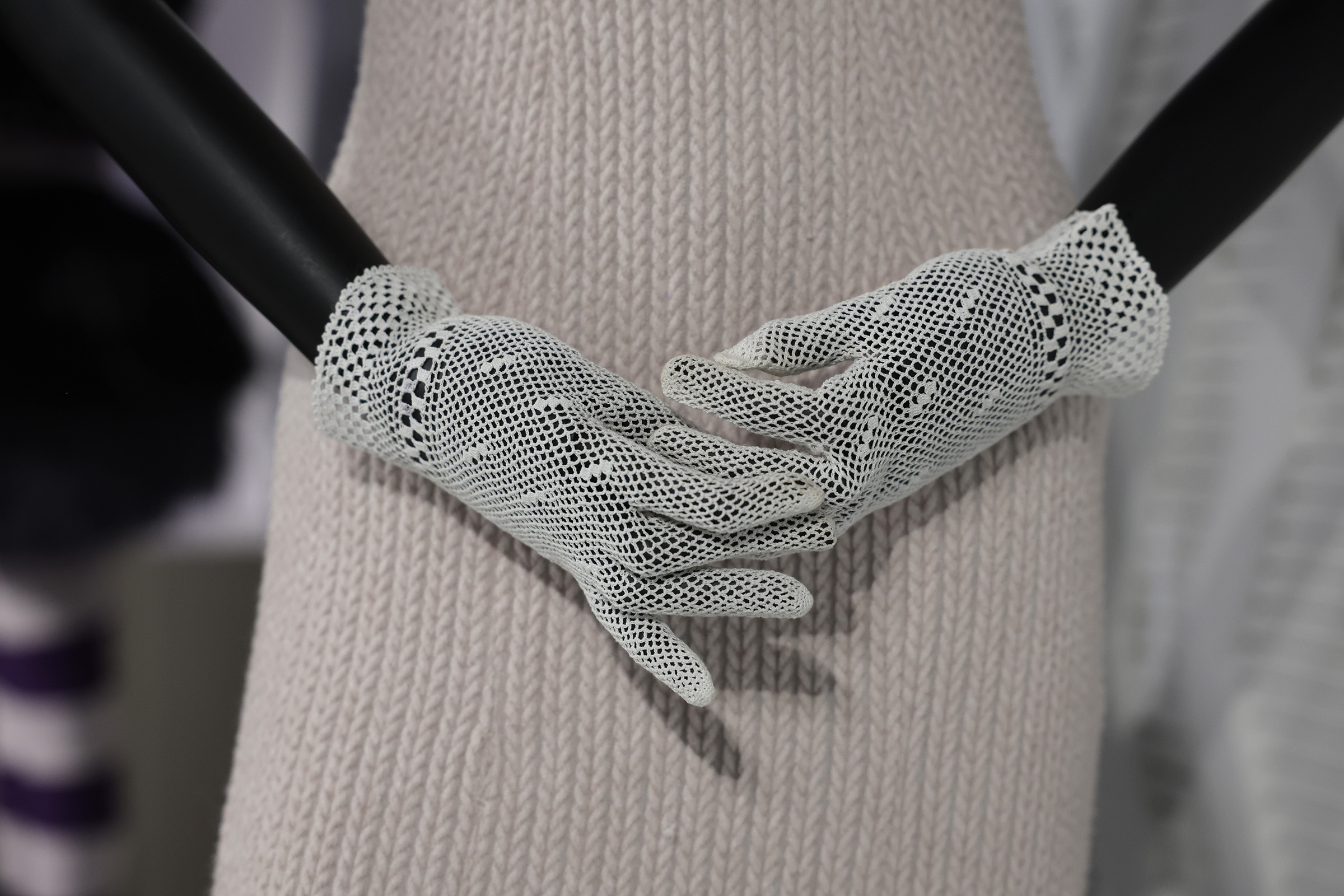
Cornbread’s (Oscar Miller) tattered sharecropper outfit is on the dais along with Mary’s (Hailee Steinfeld) blush knit dress with its short-sleeved bodice and pussy bow accent. Her matching knit beret and pearls are also on display. In the film, Mary is Stack’s childhood friend, turned girlfriend, turned vampire.
“I immerse myself in the mind, body, and soul of my characters,” said Carter. “Then I see them in my mind, how they move and with research, I come up with a look that I feel is unique to them.”
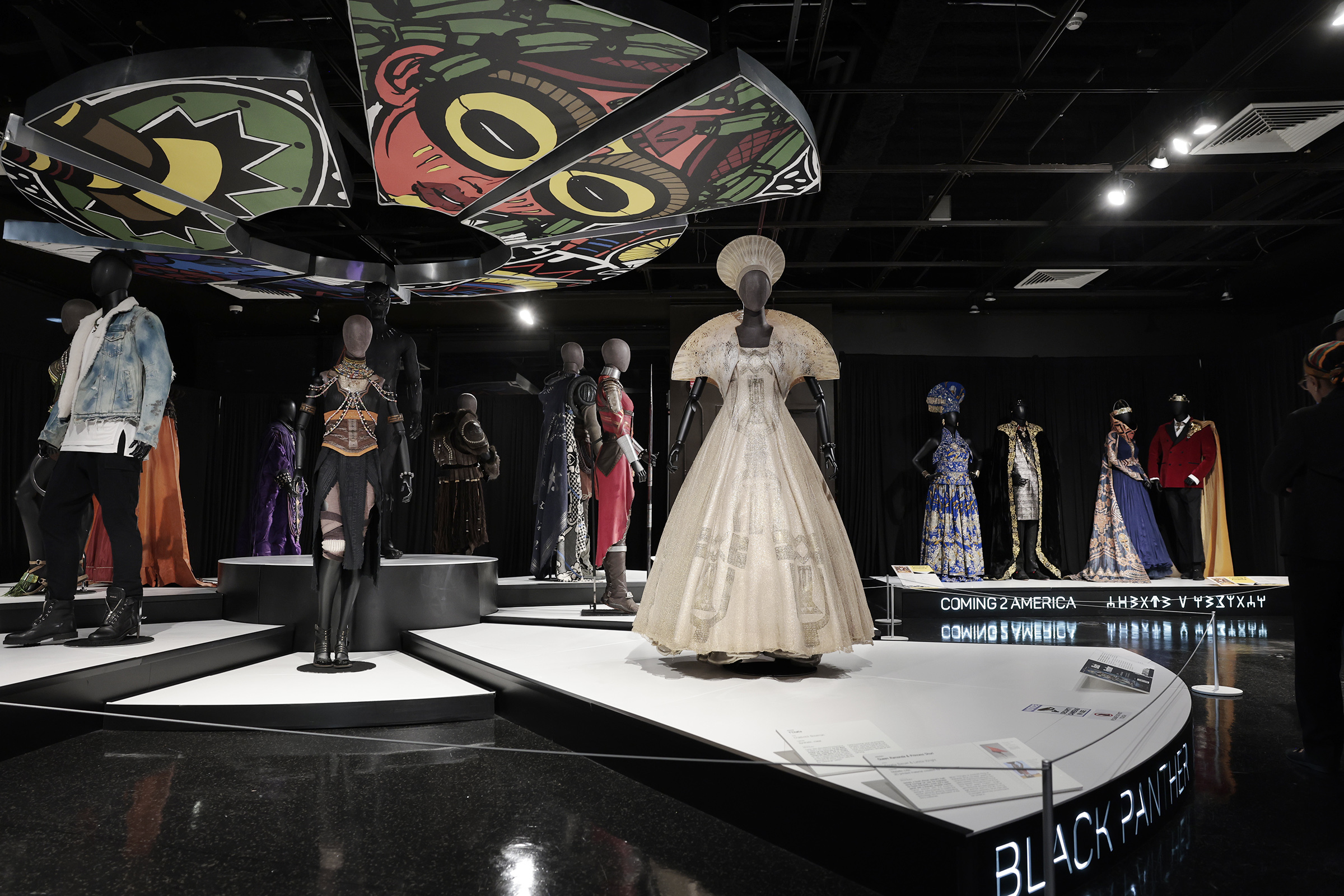
The Sinners pieces are among the more than 80 looks featured in the “Afrofuturism” exhibit, joining outfits from The Butler (Lee Daniels), and from Malcolm X, Coming 2 America, Black Panther, and its sequel, Black Panther: Wakanda Forever.
The show, headlining the African American Museum’s celebration of the nation’s Semiquincentennial, will be on display through September.
Lace gloves and knit dress detail of Mary (Hailee Steinfeld) costume from sinners.
During her five decades in the movie business, Carter has worked on more than 60 big-screen documentations of where Black Americans have been, who they are at the given moment, and who they dream of becoming.
Her work has shaped how the world sees African Americans.
In the 2010s, a friend of hers suggested she plan a museum exhibit around her costumes. After Black Panther, she partnered with Marvel, and in 2019, “Afrofuturism in Costume Design” debuted at the Savannah College of Art and Design’s Atlanta Campus.
The “Ruth E. Carter: Afrofuturism in Costume Design” exhibit at the African American Museum in Philadelphia on Saturday, Nov. 1, 2025.
Philadelphia is the exhibit’s ninth — and longest — stop. It’s also the first stop for the Sinners costumes.
“I am a griot,” Carter said. “[Throughout my career,] I’ve developed a knowledge base that embraces our culture and speaks to all of us in a positive way.”
“Ruth E. Carter: Afrofuturism in Costume Design” will be on view through Sept. 6. at the African American Museum in Philadelphia, 701 Arch St., Thursday through Sunday, 10 a.m. to 5 p.m. Tickets are $20 for adults, $10 for children.